

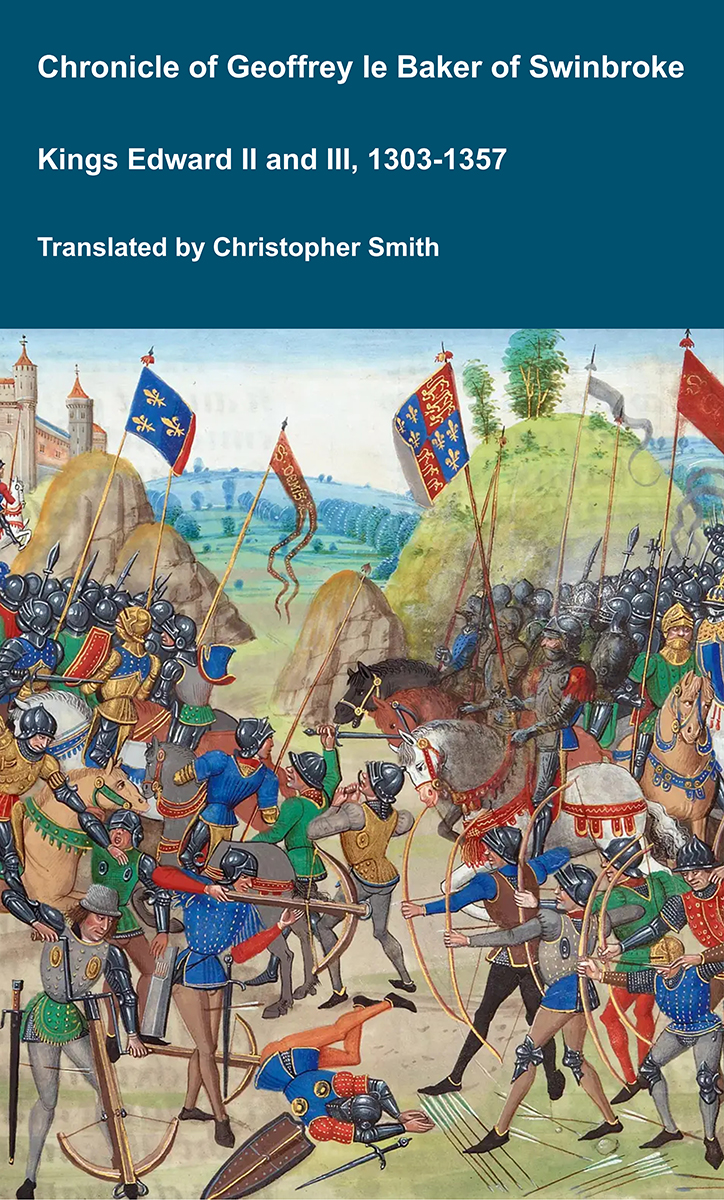
Chronicle of Geoffrey le Baker of Swinbroke
Baker was a secular clerk from Swinbroke, now Swinbrook, an Oxfordshire village two miles east of Burford. His Chronicle describes the events of the period 1303-1356: Gaveston, Bannockburn, Boroughbridge, the murder of King Edward II, the Scottish Wars, Sluys, Crécy, the Black Death, Winchelsea and Poitiers. To quote Herbert Bruce 'it possesses a vigorous and characteristic style, and its value for particular events between 1303 and 1356 has been recognised by its editor and by subsequent writers'. The book provides remarkable detail about the events it describes. Baker's text has been augmented with hundreds of notes, including extracts from other contemporary chronicles, such as the Annales Londonienses, Annales Paulini, Murimuth, Lanercost, Avesbury, Guisborough and Froissart to enrich the reader's understanding. The translation takes as its source the 'Chronicon Galfridi le Baker de Swynebroke' published in 1889, edited by Edward Maunde Thompson.
Available at Amazon in eBook and Paperback format.
Martlets is in Birds.
Martlets. Birds which have no feet so are continously in flight.
 Furnival Arms. Argent, a bend gules six martlets gules. Source.
 Arundell Arms. Sable, six martlets argent. Source.
 Harding Arms. Or, a bend azure three martlets argent.
 Brabazon Arms. Gules on a bend or three martlets sable. Source.
 Chaworth Arms. Barry argent and gules over three martlets.
 Tempest Arms. Argent, a bend engrailed between six martlets sable. Source.
 Beckford Arms. Per pale, gules and azure, on a chevron argent between three martlets or, an eagle displayed sable. Source.
 Brownlow Arms. Or an escutcheon within an orle of martlets sable. Source
 Cookes Arms. Argent, two chevronels between six martlets 3, 2 and 1 gules. Source.
 Fleetwood Arms. Per pale nebulée azure and or, six martlets, two, two and two, counterchanged. Source.
 Temple Arms. Argent two bars sable each charged with three martlets or.
 Watson Arms. Argent, on a chevron engrailed azure between three martlets sable as many crescents or. Source.
 Davers Arms. Argent, a bend gules three martlets or. Source.


#/media/File:Smith_OfExeter_Arms.png)


.svg)
#/media/File:FleetwoodArms.svg)
.svg)

.svg)