

Jean de Waurin's Chronicle of England Volume 6 Books 3-6: The Wars of the Roses
Jean de Waurin was a French Chronicler, from the Artois region, who was born around 1400, and died around 1474. Waurin’s Chronicle of England, Volume 6, covering the period 1450 to 1471, from which we have selected and translated Chapters relating to the Wars of the Roses, provides a vivid, original, contemporary description of key events some of which he witnessed first-hand, some of which he was told by the key people involved with whom Waurin had a personal relationship.
Available at Amazon in eBook and Paperback format.
Around 1636 Antonio Verrio was born in Leece.
John Evelyn's Diary. 16th October 1671. In the morning, we went hunting and hawking; in the afternoon, till almost morning, to cards and dice, yet I must say without noise, swearing, quarrel, or confusion of any sort. I, who was no gamester, had often discourse with the French Ambassador, Colbert [aged 46], and went sometimes abroad on horseback with the ladies to take the air, and now and then to hunting; thus idly passing the time, but not without more often recess to my pretty apartment, where I was quite out of all this hurry, and had leisure when I would, to converse with books, for there is no man more hospitably easy to be withal than my Lord Arlington [aged 53], of whose particular friendship and kindness I had ever a more than ordinary share. His house is a very noble pile, consisting of four pavilions after the French, beside a body of a large house, and, though not built altogether, but formed of additions to an old house (purchased by his Lordship of one Sir T. Rookwood) yet with a vast expense made not only capable and roomsome, but very magnificent and commodious, as well within as without, nor less splendidly furnished. The staircase is very elegant, the garden handsome, the canal beautiful, but the soil dry, barren, and miserably sandy, which flies in drifts as the wind sits. Here my Lord was pleased to advise with me about ordering his plantations of firs, elms, limes, etc., up his park, and in all other places and avenues. I persuaded him to bring his park so near as to comprehend his house within it; which he resolved upon, it being now near a mile to it. The water furnishing the fountains, is raised by a pretty engine, or very slight plain wheels, which likewise serve to grind his corn, from a small cascade of the canal, the invention of Sir Samuel Morland [aged 46]. In my Lord's house, and especially above the staircase, in the great hall and some of the chambers and rooms of state, are paintings in fresco by Signor Verrio [aged 35], being the first work which he did in England.


In March 1672 Antonio Verrio [aged 36] travelled to England on the recommendation of Ralph Montagu 1st Duke Montagu [aged 33].
John Evelyn's Diary. 28th June 1678. I went to Windsor, Berkshire [Map] with my Lord Chamberlain [aged 60] (the castle now repairing with exceeding cost) to see the rare work of Verrio [aged 42], an incomparable carving of Gibbons [aged 30].
John Evelyn's Diary. 23rd July 1679. To Court: after dinner, I visited that excellent painter, Verrio [aged 43], whose works in fresco in the King's [aged 49] palace, at Windsor, Berkshire [Map], will celebrate his name as long as those walls last. He showed us his pretty garden, choice flowers, and curiosities, he himself being a skillful gardener.
John Evelyn's Diary. 25th September 1679. Mr. Slingsby [aged 58] and Signor Verrio [aged 43] came to dine with me, to whom I gave China oranges off my own trees, as good, I think, as were ever eaten.

John Evelyn's Diary. 24th July 1680. We all dined at the Countess of Sunderland's [aged 34], afterward to see Signor Verrio's [aged 44] garden, thence to Eton College [Map], to salute the provost, and heard a Latin speech of one of the alumni (it being at the election) and were invited to supper; but took our leave, and got to London that night in good time.

Around 1683 Antonio Verrio [aged 47]. St George's Hall Windsor Castle.

Around 1683 Antonio Verrio [aged 47]. Chapel Royal, Windsor Castle.

John Evelyn's Diary. 16th June 1683. I went to Windsor, Berkshire [Map], dining by the way at Chiswick, at Sir Stephen Fox's [aged 56], where I found Sir Robert Howard (that universal pretender), and Signor Verrio [aged 47], who brought his draught and designs for the painting of the staircase of Sir Stephen's new house.

Anne Boleyn. Her Life as told by Lancelot de Carle's 1536 Letter.
In 1536, two weeks after the execution of Anne Boleyn, her brother George and four others, Lancelot du Carle, wrote an extraordinary letter that described Anne's life, and her trial and execution, to which he was a witness. This book presents a new translation of that letter, with additional material from other contemporary sources such as Letters, Hall's and Wriothesley's Chronicles, the pamphlets of Wynkyn the Worde, the Memorial of George Constantyne, the Portuguese Letter and the Baga de Secrets, all of which are provided in Appendices.
Available at Amazon in eBook and Paperback format.
John Evelyn's Diary. 10th October 1683. Visited the Duchess of Grafton [aged 15], not yet brought to bed, and dining with my Lord Chamberlain (her father) [aged 65], went with them to see Montague House, a palace lately built by Lord Montague [aged 44], who had married the most beautiful Countess of Northumberland [aged 29]. It is a stately and ample palace. Signor Verrio's [aged 47] fresco paintings, especially the funeral pile of Dido, on the staircase, the labors of Hercules, fight with the Centaurs, his effeminacy with Dejanira, and Apotheosis or reception among the gods, on the walls and roof of the great room above,-I think exceeds anything he has yet done, both for design, coloring, and exuberance of invention, comparable to the greatest of the old masters, or what they so celebrate at Rome. In the rest of the chamber are some excellent paintings of Holbein, and other masters. The garden is large, and in good air, but the fronts of the house not answerable to the inside. The court at entry, and wings for offices seem too near the street, and that so very narrow and meanly built, that the corridor is not in proportion to the rest, to hide the court from being overlooked by neighbours; all which might have been prevented, had they placed the house further into the ground, of which there was enough to spare. But on the whole it is a fine palace, built after the French pavilion-way, by Mr. Hooke, the Curator of the Royal Society. There were with us my Lady Scroope, the great wit, and Monsieur Chardine [aged 39], the celebrated traveler.


John Evelyn's Diary. 10th May 1684. I went to visite my brother in Surrey. Call'd by the way at Ashted, where Sr Rob Howard [aged 58] (Auditor of the Exchequer) entertain'd me very civilly at his new built house, which stands in a Park on the Downe, the avenue South; tho' downe hill to the house, which is not greate, but with the outhouses very convenient. The stairecase is painted by Verrio [aged 48] with the storie of Astrea; amongst other figures is the Picture of the Painter himselfe, and not unlike him; the rest is well done, onely the columns did not at all please me; there is also Sir Robert's own Picture in an oval; the whole in fresca. The place has this greate defect, that there is no water but what is drawn up by horses from a very deepe well.
John Evelyn's Diary. 6th September 1685. Sunday. I went to prayer in the Chapell, and heard Dr. Standish. The second sermon was preach'd by Dr. Creighton [aged 46], on 1 Thess. 4, 11, persuading to unity and peace, and to be mindfull of our owne businesse, according to the advise of the Apostle. Then I went to heare a Frenchman who preached before the King [aged 51] and Queene [aged 26] in that splendid Chapell [Map] next St. George's Hall. Their Maties going to masse, I withdrew to consider the stupendous painting of ye Hall, which, both for the art and invention, deserve the inscription in honour of the painter, Signior Verrio [aged 49]. The history is Edward the 3rd receiving the Black Prince, coming towards him in a Roman triumph. The whole roofe is the history of St. George. The throne, the carvings, &e. are incomparable, and I think equal to any, and in many circumstances exceeding any, I have seene abroad.


John Evelyn's Diary. 4th August 1686. I dined at Signor Verrio's [aged 50], the famous Italian painter, now settled in his Majesty's garden at St. James's [Map], which he had made a very delicious paradise.

Around 1691 Antonio Verrio [aged 55]. The Great Staircase at Chatsworth House, Derbyshire [Map].
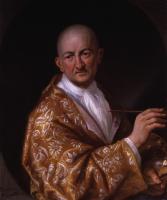
Around 1707 Antonio Verrio [aged 71]. Self-Portrait.
On 15th June 1707 Antonio Verrio [aged 71] died.