

Chronicle of Walter of Guisborough
A canon regular of the Augustinian Guisborough Priory, Yorkshire, formerly known as The Chronicle of Walter of Hemingburgh, describes the period from 1066 to 1346. Before 1274 the Chronicle is based on other works. Thereafter, the Chronicle is original, and a remarkable source for the events of the time. This book provides a translation of the Chronicle from that date. The Latin source for our translation is the 1849 work edited by Hans Claude Hamilton. Hamilton, in his preface, says: 'In the present work we behold perhaps one of the finest samples of our early chronicles, both as regards the value of the events recorded, and the correctness with which they are detailed; Nor will the pleasing style of composition be lightly passed over by those capable of seeing reflected from it the tokens of a vigorous and cultivated mind, and a favourable specimen of the learning and taste of the age in which it was framed.'
Available at Amazon in eBook and Paperback format.
In 1656 Willem Wissing was born.
In 1676 Willem Wissing [aged 20] moved to London where he studied under Peter Lely [aged 57].


Around 1680 Willem Wissing [aged 24]. Portrait of King William III of England, Scotland and Ireland [aged 29] wearing his Garter Collar.

Around 1680 Willem Wissing [aged 24]. Portrait of Winifred Trentham [aged 34].

In 1684 Willem Wissing [aged 28]. Portrait of Elizabeth Jones Countess Kildare [aged 19].
Elizabeth Jones Countess Kildare: In 1665 she was born to Richard Jones 1st Earl Ranelagh and Elizabeth Willoughby Countess Ranelagh. On 12th June 1684 John Fitzgerald 18th Earl of Kildare and she were married. She by marriage Countess Kildare. She the daughter of Richard Jones 1st Earl Ranelagh and Elizabeth Willoughby Countess Ranelagh. He the son of Wentworth Fitzgerald 17th Earl of Kildare and Elizabeth Holles Countess Kildare. They were second cousins. In April 1758 Elizabeth Jones Countess Kildare died.

Around 1685 Willem Wissing [aged 29]. Portrait of Mary of Modena Queen Consort England Scotland and Ireland [aged 26].

Around 1685 Willem Wissing [aged 29]. Portrait of Ruperta Palatinate Simmern [aged 14].
Ruperta Palatinate Simmern: In 1671 she was born illegitimately to Prince Rupert Palatinate Simmern 1st Duke Cumberland and Margaret "Peg" Hughes. She a great granddaughter of King James I of England and Ireland and VI of Scotland. In 1695 Emanual Scrope Howe and she were married. She the illegitmate daughter of Prince Rupert Palatinate Simmern 1st Duke Cumberland and Margaret "Peg" Hughes. In 1740 Ruperta Palatinate Simmern died.

Around 1686 Willem Wissing [aged 30]. Portrait of Mary Stewart II Queen England Scotland and Ireland [aged 23].
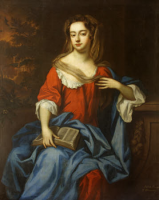
Around 1686 Willem Wissing [aged 30]. Portrait of Frances Jones [aged 18], future Countess of Scarborough.
Frances Jones Countess Scarborough: In March 1667 she was born to Henry Jones of Oxfordshire and Frances Belasyse. In or before 1685 Richard, Baron Lumley and Frances Jones were married. On 15th April 1690 Richard Lumley was created Earl of Scarborough by King William III of England, Scotland and Ireland in recognition of his support of the Glorious Revolution he having been one of the signatories of the Invitation to William of Orange from the Immortal Seven. Frances Jones by marriage Countess of Scarborough. In 1722 she died.

Around 1686 Willem Wissing [aged 30]. Portrait of Lawrence Hyde 1st Earl Rochester [aged 43] wearing his Garter Robes including the Garter Collar and holding his white Lord High Treasurer Staff of Office.

In 1686 Willem Wissing [aged 30]. Portrait of Queen Anne of England Scotland and Ireland [aged 20].

In 1686 Willem Wissing [aged 30]. Portrait of Isabella Bennet Duchess Grafton [aged 18].

In 1687 Willem Wissing [aged 31]. Portrait of Frances Teresa Stewart Duchess Lennox.

In 1687 Willem Wissing [aged 31]. Portrait of Anna Mason Countess Macclesfield [aged 19].

In 1687 Willem Wissing [aged 31]. Portrait of Frances Jones [aged 14] and Catherine Jones [aged 15].
Frances Jones: Around 1673 she was born to Richard Jones 1st Earl Ranelagh and Elizabeth Willoughby Countess Ranelagh. On 23rd April 1698 Thomas Coningsby 1st Earl Coningsby and she were married. She the daughter of Richard Jones 1st Earl Ranelagh and Elizabeth Willoughby Countess Ranelagh. They were second cousins. Around 1716 Frances Jones died.
Catherine Jones: In 1672 she was born to Richard Jones 1st Earl Ranelagh and Elizabeth Willoughby Countess Ranelagh. On 5th January 1712 Richard Jones 1st Earl Ranelagh died. His daughter Catherine Jones inherited Ranelagh House. On 14th April 1740 Catherine Jones died.

Before 10th September 1687 Willem Wissing [aged 31]. Portrait of Alice Sherard Baroness Brownlow [aged 28].

Before 10th September 1687 Willem Wissing [aged 31]. Portrait of James Butler 1st Duke Ormonde [aged 76].

Before 10th September 1687 Willem Wissing [aged 31]. Portrait of Dorothy Ferrers Countess Arran [aged 32].
Dorothy Ferrers Countess Arran: In 1655 she was born to John Ferrers and Anne Carlton Before 19th February 1674 Richard Butler 1st Earl Arran and she were married. She by marriage Countess Arran. He the son of James Butler 1st Duke Ormonde and Elizabeth Preston Duchess Ormonde. On 30th November 1716 Dorothy Ferrers Countess Arran died.
On 10th September 1687 Willem Wissing [aged 31] died at Burghley House. He was buried at St Martin's Church, Stamford [Map].