

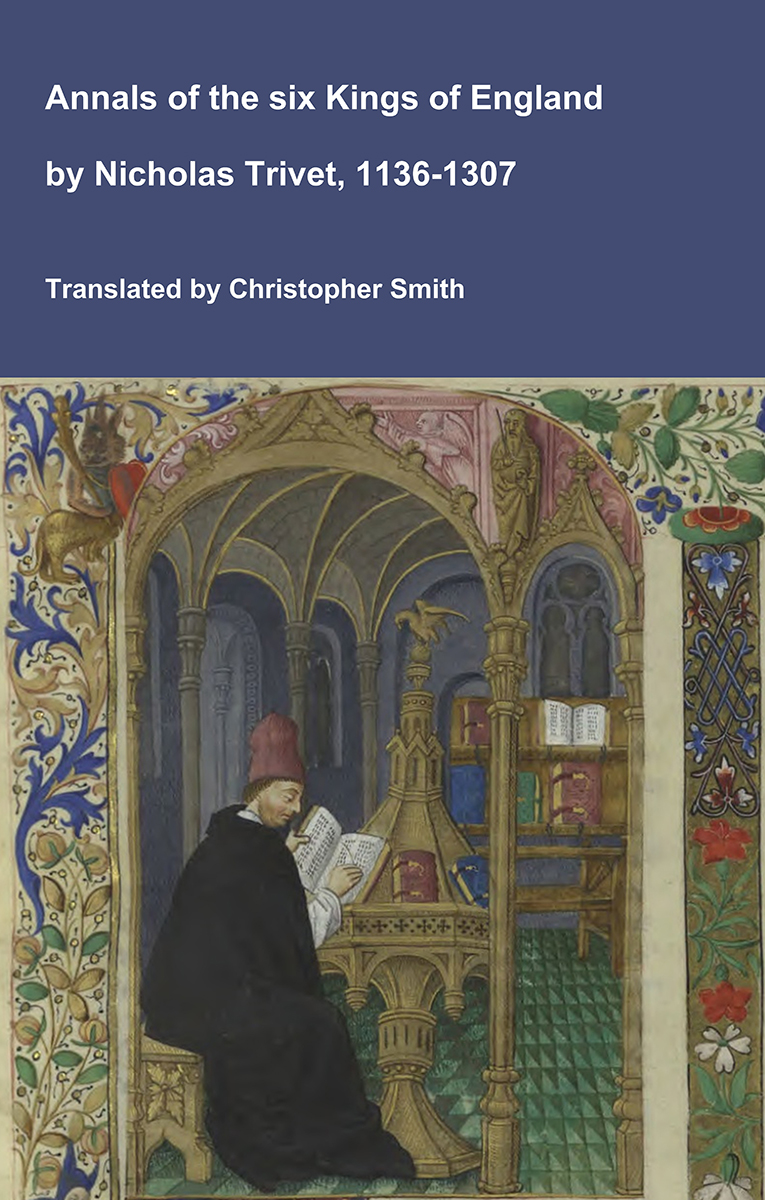
Annals of the six Kings of England by Nicholas Trivet
Translation of the Annals of the Six Kings of England by that traces the rise and rule of the Angevin aka Plantagenet dynasty from the mid-12th to early 14th century. Written by the Dominican scholar Nicholas Trivet, the work offers a vivid account of English history from the reign of King Stephen through to the death of King Edward I, blending political narrative with moral reflection. Covering the reigns of six monarchs—from Stephen to Edward I—the chronicle explores royal authority, rebellion, war, and the shifting balance between crown, church, and nobility. Trivet provides detailed insight into defining moments such as baronial conflicts, Anglo-French rivalry, and the consolidation of royal power under Edward I, whose reign he describes with particular immediacy. The Annals combines careful year-by-year reporting with thoughtful interpretation, presenting history not merely as a sequence of events but as a moral and political lesson. Ideal for readers interested in medieval history, kingship, and the origins of the English state, this chronicle remains a valuable and accessible window into the turbulent world of the Plantagenet kings.
Available at Amazon in eBook and Paperback format.
 South England Neolithic Cursus
 Dorset Cursus
 Dorset Cursus North-Western End Martin Down
 North Farm, Cashmoor
 Wyke Down Barrow 1
 Thickthorn Down Long Barrows
 Big Rings Henge
 East End of Greater Cursus
 Greater Cursus 1
 Greater Cursus 2
 Middle of Greater Cursus
 West End of Greater Cursus
Cursus is in Neolithic Monuments.
Cursus. A Cursus is a linear feature of banks and ditches ranging from 50m to nearly 10km. The word cursus was given by William Stukeley from the Latin word cursus.
3000BC. Stonehenge Lesser Cursus is a Cursus around 400m long an 60m wide around 750 north-west of the Stonehenge Greater Cursus oriented west-southwest and east-northeast. It is now only visible as a cropmark. The Stonehenge Environs Project discovered Red Deer Antlers picks that dated the monument to 3000BC.