

William of Worcester's Chronicle of England
William of Worcester, born around 1415, and died around 1482 was secretary to John Fastolf, the renowned soldier of the Hundred Years War, during which time he collected documents, letters, and wrote a record of events. Following their return to England in 1440 William was witness to major events. Twice in his chronicle he uses the first person: 1. when writing about the murder of Thomas, 7th Baron Scales, in 1460, he writes '… and I saw him lying naked in the cemetery near the porch of the church of St. Mary Overie in Southwark …' and 2. describing King Edward IV's entry into London in 1461 he writes '… proclaimed that all the people themselves were to recognize and acknowledge Edward as king. I was present and heard this, and immediately went down with them into the city'. William’s Chronicle is rich in detail. It is the source of much information about the Wars of the Roses, including the term 'Diabolical Marriage' to describe the marriage of Queen Elizabeth Woodville’s brother John’s marriage to Katherine, Dowager Duchess of Norfolk, he aged twenty, she sixty-five or more, and the story about a paper crown being placed in mockery on the severed head of Richard, 3rd Duke of York.
Available at Amazon in eBook and Paperback format.
Before 1016 [his father] King Cnut of England [aged 20] and [his mother] Aelfgifu Northumbria [aged 25] were married. She the daughter of [his grandfather] Aelfhelm Northumbria and [his grandmother] Wulfruna. He the son of Sweyn "Forkbeard" King of Denmark, Norway and England.
Around 1016 Harold "Harefoot" King England was born to King Cnut of England [aged 21] and Aelfgifu Northumbria [aged 26].
On 23rd April 1016 King Æthelred II of England [aged 50] died. His son Edmund [aged 26] succeeded I King of England although the Witan meeting at Southampton chose [his father] King Cnut of England [aged 21].
In 1017 Eadwig Ætheling Wessex [aged 26] was executed by [his father] King Cnut of England [aged 22]. He was buried at Tavistock Abbey, Devon [Map].
In 1017 [his father] King Cnut of England [aged 22] was crowned King of England by Archbishop Ælfstan aka Lyfing.
Around August 1017 [his father] King Cnut of England [aged 22] and [his step-mother] Emma aka Ælfgyfu of Normandy Queen Consort England [aged 32] were married. She the daughter of Richard "Fearless" I Duke Normandy and Gunnora Countess Ponthieu. He the son of [his grandfather] Sweyn "Forkbeard" King of Denmark, Norway and England.
In December 1017 Earldorman Eadric Streona was killed on the orders of [his father] King Cnut of England [aged 22]. See Henry of Huntingdon.
On 12th November 1035 [his father] King Cnut of England [aged 40] died at Shaftesbury, Dorset. His son Harold [aged 19] succeeded King of England.
[his half-brother] King Harthacnut of Denmark and England [aged 17] succeeded King of Denmark.
Anglo-Saxon Chronicle. 1035. This year died [his father] King Knute [aged 40] at Shaftesbury, Dorset, on the second day before the ides of November; and he is buried at Winchester Old Minster in the old minster. He was king over all England very near twenty winters. Soon after his decease, there was a council of all the nobles at Oxford; wherein Earl Leofric, and almost all the thanes north of the Thames, and the naval men in London, chose Harold [aged 19] to be governor of all England, for himself and his brother [his half-brother] Hardacnute [aged 17], who was in Denmark. Earl Godwin [aged 34], and all the eldest men in Wessex, withstood it as long as they could; but they could do nothing against it. It was then resolved that Elfgiva [aged 45], the mother of Hardacnute [Note. Aelfgifu Northumbria is the mother of Harold "Harefoot" King England, Emma aka Ælfgyfu of Normandy Queen Consort England [aged 50] is the mother of King Harthacnut of Denmark and England], should remain at Winchester with the household of the king her son. They held all Wessex in hand, and Earl Godwin was their chief man. Some men said of Harold, that he was the son of King Knute and of Elfgive the daughter of Alderman Elfelm; but it was thought very incredible by many men. He was, nevertheless, full king over all England. Harold himself said that he was the son of Knute and of Elfgive the Hampshire lady; though it was not true; but he sent and ordered to be taken from her all the best treasure that she could not hold, which King Knute possessed; and she nevertheless abode there continually within the city as long as she could.
Chronicon ex Chronicis by Florence and John of Worcester. [12th November 1035] [his father] Canute [aged 40], king of England, before his death, gave the kingdom of Norway to [his brother] Sweyn, who was reported to be his son by [his mother] Elfgiva of Northampton [aged 45] [Note. Possibly a mistake for Northumberland?], the daughter of [his grandfather] Alfhelm the ealdorman, and the noble lady [his grandmother] Wulfruna. Some, however, asserted that this Elfgiva desired to have a son by the king, but as she could not, she caused the new-born child of a certain priest to be brought to her, and made the king fully believe that she had just borne him a son. He also gave the kingdom of Denmark to [his half-brother] Hardicanute [aged 17], his son by the queen [his step-mother] Elfgiva [aged 50]. Afterwards, the same year, he departed this life at Shaftesbury on Wednesday, the second of the ides [the 12th] of November; but he was buried at Winchester in the Old Minster, with due honours. After his burial the queen Elfgiva took up her abode there. Harold [aged 19] also said that he was the son of king Canute and Elfgiva of Northampton, although that is far from certain; for some say that he was the son of a cobbler, and that Elfgiva had acted with regard to him as she had done in the case of Sweyn: for our part, as there are doubts on the subject, we cannot settle with any certainty the parentage of either. Harold, however, assuming the royal dignity, sent his guards in the utmost haste to Winchester, and tyrannically seized the largest and best part of the treasure and wealth which king Canute had bequeathed to queen Elfgiva, and having thus robbed her, permitted her to continue her residence at Winchester. He then, with the consent of many of the higher orders of England, began to reign as though he was the lawful heir; but he had not the same power as Canute, because the arrival of Hardicanute, the more rightful heir, was looked for. Hence, shortly afterwards, the kingdom was divided by lot, Harold getting the northern, and Hardicanute the southern portion.
Deeds of the Dukes of Normandy. At that time King Cnut of the English died [on 12th November 1035], and his son Harold [aged 19] [Harefoot] succeeded him, born of a concubine named Ælfgifu. When Edward [the Confessor], still living with the duke, heard of the long-desired death of Harold, he crossed the sea as quickly as he could with forty ships full of soldiers, and landed at Southampton. There he encountered an innumerable multitude of English awaiting him to bring about his destruction. Straightway engaging them, he quickly sent no small number of them to the realm of the dead. He himself, remaining the victor, returned to his ships with his men. But seeing that he could not obtain the kingdom of the English without a much larger force of soldiers, he turned the prows of the ships and returned to Normandy with great spoil.
Eadem tempestate Anglorum rex Chunutus obiit, cui successit Heraldus filius ejus, ex concubina nomine Elfgiva natus. Cujus diu cupitam mortem Edwardus audiens, adhuc cum duce degens, quantocius cum 40 navibus milite plenis superato mari Hantunam appulit; ubi innumerabilem Anglorum multitudinem ad sui perniciem se opperientem offendit. Qui protinus congressus cum eis, non minimam partem ex illis ocius Orco transmisit. Ipse vero victor existens, ad naves regressus est cum suis. Videns autem non absque plurimo militum numero se posse regnum obtinere Anglorum, regyratis navium proris Northmanniam cum maxima præda repetiit.
Anglo-Saxon Chronicle. 1036. This year came hither Alfred the innocent etheling [aged 31], son of King Ethelred, and wished to visit his [his step-mother] mother [aged 51], who abode at Winchester: but Earl Godwin [aged 35], and other men who had much power in this land, did not suffer it; because such conduct was very agreeable to Harold [aged 20], though it was unjust.
Him did Godwin let, and in prison set. His friends, who did not fly, they slew promiscuously. And those they did not sell, like slaughter'd cattle fell! Whilst some they spared to bind, only to wander blind! Some ham-strung, helpless stood, whilst others they pursued. A deed more dreary none in this our land was done, since Englishmen gave place to hordes of Danish race. But repose we must in God our trust, that blithe as day with Christ live they, who guiltless died- their country's pride! The prince with courage met each cruel evil yet; till 'twas decreed, they should him lead, all bound, as he was then, to Ely-bury fen. But soon their royal prize bereft they of his eyes! Then to the monks they brought their captive; where he sought a refuge from his foes till life's sad evening close. His body ordered then these good and holy men, according to his worth, low in the sacred earth, to the steeple full-nigh, in the south aile to lie of the transept west- his soul with Christ doth rest.
Chronicon ex Chronicis by Florence and John of Worcester. 1036. The innocent ethelings Alfred [aged 31] and Edward, sons of Ethelred, formerly king of England, sailed from Normandy, where they had been for many years at the court of their uncle Richard, and, attended by many Norman knights, crossed over to England with a small fleet to confer with their [his step-mother] mother [aged 51], who still abode at Winchester. Some of the men in power were very indignant at this, being much more devoted to Harold [aged 20], however unjustly, than to the ethelings: especially, it is said, earl Godwin [aged 35]. The earl, therefore, arrested Alfred on his road to London to confer with King Harold as he had commanded, and threw him into prison.
After 1036 [his mother] Aelfgifu Northumbria [deceased] died.
Chronicon ex Chronicis by Florence and John of Worcester. 1037. Harold [aged 21], king of Mercia and Northumbria, was elected by the nobles, and the whole people, king of all England; [his half-brother] Hardicanute [aged 19] being entirely deposed, because he wasted his time in Denmark, and deferred coming over, as he was requested. His mother [his step-mother] Elfgiva [aged 52], formerly queen of England, was banished from the kingdom, without mercy, at the beginning of winter. As soon as a ship could be got ready she sailed for Flanders, where she received an honourable welcome from the noble count Baldwin [aged 24], who, with a liberality becoming his rank, took care that she should be freely supplied with all things needful, as long as she required it. A little before this, the same year, Ælfic, dean of Evesham, a man of deep piety, died.
Anglo-Saxon Chronicle. 1037. This year men chose Harold [aged 21] king over all; and forsook [his half-brother] Hardacnute [aged 19], because he was too long in Denmark; and then drove out his mother [his step-mother] Elgiva [aged 52] [Note. See above for the confusion over the mother of King Harthacnut of Denmark and England], the relict of King Knute, without any pity, against the raging winter! She, who was the mother of Edward as well as of King Hardacnute, sought then the peace of Baldwin by the south sea. Then came she to Bruges [Map], beyond sea; and Earl Baldwin well received her there; and he gave her a habitation at Bruges [Map], and protected her, and entertained her there as long as she had need. Ere this in the same year died Eafy, the excellent Dean of Evesham.
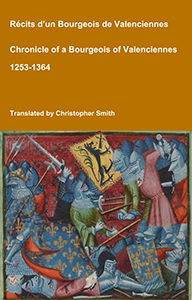
Chronicle of a Bourgeois of Valenciennes
Récits d’un bourgeois de Valenciennes aka The Chronicle of a Bourgeois of Valenciennes is a vivid 14th-century vernacular chronicle written by an anonymous urban chronicler from Valenciennes in the County of Hainaut. It survives in a manuscript that describes local and regional history from about 1253 to 1366, blending chronology, narrative episodes, and eyewitness-style accounts of political, military, and social events in medieval France, Flanders, and the Low Countries. The work begins with a chronological framework of events affecting Valenciennes and its region under rulers such as King Philip VI of France and the shifting allegiances of local nobility. It includes accounts of conflicts, sieges, diplomatic manoeuvres, and the impact of broader struggles like the Hundred Years’ War on urban life in Hainaut. Written from the perspective of a burgher (bourgeois) rather than a monastery or royal court, the chronicle offers a rare lay viewpoint on high politics and warfare, reflecting how merchants, townspeople, and civic institutions experienced the turbulence of the 13th and 14th centuries. Its narrative style combines straightforward reporting of events with moral and civic observations, making it a valuable source for readers interested in medieval urban society, regional politics, and the lived experience of war and governance in pre-modern Europe.
Available at Amazon in eBook and Paperback format.
Chronicon ex Chronicis by Florence and John of Worcester. 1038. Æthelnoth, archbishop of Canterbury, departed this life on the fourth of the calends of November [29th September]. Seven days after, Ethelric, bishop of Sussex, died; for he had prayed to God that he might not long survive his beloved father Ethelnoth. Grimkytel succeeded him in the bishopric, and Eadsige, one of the king's chaplains, succeeded Ethelnoth in the archbishopric. In the same year died Ælfric, bishop of East-Anglia, and Brihteag, bishop of the Hwiccas [Worcester], ended his days on Wednesday the third of the calends of January [20th December], whose see king Harold [aged 22] gave to Living, bishop of Crediton. Stigand, the king's chaplain, was appointed in Ælfric's place, but was afterwards ejected, and Grimkytel chosen in his stead; so that he held for the tune the two dioceses of Sussex and Essex; but Stigand was restored, and Grimkytel ejected, and Stigand kept the bishopric of Sussex for himself, and procured that of East-Anglia for his brother Ethelmar; but not satisfied with this, he was raised to the thrones of Winchester and Canterbury: he also strove hard to hold with them the bishopric of Sussex, and nearly carried his point. Ethelmar; was succeeded by Ærfast, bishop of Elmham, who, lest he should have seemed to have done nothing—for the Normans are very ambitious of future renown—transferred the see from Elmham to Thetford.
Chronicon ex Chronicis by Florence and John of Worcester. 1040. Godwin [aged 39], to obtain the king's favour, presented him with a galley of admirable workmanship, with a gilded figure-head, rigged with the best materials, and manned with eighty chosen soldiers splendidly armed. Every one of them had on each arm a golden bracelet weighing six ounces, and wore a triple coat of mail and a helmet partly gilt, and a sword with gilded hilt girt to his side, and a Danish battle-axe inlaid with gold and silver hanging from his left shoulder; in his left hand he bore a shield, the boss and studs of which were also gilt, and in his right hand a lance, called in the English tongue "Atagar."61 Moreover, he made oath to the [his half-brother] king [aged 22], with almost all the chief men and greater thanes in England, that it was not by his counsel, or at his instance, that his brother's eyes were put out, but that he had only obeyed the commands of his lord, king Harold [aged 24].
Note 61. Anglo-Saxon, atgar; old Norsk, atgeirr.
Chronicon ex Chronicis by Florence and John of Worcester. 1040. Harold [aged 24], king of England, died at London, and was buried at Westminster. After his funeral, the nobles of almost the whole of England sent envoys to [his half-brother] Hardicanute [aged 22] at Bruges, where he was staying with his [his step-mother] mother [aged 55], and, thinking it was for the best, invited him to come to England and ascend the throne. Thereupon, he fitted out fifty ships, and embarking Danish troops, before midsummer sailed over to England, where he was received with universal joy, and shortly afterwards crowned; but during his government he did nothing worthy his royal power. For as soon as he began to reign, calling to mind the injuries which both he and his mother had suffered at the hands of his predecessor, and reputed brother, king Harold, he despatched to London, Ælfric, archbishop of York, and earl Godwin [aged 39], with Stor, the master of his household, Edric, his steward, Thrond, captain of his guards, and other men of high rank, with orders to dig up the body of Harold and throw it into a sewer; and when it was thrown there, he caused it to be dragged out and cast into the river Thames. Shortly afterwards, it was picked up by a fisherman, and being immediately brought to the Danes, was honourably buried by them in a cemetery they possessed at London.60 After this, he ordered that eight marks should be paid to every rower in his fleet, and twelve to each steersman, to be levied from the whole of England; a tax so burthensome, that scarcely any one would pay it, and he became thoroughly detested by those who at first were most anxious for his coming. Besides, he was greatly incensed against earl Godwin, and Living, bishop of Worcester, for the death of his brother Alfred, of which they were accused by Ælfric, archbishop of York, and some others. In consequence, he took the bishopric of Worcester from Living and gave it to Ælfric; but the following year, he ejected Ælfric and graciously restored Living, who had made his peace with him.
Note 60. The cemetery of St Clement-Danes, where the Northmen had a settlement on the bank of the Thames, outside the walls of London. The Saxon Chronicle is silent as to Harold's corpse being thrown into the Thames and fished up, but Henry of Huntingdon gives the same account as our author.
Anglo-Saxon Chronicle. 1040. This year died King Harold [aged 24] at Oxford, Oxfordshire [Map], on the sixteenth before the calends of April; and he was buried at Westminster. He governed England four years and sixteen weeks; and in his days tribute was paid to sixteen ships, at the rate of eight marks for each steersman, as was done before in King Knute's days. The same year they sent after [his half-brother] Hardacnute [aged 22] to Bruges [Map], supposing they did well; and he came hither to Sandwich, Kent [Map] with sixty ships, seven nights before midsummer. He was soon received both by the Angles and Danes, though his advisers afterwards severely paid for it. They ordered a tribute for sixty-two ships, at the rate of eight marks for each steersman. Then were alienated from him all that before desired him; for he framed nothing royal during his whole reign. He ordered the dead Harold to be dragged up and thrown into a ditch. This year rose the sester of wheat to fifty-five pence, and even further. This year Archbishop Edsy went to Rome.
On 17th March 1040 Harold "Harefoot" King England [aged 24] died at Oxford, Oxfordshire [Map]. His half brother [his half-brother] Harthacnut [aged 22] succeeded King of England.
Father: King Cnut of England
Harold "Harefoot" King England
GrandFather: Aelfhelm Northumbria
Mother: Aelfgifu Northumbria
GrandMother: Wulfruna