

William of Worcester's Chronicle of England
William of Worcester, born around 1415, and died around 1482 was secretary to John Fastolf, the renowned soldier of the Hundred Years War, during which time he collected documents, letters, and wrote a record of events. Following their return to England in 1440 William was witness to major events. Twice in his chronicle he uses the first person: 1. when writing about the murder of Thomas, 7th Baron Scales, in 1460, he writes '… and I saw him lying naked in the cemetery near the porch of the church of St. Mary Overie in Southwark …' and 2. describing King Edward IV's entry into London in 1461 he writes '… proclaimed that all the people themselves were to recognize and acknowledge Edward as king. I was present and heard this, and immediately went down with them into the city'. William’s Chronicle is rich in detail. It is the source of much information about the Wars of the Roses, including the term 'Diabolical Marriage' to describe the marriage of Queen Elizabeth Woodville’s brother John’s marriage to Katherine, Dowager Duchess of Norfolk, he aged twenty, she sixty-five or more, and the story about a paper crown being placed in mockery on the severed head of Richard, 3rd Duke of York.
Available at Amazon in eBook and Paperback format.
Before 19th September 1806 [his father] William Dyce of Fonthill and Cuttlehill [aged 36] and [his mother] Margaret Chambers of Westburn [aged 30] were married.
On 19th September 1806 William Dyce was born to William Dyce of Fonthill and Cuttlehill [aged 36] and Margaret Chambers of Westburn [aged 30] at 48 Marischal Street, Aberdeen.
In 1825 William Dyce [aged 18] travelled to Rome, Italy [Map] returning after nine months.
In 1827 William Dyce [aged 20] returned to Rome, Italy [Map], staying for eighteen months.
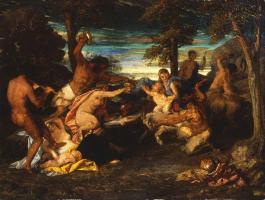
1827. William Dyce [aged 20]. "Bacchus Nursed by the Nymphs of Nyssa".

1834 to 1835. William Dyce [aged 27]. Portrait of Galbraith Lowry-Cole [aged 61].
Galbraith Lowry-Cole: On 1st May 1772 he was born to William Willoughby Cole 1st Earl Enniskillen and Anne Lowry-Corry Countess Enniskillen. In 1802 Galbraith Lowry-Cole and Catherine Pakenham were engaged; it was broken off a year later. She married his friend Arthur Wellesley, future Duke of Wellington, in 1806. On 15th June 1815 Galbraith Lowry-Cole and Frances Harris were married. She the daughter of James Harris 1st Earl Malmesbury and Harriet Maria Amyand Countess Malmesbury. He the son of William Willoughby Cole 1st Earl Enniskillen and Anne Lowry-Corry Countess Enniskillen. On 4th October 1842 Galbraith Lowry-Cole died.
In 1835 [his father] William Dyce of Fonthill and Cuttlehill [aged 65] died.

1848. William Dyce [aged 41]. Portrait of Princess Victoria [aged 4].
Princess Alice Saxe Coburg Gotha: On 25th April 1843 she was born to Prince Albert Saxe Coburg Gotha and Queen Victoria of the United Kingdom. Coefficient of inbreeding 7.25%. On 1st July 1862 Prince Louis Hesse Darmstadt IV Grand Duke and she were married at Osborne House, Isle of Wight. She the daughter of Prince Albert Saxe Coburg Gotha and Queen Victoria of the United Kingdom. On 14th December 1878 Princess Alice Saxe Coburg Gotha died.

18th January 1848. William Dyce [aged 41]. Portrait of Princess Victoria [aged 7]. See Queen Victoria's Journal.
Queen Victoria's Journal 1848. 18th January 1848. Windsor Castle [Map]. A fine, frosty morning. — We took a walk after breakfast. — Poor Ld Powis [deceased] has died in a most melancholy way. The whole party were out shooting & his 3rd son [aged 22] accidentally shot his father in the thigh. At 1st he went on well, but unfortunately mortification set in, & he died. It is too dreadful for the unfortunate son. — Vicky [aged 7] sat to Dyce [aged 41] [See image], who began a new drawing. — Mama [aged 61] came to luncheon, & we walked out again afterwards. — Mama, &c — & Ld Liverpool [aged 63] (staying till the end of the week) dined. —

The True Chronicles of Jean le Bel Volume 1 Chapters 1-60 1307-1342
The True Chronicles of Jean le Bel offer one of the most vivid and immediate accounts of 14th-century Europe, written by a knight who lived through the events he describes, and experienced some of them first hand. Covering the early decades of the Hundred Years’ War, this remarkable chronicle follows the campaigns of Edward III of England, the politics of France and the Low Countries, and the shifting alliances that shaped medieval warfare. Unlike later historians, Jean le Bel writes with a strong sense of eyewitness authenticity, drawing on personal experience and the testimony of fellow soldiers. His narrative captures not only battles and sieges, but also the realities of military life, diplomacy, and the ideals of chivalry that governed noble society. A key source for Jean Froissart, Le Bel’s chronicle stands on its own as a compelling and insightful work, at once historical record and literary achievement. This translation builds on the 1905 edition published in French by Jules Viard, adding extensive translations from other sources Rymer's Fœdera, the Chronicles of Adam Murimuth, William Nangis, Walter of Guisborough, a Bourgeois of Valenciennes, Geoffrey le Baker of Swinbroke and Richard Lescot to enrich the original text and Viard's notes.
Available at Amazon in eBook and Paperback format.
In 1850 William Dyce [aged 43] and Jane Bickerton Brand were married.
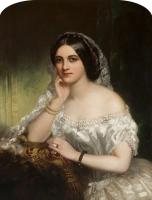
1856. William Dyce [aged 49]. "Portrait of a Lady". The artist's wife Jane Bickerton Brand.
Jane Bickerton Brand: In 1850 William Dyce and she were married. In 1885 she died.
In 1856 [his mother] Margaret Chambers of Westburn [aged 80] died.

1860. William Dyce [aged 53]. George Herbert at Bemerton, Salisbury.
George Herbert: On 3rd April 1593 he was born to Richard Herbert and Magdalen Newport. On 1st March 1633 George Herbert died.
On 14th February 1864 William Dyce [aged 57] died.
In 1885 [his former wife] Jane Bickerton Brand died.