

Chronicle of Abbot Ralph of Coggeshall
The Chronicle of Abbot Ralph of Coggeshall (Chronicon Anglicanum) is an indispensable medieval history that brings to life centuries of English and European affairs through the eyes of a learned Cistercian monk. Ralph of Coggeshall, abbot of the Abbey of Coggeshall in Essex in the early 13th century, continued and expanded his community’s chronicle, documenting events from the Norman Conquest of 1066 into the tumultuous reign of King Henry III. Blending eyewitness testimony, careful compilation, and the monastic commitment to record-keeping, this chronicle offers a rare narrative of political intrigue, royal power struggles, and social upheaval in England and beyond. Ralph’s work captures the reigns of pivotal figures such as Richard I and King John, providing invaluable insights into their characters, decisions, and the forces that shaped medieval rule. More than a simple annal, Chronicon Anglicanum conveys the texture of medieval life and governance, making it a rich source for scholars and readers fascinated by English history, monastic authorship, and the shaping of the medieval world.
Available at Amazon in eBook and Paperback format.
On 27th January 1832 Arthur Hughes was born to Edward Hughes [aged 45].
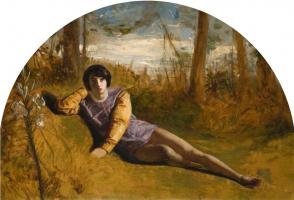
1848-1849. Arthur Hughes [aged 15]. "The Young Poet (Portrait of the Artist)".
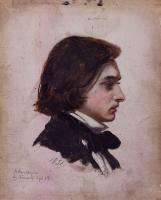
1851. Arthur Hughes [aged 18]. Self-portrait.

1852. John Everett Millais 1st Baronet [aged 22]. "The Proscribed Royalist, 1651". A young Puritan woman protecting a fleeing Royalist after the Battle of Worcester in 1651. The model for the Royalist hiding in the tree is Arthur Hughes [aged 19].

1852. John Everett Millais 1st Baronet [aged 22]. Portrait study for "The Proscribed Royalist", "The Proscribed Royalist, 1746".. Arthur Hughes [aged 19], then a student at the Royal Academy, recalled meeting Millais in the Academy library. Millais asked him to 'sit…for a head in his picture, 'The Proscribed Royalist '. I went and sat 5 or 6 times. He painted me in a small back room on the 2nd floor of the Gower Street house [Map]'.
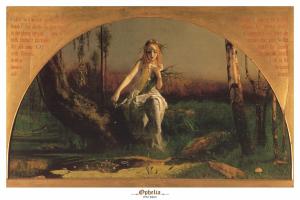
1852. Arthur Hughes [aged 19]. "Ophelia". The quote from Hamlet Act IV Scene 7 Part IV: "There is a willow grows aslant a brook, That shows his hoar leaves in the glassy stream. There with fantastic garlands did she come, Of crowflowers, nettles, daisies, and long purples, That liberal shepherds give a grosser name, But our cold maids do dead men's fingers call them. There on the pendant boughs her coronet weeds, Clamb'ring to hang, an envious sliver broke, When down her weedy trophies and herself, Fell in the weeping brook."
The Diary of George Price Boyce 1852. 30th December 1852. Went down to Dante G [aged 24]. and William Rossetti's chambers at 14 Chatham Place, Blackfriars Bridge. Met there Wells [aged 24], J. P. Seddon [aged 25], Clayton [aged 25], and Mr. Munro [aged 27], Mr. Stephens [aged 25] and Mr. Hughes [aged 20]. Rossetti showed me his studio but none of his works (which is his way). He had for our entertainment a series of anastatic drawings designed and coloured by the Hon. Mrs. Boyle, some of which as beautiful in feeling, natural simplicity, and colour, and in poetical treatment as almost anything I have seen. They illustrate a nursery rhyme. Also a quantity of Gavarni's works, and a grand and most striking mask of Dante taken from a caste of his face in death; a tracing of his head in Giotto's fresco with the eye imperfect; a pen and ink sketch by Millais from Keats' "Isabella." In the physical way, roast chestnuts and coffee, honey, and hot spirits. His room has a jolly balcony overhanging the river, the reflection of the lights on the bridge and quays, etc., were charming. Conversation throughout delightful, resulting methought from the happy and gentlemanly freedom of the company generally. There was only one of D. G. Rossetti's works to be seen in the room, and that was a sketch, study of a man, back view. Gabriel Rossetti invited me to his studio next Thursday.


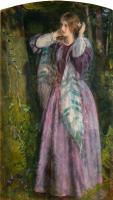
1853-1859. Arthur Hughes [aged 20]. "Amy" aka Study for the "The Long Engagement".
The Diary of George Price Boyce 1854. 13th March 1854. To Rossetti's [aged 25]. Found him at home but unwell; he sleeps little at nights. A young man of the name of Hughes [aged 22] was painting a picture of Orlando inscribing his mistress' name on a tree. Parts nicely painted. Rossetti showed me an exquisite drawing of his from the Vita Nuova, Dante receiving visitors on the anniversary of Beatrice's death. He showed me too a little unfinished drawing of Dante, Beatrice, and two others, in Paradise, he promised to finish for me, as I liked it, and would like some work in exchange. On the wall he has pen and ink outlines by J. E. Millais [aged 24], W. H. Hunt [aged 26], Deverell, and W. B. Scott, pencil design by Woolner, chalk study by F. M. Brown [aged 32]. A lovely hasty rub in of a cornfield against a deep blue sky, by W. H. Hunt. We read a long critique of the National Exhibition in the Daily News by Coventry Patmore; intensive praise of my small drawing, finding fault with the others. Rossetti came round to Russell St. and took ten of the drawings I showed him. He liked the long Sunset, Moel Siabod—Autumn Study, Thought the 3 greatest men in art were Giotto, Durer, Hogarth.
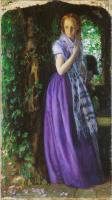
1855-1856. Arthur Hughes [aged 22]. "April Love". The model was the artist's future wife Tryphena Foord [aged 26]. The painting was first exhibited at the Royal Academy of Arts in 1856. At its first showing Hughes accompanied the painting with an extract from Tennyson's poem "The Miller's Daughter":
Love is hurt with jar and fret,
Love is made a vague regret,
Eyes with idle tears are set,
Idle habit links us yet;
What is Love? For we forget.
Ah no, no.
Tryphena Foord: On or before 14th December 1828, the date she was baptised, she was born to Robert Foord. In October 1855 Arthur Hughes and she were married. His brother Edward Hughes was married to her older sister Harriet Foord. An example of Marriage of Two Sets of Siblings. They had five children including painter Arthur Foord Hughes. In March 1921 she died.
Annals of Kings Richard II and Henry IV 1393-1406
The Annals of Kings Richard II and Henry IV offers a vivid contemporary account of one of the most turbulent periods in late medieval England. Covering the reigns of Richard II and Henry IV, the chronicle records royal ceremonies, political conflict, rebellion, war, taxation, religious controversy, executions, popular unrest and remarkable portents. Its pages include a detailed description of Richard II’s coronation, the fall and deposition of the king, Henry IV’s seizure of the throne, the Percy rebellion, the execution of Archbishop Richard Scrope, the campaigns of Owain Glyndŵr, and England’s relations with Scotland, France, Portugal and Scandinavia. Alongside affairs of state, the annalist preserves reports of miracles, eclipses, prophecies, supernatural events and the experiences of ordinary townspeople, clergy, soldiers and travellers. Written from a monastic perspective, the work combines political observation with moral judgement, presenting victories and disasters as evidence of divine favour or punishment. At once a historical record and a reflection of medieval belief, the Annals provides an invaluable window into the challenges, ceremonies and conflicts of England at the turn of the fifteenth century.
Available at Amazon in eBook and Paperback format.
In October 1855 Arthur Hughes [aged 23] and Tryphena Foord [aged 26] were married. His brother Edward Hughes [aged 27] was married to her older sister Harriet Foord [aged 29]. An example of Marriage of Two Sets of Siblings. They had five children including painter Arthur Foord Hughes.
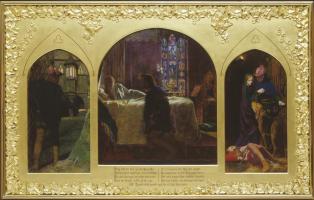
1856. Arthur Hughes [aged 23]. "The Eve of St Agnes".
In 1856 [his son] Arthur Foord Hughes was born to Arthur Hughes [aged 23] and [his wife] Tryphena Foord [aged 27] in Pimlico. He married 1891 Elizabeth Jones.
Life of William Morris. In the early part of the Long Vacation of 1857, Rossetti [aged 28] went down to Oxford to see his friend Benjamin Woodward, the architect. Morris, always delighted to take a day at Oxford, went with him. The long battle between the Palladian and Gothic styles for the new University Museum had been at last decided by the Oxford authorities in favour of the latter. Woodward's plans, in a style of mixed Rhenish and Venetian Gothic, had been accepted, and the museum was now in progress. Besides his principal work at the museum, he was engaged in building a debating hall for the Union Society. That hall, now the principal library, was just roofed in. In formi, the hall was a long building with apsidal ends. A narrow gallery fitted with bookshelves ran completely round it, and above the shelves was a broad belt of wall divided into ten bays, pierced by twenty six-foil circular windows, and surmounted by an open timber roof. Rossetti was at once fired with the idea of painting the space thus given. In his notions of the application of painting to architedural surfaces, Woodward, an ardent admirer and a skilled imitator of the Venetian builders, cordially concurred ; and it was at once settled that the ten bays and the whole of the ceiling should be covered with painting in tempera. The Building Committee of the Union, who had a general discretion as regards the work to be done during the Long Vacation, were induced to authorize the work without waiting to refer the matter to a general meeting of the Society. It was arranged that the paintings should forthwith be designed and carried out under Rossetti's superintendence. He himself, and other artists whom he should invite to join him, were to be the executants. The Union was to defray the expense of scaffolding and materials, and the travelling and lodging expenses of the artists, who, beyond this, were to give their services for nothing. No sooner was this settled, than Rossetti went straight back to London and issued his orders: Burne-Jones [aged 23] and Morris [aged 22] were to lay aside all other work and start on the new scheme at once. He had it all planned in his mind. The ten paintings on the walls were to be a series of scenes from the "Morte d' Arthur," and the roof above them was to be covered with a floriated design. For the pidures, ten men had to be found, each of whom should execute one bay, and the work, in the first enthusiasm, was estimated as a matter of six weeks or so. Arthur Hughes [aged 24], Spencer Stanhope [aged 27], Val Prinsep [aged 18], and Hungerford Pollen [aged 36], were drawn into the scheme and agreed to take a picture each; Madox Brown [aged 35] was also asked to execute one, but declined. Rossetti undertook to do two, or if possible three, himself, and Morris and Burne-Jones were each to do one under his eye and with his guidance : eight or nine of the ten bays were thus accounted for, and the remainder of the space was for the moment left to chance.
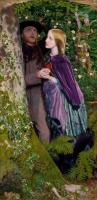
1859. Arthur Hughes [aged 26]. "The Long Engagement". The painting was originally titled Orlando. Her name Amy scratched into the tree top left. Model possibly [his wife] Tryphena Foord [aged 30].

1860. Arthur Hughes [aged 27]. "Aurora Leigh’s Dismissal of Romney (‘The Tryst’)".
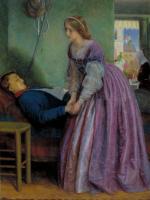
1862. Arthur Hughes [aged 29]. "That was a Piedmontese ...".

1865. Arthur Hughes [aged 32]. Study for "Lady of Shalott".
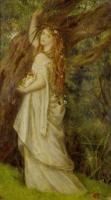
1865. Arthur Hughes [aged 32]. "Ophelia". It illustrates the scene in Shakespeare's 'Hamlet' (Act IV, scene 7) in which Ophelia picks flowers to make garlands shortly before she drowns.

1866. Arthur Hughes [aged 33]. "The Singer".
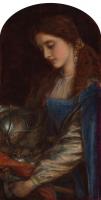
1867. Arthur Hughes [aged 34]. "Elaine with the armour of Lancelot".
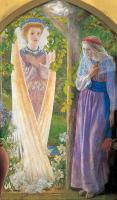
1872-1873. Arthur Hughes [aged 39]. "The Annunciation".
Chronicle of Abbot Ralph of Coggeshall
The Chronicle of Abbot Ralph of Coggeshall (Chronicon Anglicanum) is an indispensable medieval history that brings to life centuries of English and European affairs through the eyes of a learned Cistercian monk. Ralph of Coggeshall, abbot of the Abbey of Coggeshall in Essex in the early 13th century, continued and expanded his community’s chronicle, documenting events from the Norman Conquest of 1066 into the tumultuous reign of King Henry III. Blending eyewitness testimony, careful compilation, and the monastic commitment to record-keeping, this chronicle offers a rare narrative of political intrigue, royal power struggles, and social upheaval in England and beyond. Ralph’s work captures the reigns of pivotal figures such as Richard I and King John, providing invaluable insights into their characters, decisions, and the forces that shaped medieval rule. More than a simple annal, Chronicon Anglicanum conveys the texture of medieval life and governance, making it a rich source for scholars and readers fascinated by English history, monastic authorship, and the shaping of the medieval world.
Available at Amazon in eBook and Paperback format.

1873. Arthur Hughes [aged 40]. Portrait of the artists's nephew Edward Robert Hughes [aged 21].

1873. Arthur Hughes [aged 40]. "Lady of Shalott".
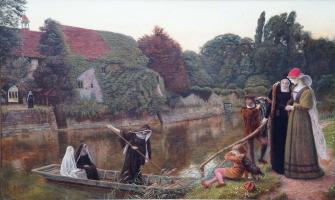
Around 1874. Arthur Hughes [aged 41]. "The Convent Boat". The composition is of a novice nun leaving her family to cross a river, in the Convent Boat, to go to her new life in cloisters on the other side.
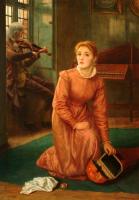
1882-1883. Arthur Hughes [aged 49]. "Memories".
In 1891 Arthur Foord Hughes [aged 35] and Elizabeth Jones [aged 27] were married. He the son of Arthur Hughes [aged 58] and Tryphena Foord [aged 62].

1897. Arthur Hughes [aged 64]. "La Belle Dame Sans Merci".
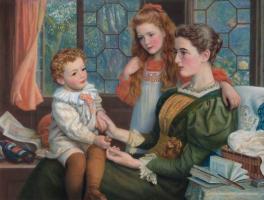
1897. Arthur Hughes [aged 64]. "Mrs Norman Hill and Her Children".

1903. Arthur Hughes [aged 70]. Portrait of Margaret Lushington [aged 33], Mrs Stephen Langton Massingberd. In the collection of Gunby Hall, Lincolnshire which is shown in the background.
Margaret Lushington: Around 1870 she was born. Before 1903 Stephen Langton aka Massingberd and she were married. In 1906 she died.
On 22nd December 1915 Arthur Hughes [aged 83] died in Kew Green, London. He was buried in Richmond Cemetery.
In March 1921 [his former wife] Tryphena Foord [aged 92] died.