

Jean de Waurin's Chronicle of England Volume 6 Books 3-6: The Wars of the Roses
Jean de Waurin was a French Chronicler, from the Artois region, who was born around 1400, and died around 1474. Waurin’s Chronicle of England, Volume 6, covering the period 1450 to 1471, from which we have selected and translated Chapters relating to the Wars of the Roses, provides a vivid, original, contemporary description of key events some of which he witnessed first-hand, some of which he was told by the key people involved with whom Waurin had a personal relationship.
Available at Amazon in eBook and Paperback format.
Abergavenny Castle is in Abergavenny, Monmouthshire [Map], Castles in Monmouthshire.
Around 1087 the first Abergavenny Castle [Map] was commissioned by Hamelin de Balun - motte and bailey.
Around 1100 a stone keep was added to Abergavenny Castle [Map].
On 5th March 1106 Hamelin de Ballon [aged 46] died. Some of his lands, including Abergavenny Castle [Map] were inherited by Brian de Wallingord aka Fitzcount.
Around 25th December 1175, Christmas, William de Braose 4th Baron Bramber [aged 31] invited the local Welsh nobles to his Christmas court at Abergavenny Castle [Map] as an act of reconciliation. Seisyll ap Dyfnwal Gwent and his elder son Geoffrey Gwent were murdered. William de Braose 4th Baron Bramber and his men then rode to Seisyll's home. There his younger son Cadwalladr Gwent [aged 7] was murdered and his wife captured.
Chronicle of the Princes of Wales. Immediately after that, Seisyll, son of Dyvnwal, was slain, through the treachery of the lord of Brecheiniog [William de Braose 4th Baron Bramber [aged 31]], in the castle of Abergavenny [Map] and with him Gruffudd his son, and many of the chieftains of Gwent. And then the French repaired to the court of Seisyll, son of Dyvnwal; and after seizing Gwladus his wife, they killed his son Cadwalader [aged 7]. And on that day there was the most miserable slaughter of the good people of Gwent. And after that most open and ílagitious treachery, none of the Welsh dared trust to the French
Holinshed's Chronicle [1525-1582]. The same yeare [1175] William de Breause having got a great number of Welshmen into the castell of Abergauennie [Map], vnder a colourable pretext of communication, proponed this ordinance to be receiued of them with a corporall oth; That no traueller by the waie amongst them should beare The Welshmē not well dealt withall.any bow, or other vnlawfull weapon. Which oth when they refused to take, bicause they would not stand to that ordinance he condemned them all to death. This deceit he vsed towards them in reuenge of the death of his vncle Henrie of Hereford, whom vpon easter euen before, they had through treason murthered, and were now acquited with the like againe.
The Itinerary of Archbishop Baldwin through Wales: Book 1 Chapter 4. From thence59 we proceeded through the narrow, woody tract called the bad pass of Coed Grono, leaving the noble monastery of Lanthoni, inclosed by its mountains, on our left. The castle of Abergevenni [Map] is so called from its situation at the confluence of the river Gevenni with the Usk.
Note 59. The last chapter having been wholly digressive, we must now recur back to Brecknock, or rather, perhaps, to our author's residence at Landeu [Map], where we left him, and from thence accompany him to Abergavenny. It appears that from Landeu [Map] he took the road to Talgarth [Map], a small village a little to the south east of the road leading from Brecknock to Hay; from whence, climbing up a steep ascent, now called Rhiw Cwnstabl [Map], or the Constable's ascent, he crossed the black mountains of Llaneliew to the source of the Gronwy-fawr river, which rises in that eminence, and pursues its rapid course into the Vale of Usk. From thence a rugged and uneven track descends suddenly into a narrow glen, formed by the torrent of the Gronwy, between steep, impending mountains; bleak and barren for the first four or five miles, but afterwards wooded to the very margin of the stream. A high ledge of grassy hills on the left hand, of which the principal is called the Bal, or Y Fal [Map], divides this formidable pass (the "Malus passus" of Giraldus) from the vale of Ewyas, in which stands the noble monastery of Llanthoni, "montibus suis inclusum," encircled by its mountains. The road at length emerging from this deep recess of Coed Grono, or Cwm Gronwy, the vale of the river Gronwy, crosses the river at a place called Pont Escob, or the Bishop's bridge [Map], probably so called from this very circumstance of its having been now passed by the archbishop and his suite, and is continued through the forest of Moel, till it joins the Hereford road, about two miles from Abergavenny. This formidable defile is at least nine miles in length.
Around 1190 Abergavenny Castle [Map] was rebuilt in red sandstone with a curtain wall, five towers and a keep.
On 29th March 1252 George Cantilupe 12th Baron Abergavenny was born to William Cantilupe and Eva de Braose [aged 25] at Abergavenny Castle [Map]. He married before 18th October 1273 his fifth cousin once removed Margaret de Lacy Baroness Bergavenny, daughter of Edmund Lacy 8th Baron Pontefract, 9th Baron Halton and Alice Saluzzo Baroness Lacy.
On 20th August 1348 Laurence Hastings 1st Earl Pembroke [aged 29] died at Abergavenny Castle [Map]. He was buried at Abergavenny Priory [Map]. His son John succeeded 2nd Earl Pembroke, 4th Baron Hastings, 15th Baron Abergavenny Feudal Creation.
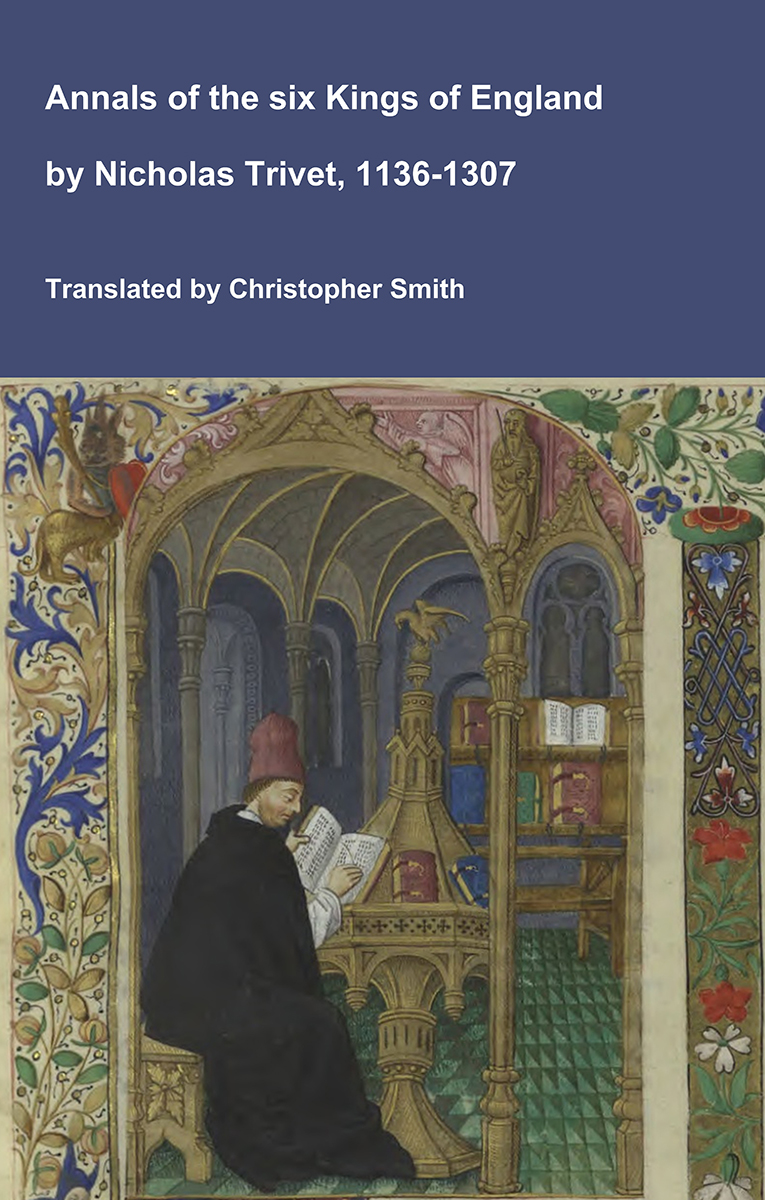
Annals of the six Kings of England by Nicholas Trivet
Translation of the Annals of the Six Kings of England by that traces the rise and rule of the Angevin aka Plantagenet dynasty from the mid-12th to early 14th century. Written by the Dominican scholar Nicholas Trivet, the work offers a vivid account of English history from the reign of King Stephen through to the death of King Edward I, blending political narrative with moral reflection. Covering the reigns of six monarchs—from Stephen to Edward I—the chronicle explores royal authority, rebellion, war, and the shifting balance between crown, church, and nobility. Trivet provides detailed insight into defining moments such as baronial conflicts, Anglo-French rivalry, and the consolidation of royal power under Edward I, whose reign he describes with particular immediacy. The Annals combines careful year-by-year reporting with thoughtful interpretation, presenting history not merely as a sequence of events but as a moral and political lesson. Ideal for readers interested in medieval history, kingship, and the origins of the English state, this chronicle remains a valuable and accessible window into the turbulent world of the Plantagenet kings.
Available at Amazon in eBook and Paperback format.
Norman Castles in Wales include Chepstow Castle [Map], Grosmont Castle [Map], Pembroke Castle [Map], Kidwelly Castle [Map], Haverfordwest Castle [Map], Walwyn's Castle [Map], Cardigan Castle [Map], Tenby Castle [Map], Abergavenny Castle [Map], Monmouth Castle [Map], Cilgerran Castle [Map] and Raglan Castle [Map].