William of Worcester's Chronicle of England
William of Worcester, born around 1415, and died around 1482 was secretary to John Fastolf, the renowned soldier of the Hundred Years War, during which time he collected documents, letters, and wrote a record of events. Following their return to England in 1440 William was witness to major events. Twice in his chronicle he uses the first person: 1. when writing about the murder of Thomas, 7th Baron Scales, in 1460, he writes '… and I saw him lying naked in the cemetery near the porch of the church of St. Mary Overie in Southwark …' and 2. describing King Edward IV's entry into London in 1461 he writes '… proclaimed that all the people themselves were to recognize and acknowledge Edward as king. I was present and heard this, and immediately went down with them into the city'. William’s Chronicle is rich in detail. It is the source of much information about the Wars of the Roses, including the term 'Diabolical Marriage' to describe the marriage of Queen Elizabeth Woodville’s brother John’s marriage to Katherine, Dowager Duchess of Norfolk, he aged twenty, she sixty-five or more, and the story about a paper crown being placed in mockery on the severed head of Richard, 3rd Duke of York.
Available at Amazon in eBook and Paperback format.
Denbigh Castle
 Great Gatehouse
 Well
Well
 Great Kitchen Tower
 Great Hall
 White Chamber Tower
 Green Chambers
 Postern Gate and Barbican
 Mantlet
 Treasure House Tower
Denbigh Castle is in Denbigh Castle and Town Walls [Map].
After 1282 Edmund de Lacy [deceased] drowned in the Well [Map] at Denbigh Castle. The date based on his father havbing been granted the Lordship of Denbigh in 1282.
On 25th December 1281 Alice Lacy Countess Leicester, and Lancaster 5th Countess of Salisbury 5th Countess Lincoln was born to Henry Lacy 4th Earl Lincoln, Earl Salisbury [aged 30] and Margaret Longespée 4th Countess of Salisbury and Lincoln at Denbigh Castle. She a great x 3 granddaughter of King Henry "Curtmantle" II of England. She married (1) 1294 her half second cousin twice removed Thomas Plantagenet 2nd Earl of Leicester, 2nd Earl Lancaster, Earl of Salisbury and Lincoln, son of Edmund "Crouchback" Plantagenet 1st Earl of Leicester 1st Earl Lancaster and Blanche Capet Queen Navarre (2) 1324 her second cousin twice removed Eubulus Strange, son of Roger Strange 5th Baron Strange Knockin and Aline Fitzalan Baroness Strange Knockin (3) 1336 Hugh de Freyne Earl of Lincoln and Salisbury.

1800. Unknown Painter. Denbigh Castle and Town. Antique Steel Vignette by & Co Newman published by D.L.L.Lewis, Rhyl.
 Annals of Six Kings of England by Nicholas Trivet [1258-1328]. At the same time the Welsh, rising against the king, in different regions set up different leaders over themselves. For the northerners, who dwell about the parts of Snowdonia, having as their captain and leader a certain man of the lineage of Llywelyn, the last prince, named Madog, burned the town and castle of Caernarfon, a great number of Englishmen, who had come to the fair suspecting nothing of the kind, having been slain. The western Welsh, however, having set over themselves a certain youth named Maelgwn, committed many outrages in the parts of Pembroke and Carmarthen. There was also a certain man called Morgan, who, stirring up the southern Welsh, drove out and expelled the Earl of Gloucester, Gilbert, who had disinherited his ancestors from their land, which is called Glamorgan. The King of England, entering Wales, recalled to himself into Wales his brother Edmund and Henry, Earl of Lincoln, who were preparing to cross over into Gascony with an army. As they approached on the day of Saint Martin [11th November 1294] towards the castle of the Earl of Lincoln at Denbigh, the Welsh met them in great force, and, a fierce battle having been joined, drove them back.
Eodem tempore Wallenses, insurgentes contra regem, in diversis partibus diversos sibi principes præfecerunt. Aquilonares enim, qui circa partes Snowdoniæ habitant, capitaneum habentes et ducem quemdam de genere Lewelini principis ultimi, Madocum nomine, villam et castrum de Karnervan combusserunt; magna Anglicorum multitudine, qui nihil tale suspicantes ad nundinas venerant, interfecta. Occidentales vero Wallenses, præposito sibi juvene quodam Mailgone, in partibus Penbrochiæ et Kaermerdyn mala plurima perpetrarunt. Qui dam etiam Morganus dictus, Wallenses australes concitans, comitem Gloverniæ Gilbertum, qui progenitores suos exheredaverat de terra sua, quæ Glamorgan dicitur, fugavit et expulit. Rex Angliæ Walliam ingressus, Eadmundum germanum suum et Henricum comitem Lincolniæ, parantes se ad transfretandum in Vasconiam cum exercitu, ad se in Walliam revocavit. Quibus in die sancti Martini appropinquantibus castello comitis Lincolniæ de Dunbey, Wallenses in magna virtute occurrerunt, et conserto gravi prælio repulerunt.
 Chronicle of Walter of Guisborough. When the king heard of these things, he immediately gathered his army and turned aside there, sending letters to his brother Lord Edmund and to the Earl of Lincoln1, who at that time were in the port of Portsmouth with many thousands of armed men, prepared to cross over into Gascony, ordering them to return to him in Wales with all haste. Upon hearing this, they hurried to him and remained there until nearly the middle of Lent. Now it happened that on the Feast of Saint Martin [11th November 1294] in winter, while the Earl of Lincoln was hastening before our king to his own castle of Denbigh, hoping perhaps to save it. as he believed, he was intercepted by his own Welsh men, he had many possessions and castles there, who engaged him in a fierce battle. These Welshmen of his ultimately prevailed against him, and after many on both sides had been killed, they finally forced him to flee with a few men, although he had fought bravely for a long time. Our king also, after crossing the river Conway, while making his way to the castle [Map], was not followed by the whole army. And so, as the sea waters and sudden tides overflowed, he was besieged by the Welsh for some time. Thus separated from his men and cut off, he suffered for a short time both hunger and thirst, drinking water mixed with honey and not eating bread to satisfaction; for the Welsh had overtaken his wagons, seized his supplies, and slaughtered the men they could catch. When they had only a small amount of wine, barely a flask's2 worth, which they had decided to preserve for the king, the king refused it and said: "In necessity all things ought to be held in common, and we shall all endure one and the same meagre fare until God Himself from on high looks down upon us. I will not be preferred to you in food, since I am the very cause and origin of this hardship." But soon after, God Almighty visited them with mercy: the waters receded, the whole army came to the king, and the Welsh were turned to flight. After many events and various battles, the Welsh were so harassed and pressed that, after many messengers were sent and returned, Madog himself and his followers were admitted to the king's peace, on the condition, however, that he would pursue and capture the other, namely Morgan, and hand him over to the royal prison within a set time. This agreement he kept and fulfilled, and so he obtained full peace. Many nobles from all over Wales were taken as hostages and sent to various castles in England to be held there until the king gave further orders; and they remained in those places until nearly the end of the war in Scotland. In the same year, a severe famine afflicted England, and many thousands of the poor died. A quarter of wheat was sold for sixteen shillings, and often for twenty.
Quæ cum audisset rex, mox congregato exercitu declinavit ibidem, missisque literis ad dominum Edmundum fratrem suum et comitem Lincolniæ, qui tunc temporis in portu de Portesmuth cum multis millibus armatorum parati fuerant in Vasconiam transfretare, ut ad eum in Walliam cum omni festinatione redirent; qui cum audissent talia properabant ad eum, et manserunt ibidem usque and defeat fere ad medium Quadragesimæ. Contigit autem quod die sancti Martini in hyeme dum idem comes Lincolniæ ad castrum suum de Tynebech ante regem nostrum festinaret, si forte illud salvare posset, sicut credidit, obviatus est ab hominibus suis propriis Wallensibus, habet enim ibidem multas possessiones et castra, qui quidem Wallenses sui commisso cum eo gravi prœlio prævaluerunts adversus eum, et interfectis hinc inde multis, ipsum tandem, cum jam diu strenue militasset, in fugam cum paucis converterunt. Rex etiam noster, transito flumine de Conway, dum ad castrum declinaret non est eum secutus totus exercitus, unde superabundantibus aquis maris et fluctuum subitorum obsessus est a Wallensibus per tempus aliquod. Sic separatus a suis et exclusus passusque est ad tempus modicum et famem et sitim, bibitque aquam cum melle mixtam et panem in saturitate non comedit; præoccupaverant enim Wallenses quadrigas suas, et victualibus acceptis et ablatis, homines quos poterant detruncabant. Cumque haberent modicum vini, vix unius lagenæ costrellum, quod pro rege salvare decreverant, non adquievit ipse rex, sed ait, "Omnia in necessitate debent esse communia, et omnes unam et similem dietam patiemur quousque respiciat nos ipse Deus ab alto, nec præficiar vobis in esu qui coarctationis istius origo et causa sum;" cito autem post visitavit Deus omnipotens eos, et decrescentibus aquis, venit ad regem exercitus totus et ipsi Wallenses in fugam versi sunt. Post multos autem eventus et conflictus varios in tantum Wallenses sunt agitati et astricti, quod missis et remissis nuntiis ipse Maddoch cum suis ad pacem regis admissus est, sub conditione tamen tali quod alterum scilicet Morgan prosequeretur et caperet, et infra certum tempus regio carceri manciparet. Quod quidem pactum tenuit et fecit, et plenam pacem adeptus est; acceptique sunt obsides multi de nobilioribus and gives totius Walliæ, et missi sunt in Angliam ad diversa castra ut custodirentur in eis usque ad jussionem regis, manseruntque in eisdem usque ad guerram Scotia fere finitam. Eodem anno fames valida Angliam afflixit et moriebantur pauperum multa millia, vendebatur enim quarterium frumenti pro XVI solidis et multotiens pro XX.
Note 1. Henry de Lacy, third earl of Lincoln, succeeded his father in 1257. In the preceding year, having espoused Margaret, daughter and co-heir of William de Longespee, (son of William de Longespee, Earl of Salisbury,) he became, jure uxoris i.e. by right of his wife, Earl of Salisbury.
Note 2. The capacity of the 'lagena' i.e. flask is thus given in an Assize of David, King of Scotland, concerning weights and measures. The lagena should be capable of containing twelve pounds of water, four pounds of sea-water, four of stagnant water, and four of pure. Its depth should be six inches and a-half, its breadth at the foot should be eight inches and a-half, taking the thickness of the wood on either side; at the higher extremity it should measure in circumference twenty-seven inches, and at the lower twenty-three. The lagena was also a dry measure, as we read of it in connection with corn and butter.
Chronicle of William Rishanger. [1277].Furthermore, besides these things, the Prince [Llywelyn "Last" Aberffraw [aged 44]] will reconcile with his brothers, whom he had wronged. For he had three brothers, two of whom, Owen [aged 45] and Rhodri [aged 47], he had imprisoned; the third, David, having fled, stayed for many years with the King of England. By the King, and against the custom of his people, he was made a knight. In that war, due to his bravery and loyalty, he became highly esteemed by the King. As a result, the King granted him the castle of Denbigh in Wales, along with lands worth one thousand pounds in annual revenue; moreover, he gave him a wife [Elizabeth Ferrers [aged 37]], the daughter of the Earl of Derby, who had recently been widowed by another man [William Marshal]. Owen, then, through royal favor, was freed from the prison which he had recently broken. Rhodri, however, fled from his brother and resided in England. The King, moreover, built a significant castle at Aberystwyth [Map]1 in Western Wales, to suppress the raids of the Welsh.
Item, præter hæc, Princeps fratres suos, quos læsit, placabit. Habuit enim tres fratres, quorum duos, Owenum et Rodericum, posuerat in carcere; tertius vero, David, fuga dilapsus, multis annis cum Rege Angliæ stetit; a quo, contra morem gentis suæ, miles factus, in ista guerra, ob probitatem et fidelitatem suam, plurimum erat Regi acceptus: unde et eidem castrum de Dimby contulit in Wallia, cum terris ad valorem mille librarum annui redditus; insuper et uxorem dedit, filiam Comitis Derbeyæ, quæ nuper alio viro fuerat viduata. Owenus ergo favore regio liberatur a carcere, quem fregerat paulo ante. Rodericus vero, fratrem fugiens, in Anglia morabatur. Rex autem in Occidentali Wallia apud Lampader Vaur, ad cohibendum irruptiones Wallensium, castrum construxit insigne.
Note 1. "Lampader Vaur" i.e. "Llanbadarn Fawr" from which Aberystwyth took its name.
Archaeologia Cambrensis 1820 Page 464. Sept. 24. "Being Wednesday, the King's forces were routed by the Parlm army in a place called Rowton Moor.
"From Chester the King retreated to Denbigh Castle, and, having layed there two or three nights, retourned to Chirk Castle [Map]. The next morning, viz. 29th, he advanced from thence with his army through Llan-Silin, and quartered that night in Halchdyn1 and so passed through Mountgomeryshyre towards Ludlow.
Note 1. Halchdyn is in Deuddwr, between the rivers Havren and Vyrnwy, aad near Llandrinio. The name of the place has been anglicised into Haughton.
Archaeologia Cambrensis 1853 Page 155. Fall of Part of Denbigh Castle.
Archaeologia Cambrensis 1855 Page 64. Denbigh Castle.
Archaeologia Cambrensis 1855 Page 185-228. Original Charter Preserved Amongst The Records Of The Corporation Of Denbigh.1
Note 1. In the following document the words contracted in the original are given in extenso. In the first word the initial H has been here supplied, a space appearing obviously left for a rubricated or illuminated initial, which may have become effaced by time.
Chester Archaeological and History Society 1856 Page 48. Denbigh Castle by William Ayrton.
Jean de Waurin's Chronicle of England Volume 6 Books 3-6: The Wars of the Roses
Jean de Waurin was a French Chronicler, from the Artois region, who was born around 1400, and died around 1474. Waurin’s Chronicle of England, Volume 6, covering the period 1450 to 1471, from which we have selected and translated Chapters relating to the Wars of the Roses, provides a vivid, original, contemporary description of key events some of which he witnessed first-hand, some of which he was told by the key people involved with whom Waurin had a personal relationship.
Available at Amazon in eBook and Paperback format.

Chester Archaeological and History Society 1856 Page 48. Plan of Denbigh Castle from a Survey by James Harrison.
Chronicle of Gregory. 1460. And that same nyght the King remevyde unto London a-gayne his wylle, to the byschoppe is palys of London, and the Duke of Yorke [aged 48] com unto him that same nyght by the torchelyght and toke a-pon him as kyng, and said in many placys that this is owrys by very ryght. Ande then the quene [aged 29] hyrynge this she voydyde unto Walys, but she was met with be-syde the Castelle of Malepas [Map], and a servand of her owne that she hadde made bothe yeman and gentylman, and aftyr a-poyntyd for to be in offysce with her son the prynce, spoylyde her and robbyde hyr, and put her soo in dowt of her lyffe and sonys lyffe also. And then she com to the Castelle of Hardelowe [Probably Denbigh Castle, Possibly Hawarden, Flintshire] in Walys, and she hadde many grete gyftys and gretely comfortyd, for she hadde nede there of, for she hadde a full esy many a-boute hyr, the nombyr of iiij personnys. And moste comynly she rode by-hynde a yonge poore gentylle-man of xiiij year age, his name was Jon Combe, i-borne at Amysbery [Map] in Wyltschyre. And there hens she remevyd full prevely unto the Lord Jesper, lord and Erle of Penbroke [aged 28], for she durste not a byde in noo place that [was] a opyn but in pryvatt. The cause was that conter fete tokyns were sende unto her as thoughe that they hadde come from her moste dradde lord the Kyng Harry the VI; but it was not of his sendyng, nothyr of [his] a doynge, but forgyd thyngys, for they that brought the tokyns were of the kyngys howse, and some of the pryncys howse, and some of her owne howse, and bade her beware of the tokyns, that she gave noo credans there too; for at the kyngys departynge fro Covyntre towarde the fylde of Northehampton, he kyste her and blessyd the prynce, and commaundyd her that she shulde not com unto him tylle that [he] a sende a specyalle tokyn unto her that no man knew but the King and she. For the lordys wolde fayne hadde her unto Lundon, for they knew welle that alle the workyngys that were done growe by hyr, for she was more wyttyer then the King, and that apperythe by his dedys, &c.
Around 1545 Richard Middleton was born to Richard Myddelton [aged 36] and Jane Dryhurst [aged 20] at Denbigh Castle.
Around 1563 Robert Myddelton was born to Richard Myddelton [aged 54] and Jane Dryhurst [aged 38] at Denbigh Castle where his father was governor. He was their seventh son. He married 27th July 1591 Margaret Mounsell.
On 14th October 1646 Kenrick Eyton [aged 39] was one of the commissioners to arrange the surrender of Denbigh Castle to General Thomas Mytton.
In 1563 Humphrey Llwyd aka Lluyd [aged 36] lived at Denbigh Castle by permission of Sir John Salusbury [aged 44] [Note. Some sources say Richard Myddelton [aged 54]] who was then the Lord of the Manor of Denbigh.
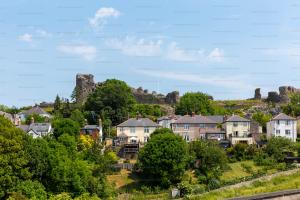
Denbigh Castle located high on the ridge over-looking the town and the Clywd valley.
In 1454 Roger Kynaston of Myddle and Hordley [aged 21] was appointed Constable of Denbigh Castle.
Great Gatehouse
The Great Gatehouse [Map] comprised three inter-connected octagonal towers known as the Porter's Lodge Tower, the Prison Tower and the Badnes Tower. The Gatehouse was further protected by a Barbican.
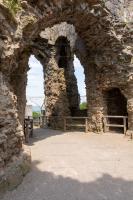
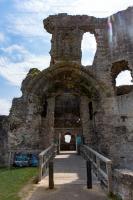
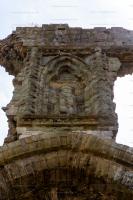
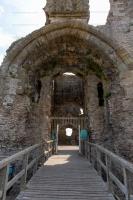
The River Clwyd rises 8km north-west Corwen, Denbighshire [Map] from where it flows past Ruthin Castle [Map], Denbigh [Map], St Asaph [Map] to Rhuddlan Castle [Map], from where the remaining 4km were canalised when the castle wads constructed, entering the Irish Sea at Rhyl [Map].
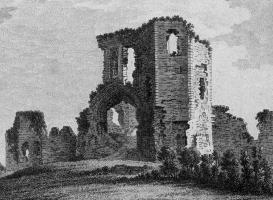
1781. Thomas Pennant [aged 54]. Great Gatehouse [Map] at Denbigh Castle.

Before 9th November 1802. Thomas Girtin [aged 27]. Great Gatehouse [Map] of Denbigh Castle.
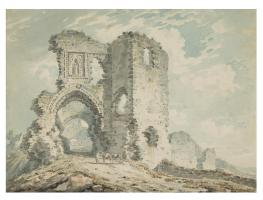
Before May 1804. Edward Dayes [aged 41]. Great Gatehouse [Map] of Denbigh Castle.
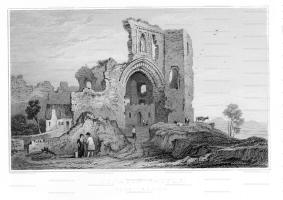
Wales Illustrated North Wales. Great Gatehouse [Map] at Denbigh Castle.

1853. Unknown Painter. Great Gatehouse [Map] at Denbigh Castle. Taken from Woodward, B. B.: "History of Wales".
Chronicle of Walter of Guisborough
A canon regular of the Augustinian Guisborough Priory, Yorkshire, formerly known as The Chronicle of Walter of Hemingburgh, describes the period from 1066 to 1346. Before 1274 the Chronicle is based on other works. Thereafter, the Chronicle is original, and a remarkable source for the events of the time. This book provides a translation of the Chronicle from that date. The Latin source for our translation is the 1849 work edited by Hans Claude Hamilton. Hamilton, in his preface, says: 'In the present work we behold perhaps one of the finest samples of our early chronicles, both as regards the value of the events recorded, and the correctness with which they are detailed; Nor will the pleasing style of composition be lightly passed over by those capable of seeing reflected from it the tokens of a vigorous and cultivated mind, and a favourable specimen of the learning and taste of the age in which it was framed.'
Available at Amazon in eBook and Paperback format.

Chester Archaeological and History Society 1856. Frontspiece. Great Gateway [Map] of Denbigh Castle.
Well
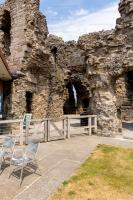
The 15m deep Well [Map] in which Edmund, son of Henry Lacy 4th Earl Lincoln, Earl Salisbury drowned.


After 1282 Edmund de Lacy [deceased] drowned in the Well [Map] at Denbigh Castle. The date based on his father havbing been granted the Lordship of Denbigh in 1282.
Great Kitchen Tower
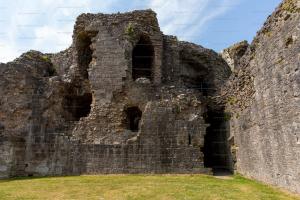
The Great Kitchen Tower [Map].
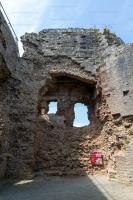
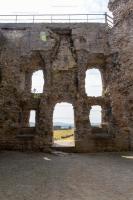
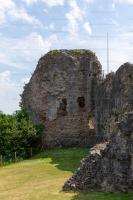
Great Hall
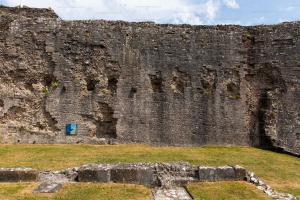
The Great Hall [Map] had a buttery (for butts of wine) and pantry at the Great Kitchen Tower [Map] end, and a porch at the other end leading to apartments in the White Chamber Tower [Map] and Green Chambers [Map]. The holes visible in the wall are where the substantial floor joists would have been placed.
White Chamber Tower
The White Chamber Tower [Map] contained apartments with fireplaces and latrines.
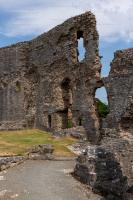
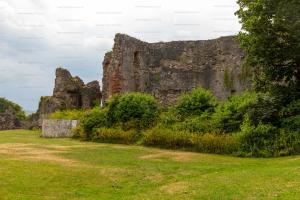
Green Chambers
The Green Chambers [Map], the name probably a reference to the green Gwespyr stone used, was a multi-purpose, multi-storey building with drainage.
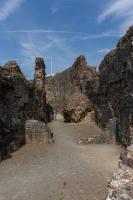
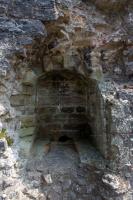
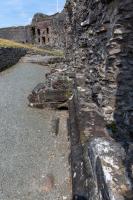
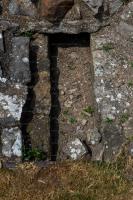
Postern Gate and Barbican
The Postern Gate and Barbican [Map] were a complex series of defensive features to protect the vulnerable rear of the castle where the rock ridge was lowest.
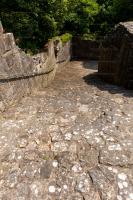
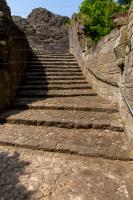
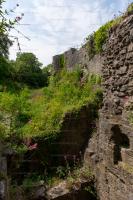
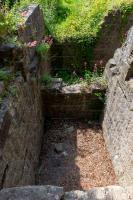
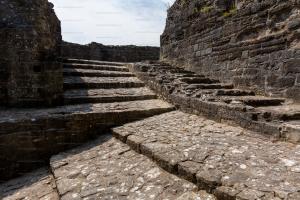
Mantlet
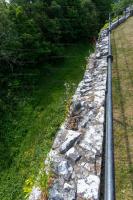
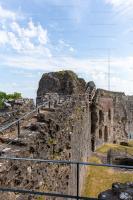
The Mantlet [Map] provided additional protection at the rear of the castle where the rock ridge was lowest, and curtain wall thinnest, over-looking the entrance to the Postern Gate and Barbican [Map].
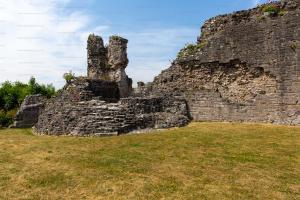
Treasure House Tower
Chronicle of Walter of Guisborough
A canon regular of the Augustinian Guisborough Priory, Yorkshire, formerly known as The Chronicle of Walter of Hemingburgh, describes the period from 1066 to 1346. Before 1274 the Chronicle is based on other works. Thereafter, the Chronicle is original, and a remarkable source for the events of the time. This book provides a translation of the Chronicle from that date. The Latin source for our translation is the 1849 work edited by Hans Claude Hamilton. Hamilton, in his preface, says: 'In the present work we behold perhaps one of the finest samples of our early chronicles, both as regards the value of the events recorded, and the correctness with which they are detailed; Nor will the pleasing style of composition be lightly passed over by those capable of seeing reflected from it the tokens of a vigorous and cultivated mind, and a favourable specimen of the learning and taste of the age in which it was framed.'
Available at Amazon in eBook and Paperback format.
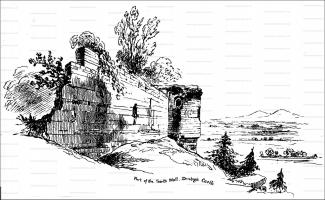
Chester Archaeological and History Society 1856 Page 48. Part of the South Wall of Denbigh Castle [looking toward the Treasure House Tower [Map]]