


The History of William Marshal was commissioned by his son shortly after William’s death in 1219 to celebrate the Marshal’s remarkable life; it is an authentic, contemporary voice. The manuscript was discovered in 1861 by French historian Paul Meyer. Meyer published the manuscript in its original Anglo-French in 1891 in two books. This book is a line by line translation of the first of Meyer’s books; lines 1-10152. Book 1 of the History begins in 1139 and ends in 1194. It describes the events of the Anarchy, the role of William’s father John, John’s marriages, William’s childhood, his role as a hostage at the siege of Newbury, his injury and imprisonment in Poitou where he met Eleanor of Aquitaine and his life as a knight errant. It continues with the accusation against him of an improper relationship with Margaret, wife of Henry the Young King, his exile, and return, the death of Henry the Young King, the rebellion of Richard, the future King Richard I, war with France, the death of King Henry II, and the capture of King Richard, and the rebellion of John, the future King John. It ends with the release of King Richard and the death of John Marshal.
Available at Amazon in eBook and Paperback format.
Ffyst Samson Burial Chamber is in St Nicholas, Pembrokeshire, Prehistoric Wales Neolithic Burials.
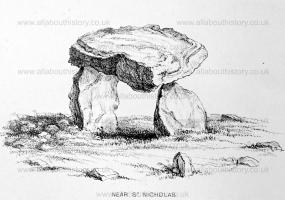
Archaeologia Cambrensis 1872 Pages 81-143. In the adjoining parish of St. Nicholas is a dolmen [Ffyst Samson Burial Chamber [Map]] which might pass for one of the free-standing or tripod ones, as all that is left of the original chamber are two supporters and the capstone, the latter resting on two separate points of one of the supporters. It is 7 ft. 9 ins. long by 6 ft. 7. ins.: measurements which do not agree with those given by Sir Gardner, who gives the breadth only 3 ft. 10 ins., and which is probably an error of the printer. The highest of the two supporters is 5 ft. 8 ins., being 2 ft. more than the other. The thickness of the capstone is a little under 2 ft. The chamber must have been small. Slight remains of the cairn still lie around. The situation is very conspicuous. At a short distance, In the lower ground, stand some pillar-stones; portions, in all probability, of a stone circle.