

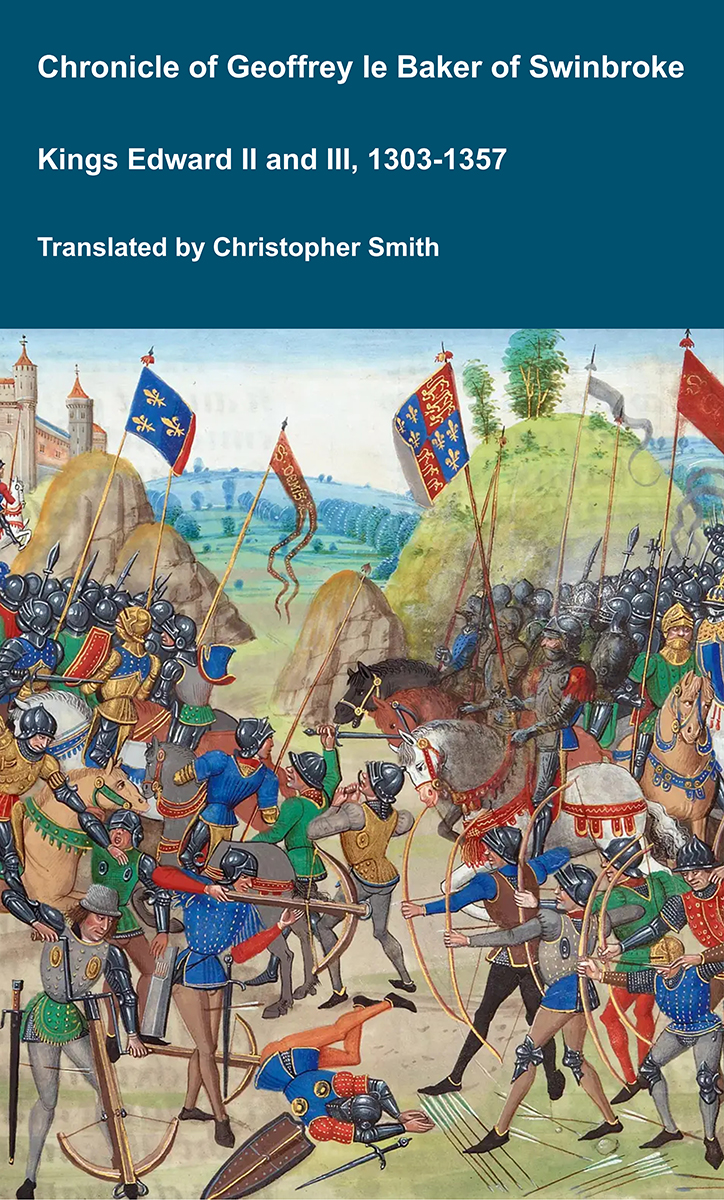
Chronicle of Geoffrey le Baker of Swinbroke
Baker was a secular clerk from Swinbroke, now Swinbrook, an Oxfordshire village two miles east of Burford. His Chronicle describes the events of the period 1303-1356: Gaveston, Bannockburn, Boroughbridge, the murder of King Edward II, the Scottish Wars, Sluys, Crécy, the Black Death, Winchelsea and Poitiers. To quote Herbert Bruce 'it possesses a vigorous and characteristic style, and its value for particular events between 1303 and 1356 has been recognised by its editor and by subsequent writers'. The book provides remarkable detail about the events it describes. Baker's text has been augmented with hundreds of notes, including extracts from other contemporary chronicles, such as the Annales Londonienses, Annales Paulini, Murimuth, Lanercost, Avesbury, Guisborough and Froissart to enrich the reader's understanding. The translation takes as its source the 'Chronicon Galfridi le Baker de Swynebroke' published in 1889, edited by Edward Maunde Thompson.
Available at Amazon in eBook and Paperback format.
King's Quoit, Manorbier is in Manorbier, Pembrokeshire, Prehistoric Wales Neolithic Burials.
Archaeologia Cambrensis 1872 Pages 81-143. No. 2. The Manorbeer cromlech [King's Quoit, Manorbier [Map]] has been already described in the Third Series of the Arch. Camb., and by Sir Gardner Wilkinson in one of the Collectanea volumes of the British Archaeological Association. There are certain anomalous features about it which seem to render it a rather exceptional example. The capstone, 16 feet 9 inches long by 8 feet 6 inches broad, has one of its ends resting on a small block of stone, and the other on three low supporters nearly at right angles to each other. Immediately above the block of stone is a wall of limestone, which Sir Gardner thinks has furnished the capstone, the thickness of which is 1 ft. 9 ins. It lies to the north-east, and the entrance is at the north-eastern extremity. Sir Gardner Wilkinson thinks this may have been an exceptional case as regards its not having been enclosed in a mound or cairn, as the ground on both sides falls away too sharp to admit of one. Although in the present state of the spot on which it now stands, it would have been almost impossible to build any mound over it, yet who can say what changes may not have taken place since its erection, and that at one time this difficulty did not exist? At any rate it must have had some external protection if it were a grave, unless, as suggested by Sir Gardner, it is the cenotaph and monument of some chief who perished in the waters below. Still, however, it may be questioned whether an uncovered and imperfect structure as this could ever have been thought an appropriate honour worthy of a great chief; for the cenotaph, in any case, would be after the usual form and fashion of a tomb of that period, which these bare stones certainly did not represent.