

The Deeds of the Dukes of Normandy
The Gesta Normannorum Ducum [The Deeds of the Dukes of Normandy] is a landmark medieval chronicle tracing the rise and fall of the Norman dynasty from its early roots through the pivotal events surrounding the Norman Conquest of England. Originally penned in Latin by the monk William of Jumièges shortly before 1060 and later expanded at the behest of William the Conqueror, the work chronicles the deeds, politics, battles, and leadership of the Norman dukes, especially William’s own claim to the English throne. The narrative combines earlier historical sources with firsthand information and oral testimony to present an authoritative account of Normandy’s transformation from a Viking settlement into one of medieval Europe’s most powerful realms. William’s history emphasizes the legitimacy, military prowess, and governance of the Norman line, framing their expansion, including the conquest of England, as both divinely sanctioned and noble in purpose. Later chroniclers such as Orderic Vitalis and Robert of Torigni continued the history, extending the coverage into the 12th century, providing broader context on ducal rule and its impact. Today this classic work remains a foundational source for understanding Norman identity, medieval statesmanship, and the historical forces that reshaped England and Western Europe between 800AD and 1100AD.
Available at Amazon in eBook and Paperback format.
Pen-Y-Wyrlod Long Barrow is in Llanigon, Breconshire, Prehistoric Wales Neolithic Burials.
Archaeologia Cambrensis Volume LXXVI 1921 Miscellania. Excavation Of A Long Barrow At Llanigon, Co. Brecon.— This Long Barrow [Map] is situated in the parish of Llanigon, on a spur of the Black Mountains, at about the 800 ft. contour line, and close to a track-way which once led from the direction of Abergavenny, and over the mountain to a ford below Llowes, and so into Radnorshire. It is unrecorded except for a reference to it as a "Druidical Altar" in the Transactions of the Woolhope Club for 1898.
When the writers commenced excavations on it in September, 1920, four stones protruded some 6 to 12 in. through the surface, and evidently formed a small cist. The elevation of the mound is slight, about 4 to 5 ft., and the ovoid-shaped outline measures roughly, 50 ft. long by 30 ft. wide. The barrow is aligned through its longest axis nearly due east and west, the narrow end pointing to the west.
Operations were commenced by carrying a trench from the west stone of the cist for about 14 ft. towards the apex. This disclosed nothing but a mass of shaley stones, many of considerable size, some being as much as 4 ft. in length, laid mostly horizontallv, and showed the barrow to be a true carnedd or cairn, was verified later by openings made in other parts of the mound.
The east and west stones of the cist had fallen over and were leaning in a westerly direction; the other two had gone over to the north. The interior of the cist was next cleared, and consisted of stones up to 2 ft. in length mixed with a certain amount of black earth, and intermingled throughout with bones in a fragmentary state. The west stone measured 5 ft. in height and ft. 6 in. in length, and overlapped the two adjoining stones, which measured about 5 ft. in height and G ft. in length. The east stone fitted inside the north and south stones, and was only 3 ft. in. in height and 2 ft. 6 in. in length. The internal measurement of the cist was 2 ft. 6 in. wide, 5 ft. 6 in. long, and 5 ft. high. All traces of the capstone had disappeared.
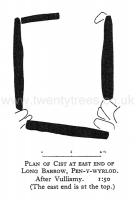
Long Barrows of the Cotswolds. Pen-Y-Wyrlod Long Barrow [Map]
Brecknockshire, 17 S.E. Parish of Llanigon. 7 *.
Latitude 52° 03' 05". Longitude 3° 07' 50". Height above O.D., about 850 feet.
This barrow is not marked on the 2nd edition (1905). It was being excavated at the time of my visit (August 12th, 1921) by the Rector of Llanigon, the Rev. W. E. T. Morgan, and Mr. George Marshall, F.S.A., of the Manor House, Breinton, Hereford. It is situated on a piece of waste land which has never been brought under cultivation, called locally "The Rocky Common." The mound itself appears to have no name, but was said by an inhabitant to have been known as "The Druid's Altar."
An account of this barrow was published by Mr. C. E. Vulliamy in Man, from which the following summary is compiled.
The side-stones of the cist at the east end of the barrow had been visible for many years protruding above the level of the soil. The work of excavation "was undertaken by representatives of the Woolhope Club of Hereford. Unfortunately, the excavation was not carried out with much regard for method, and the most interesting material has been collected subsequently from the piles of debris which were thrown up on either side of the cist." The barrow is rather a cairn than an earthen mound and consists of slabs of local sandstone. "Pear-shaped in plan, the greatest length is 6o feet and the greatest width about 33 feet. The axis of the cairn, along the line of greatest length is 66° east of true north, and the axis of the cist, 62° . The eastern end is much higher than the western." The dimensions of the cist are:- "North side, 7 feet 6 inches, south side, 8 feet 6 inches; west side, 6 feet 4 inches. The eastern slab is obviously split in half and the northern, though shown [on the plan] in situ, has tilted outward. The greatest dimensions of the side slabs are North, 6 feet 6 inches wide, 5 feet 3 inches high; south, 6 feet 5 inches wide, 5 feet 4 inches high; east (fragment) 2 feet 5 inches wide, 3 feet 8 inches high; west, 5 feet 8 inches wide, 4 feet 7 inches high. Excavations have been made at certain places, revealing, at the western end, two small blocks set on edge." I was informed by Mr. W. E. T. Morgan that charcoal had been found here but no burnt bones. "Large slabs protrude at three points; those on the northern and southern edges seem to mark the periphery of the cairn.