

Text this colour links to Pages. Text this colour links to Family Trees. Text this colour are links that are disabled for Guests.
Place the mouse over images to see a larger image. Click on paintings to see the painter's Biography Page. Mouse over links for a preview. Move the mouse off the painting or link to close the popup.
All About History Books
The Chronicle of Geoffrey le Baker of Swinbroke. Baker was a secular clerk from Swinbroke, now Swinbrook, an Oxfordshire village two miles east of Burford. His Chronicle describes the events of the period 1303-1356: Gaveston, Bannockburn, Boroughbridge, the murder of King Edward II, the Scottish Wars, Sluys, Crécy, the Black Death, Winchelsea and Poitiers. To quote Herbert Bruce 'it possesses a vigorous and characteristic style, and its value for particular events between 1303 and 1356 has been recognised by its editor and by subsequent writers'. The book provides remarkable detail about the events it describes. Baker's text has been augmented with hundreds of notes, including extracts from other contemporary chronicles, such as the Annales Londonienses, Annales Paulini, Murimuth, Lanercost, Avesbury, Guisborough and Froissart to enrich the reader's understanding. The translation takes as its source the 'Chronicon Galfridi le Baker de Swynebroke' published in 1889, edited by Edward Maunde Thompson. Available at Amazon in eBook and Paperback.
Around 1168 Bishop Robert Grosseteste was born at Stradbroke, Suffolk.
In 1229 Bishop Robert Grosseteste (age 61) was appointed Archdeacon of Lincoln.
On 17th June 1235 Bishop Robert Grosseteste (age 67) was consecrated Bishop of Lincoln.
Chronica Majora by Matthew Paris. Before 24th June 1237. In the same year, the emperor Frederick (age 42), by special messengers and imperial letters, summoned all the great Christian princes of the world to assemble on the day of St. John the Baptist's nativity, at Vaucouleurs, which is on the confines, or near the confines, of the empire and the French kingdom, there to discuss some difficult matters concerning the empire as well as the kingdom. The king of France, as if entertaining suspicion of this conference, proceeded at the time fixed to the place appointed, attended by a large army, which he had assembled for the purpose, and thus set dreadful and pernicious example to others, inasmuch as he went to discuss matters of peace in the same way as he would to attack his enemies. The king of England (age 29) made reasonable excuses for not coming in person; but sent a peaceful embassy, consisting of some of the chief men of the kingdom; namely, Richard earl of Cornwall (age 28), his brother, with some other nobles, fit to manage a conference, under the guidance of the venerable archbishop of York (age 57) and the bishop of Ely, and other trustworthy persons selected for the purpose. The bishop of Winchester, although selected before all others, absolutely refused to go, and, not without reason, gave the following as the cause for excusing himself: "My lord king," said he "you lately laid a heavy complaint against me before the emperor, telling him that I, with some other nobles, disturbed your kingdom: whether you did this with justice, or unjustly, God knows; but I trust that I have saved my conscience in every respect. But if your words were now placed with confidence in my mouth and in your letters, and should declare that I was a familar and faithful friend of yours; all this would appear as contrary, and he would accuse both you and me of instability; and this would blacken your fame in a great degree. Therefore, because it would be manifestly to your dishonour, I will not go on any account." And in the opinion of many, this reply gave sufficient excuse for him. When all preparations had been made, and they were all ready to set sail on this journey, they were met by letters from the emperor, to say that he could not go to the conference then, as he had purposed; but that what he could not do then, should, by God's favour, be carried into effect on the Nativity of St. John the Baptist in the following year; and thus each and all of them returned without effecting anything. In this year, on the day of the Supper, the bishop of Hereford consecrated the holy unction in the church of St. Albans [Map]. About this time, too, John Scott (deceased), earl of Chester, closed his life about Whitsuntide, having been poisoned by the agency of his wife (age 19), the daughter of Llewellyn (age 65). The life of the bishop of Lincoln (age 69), too, was also attempted by the same means, and he was with difficulty recalled from the gates of death. In the same year, in the week before Whitsuntide, there fell storms of hail which exceeded the size of apples, killing the sheep; and they were followed by continued rain.
 Become a Member via our Buy Me a Coffee page to read more.
On 2nd January 1241 Bishop Nicholas Farnham was elected Bishop of Durham. At first he wanted to decline the office, but Bishop Robert Grosseteste (age 73), Bishop of Lincoln persuaded him to accept.
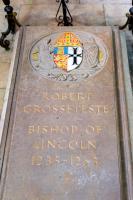
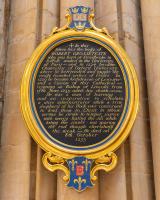
On 8th October 1253 Bishop Robert Grosseteste (age 85) died. He was buried at Lincoln Cathedral [Map]. "In this place lies the body of ROBERT GROSSETESTE who was born at Stradbroke in Suffolk, studied in the University of Paris – and in 1224 became the Chancellor of Oxford University where he befriended and taught the newly founded orders of Friars : In 1229 he became Archdeacon of Leicester and a Canon of this Cathedral – reigning as Bishop of Lincoln from 17th. June 1235 until his death. He was a man of learning and an inspiration to scholars a wise administrator whilst a true shepherd of his flock, ever concerned to lead them to Christ in whose service he strove to temper justice with mercy, hating the sin while loving the sinner, not sparing the rod though cherishing the weak – He died on 8 October 1253."