


Maternal Family Tree: Mary Robinson
Before 1601 [his father] Robert Napier 1st Baronet (age 40) and Elizabeth Staper were married without issue.
Before 1602 [his father] Robert Napier 1st Baronet (age 41) and Margaret Barnes were married without issue.
Before 10th August 1602 [his father] Robert Napier 1st Baronet (age 42) and [his mother] Mary Robinson were married.
On 10th August 1602 Robert Napier 2nd Baronet was born to [his father] Robert Napier 1st Baronet (age 42) and [his mother] Mary Robinson.
On 30th April 1623 Robert Napier 2nd Baronet (age 20) and Frances Thornhurst (age 18) were married.
In 1625 Robert Napier 2nd Baronet (age 22) was elected MP Corfe Castle, Dorset which seat he held until 1626.
Before 5th April 1626 [his wife] Frances Thornhurst (age 21) died.
In 1628 Robert Napier 2nd Baronet (age 25) was elected MP Weymouth which seat he held until 1629.
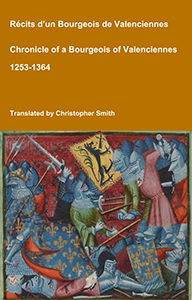
Chronicle of a Bourgeois of Valenciennes
Récits d’un bourgeois de Valenciennes aka The Chronicle of a Bourgeois of Valenciennes is a vivid 14th-century vernacular chronicle written by an anonymous urban chronicler from Valenciennes in the County of Hainaut. It survives in a manuscript that describes local and regional history from about 1253 to 1366, blending chronology, narrative episodes, and eyewitness-style accounts of political, military, and social events in medieval France, Flanders, and the Low Countries. The work begins with a chronological framework of events affecting Valenciennes and its region under rulers such as King Philip VI of France and the shifting allegiances of local nobility. It includes accounts of conflicts, sieges, diplomatic manoeuvres, and the impact of broader struggles like the Hundred Years’ War on urban life in Hainaut. Written from the perspective of a burgher (bourgeois) rather than a monastery or royal court, the chronicle offers a rare lay viewpoint on high politics and warfare, reflecting how merchants, townspeople, and civic institutions experienced the turbulence of the 13th and 14th centuries. Its narrative style combines straightforward reporting of events with moral and civic observations, making it a valuable source for readers interested in medieval urban society, regional politics, and the lived experience of war and governance in pre-modern Europe.
Available at Amazon in eBook and Paperback format.
Before 31st January 1633 Robert Napier 2nd Baronet (age 30) and Penelope Egerton Lady Napier (age 24) were married. She the daughter of John Egerton 1st Earl Bridgewater (age 54) and Frances Stanley Countess Bridgewater (age 50).
On 31st January 1633 [his daughter] Frances Napier Lady Barkham was born to Robert Napier 2nd Baronet (age 30) and [his wife] Penelope Egerton Lady Napier (age 24). She married (1) after Henry Richardson 3rd Baron Cramond (2) 28th June 1660 Edward Barkham 2nd Baronet, son of Edward Barkham 1st Baronet and Francis Berney, and had issue.
In 1636 [his son] John Napier 4th or 1st Baronet was born to Robert Napier 2nd Baronet (age 33) and [his wife] Penelope Egerton Lady Napier (age 27). He married 29th August 1666 Elizabeth Biddulph, daughter of Theophilus Biddulph 1st Baronet, and had issue.
On 22nd April 1637 [his father] Robert Napier 1st Baronet (age 77) died. His son Robert (age 34) succeeded 2nd Baronet Napier of Luton Hoo in Bedfordshire. [his wife] Penelope Egerton Lady Napier (age 28) by marriage Lady Napier of Luton Hoo in Bedfordshire.
On 6th July 1640 William Cecil 2nd Earl Exeter (age 74) died. His nephew David (age 40) succeeded 3rd Earl Exeter, 4th Baron Burghley. [his sister-in-law] Elizabeth Egerton Countess Exeter by marriage Countess Exeter.

In 1641 [his brother-in-law] John Egerton 2nd Earl Bridgewater (age 17) and Elizabeth Cavendish Countess Bridgewater (age 14) were married. She the daughter of William Cavendish 1st Duke Newcastle upon Tyne (age 48) and Elizabeth Bassett Countess Newcastle upon Tyne (age 49). He the son of [his father-in-law] John Egerton 1st Earl Bridgewater (age 62) and [his mother-in-law] Frances Stanley Countess Bridgewater. They were fourth cousins. He a great x 4 grandson of King Henry VII of England and Ireland. She a great x 5 granddaughter of King Edward IV of England.
On 4th December 1649 [his father-in-law] John Egerton 1st Earl Bridgewater (age 70) died. Monument at HR9JMi1fSt Peter and St Paul Church, Little Gaddesden. His son [his brother-in-law] John (age 26) succeeded 2nd Earl Bridgewater, 3rd Viscount Brackley, 3rd Baron Ellesmere. Elizabeth Cavendish Countess Bridgewater (age 22) by marriage Countess Bridgewater.
The monument has three panels. Panel 1 a dedication to Elizabeth Cavendish Countess Bridgewater, Panel 2 a dedication to [his mother-in-law] Frances Stanley Countess Bridgewater.
The third panel has an inscription to the Earl: "Here rests (till the last trump awakens his dust), the Right Honourable and truly noble Sir John Egerton, knt. one of the honourable Order of the Bath, Earle of Bridgewater, Viscount Brackley; and Baron of Elesmere, &c. He was son to that renowned patriot Sir Thomas Egerton, Baron of Elesmere, Viscount Brackley, and Lord Chancellor of England, and was sole heire both of his estate and virtues. He married the Right Honourable the Lady Frances Stanley, second daughter and one of the co-heires of Ferdinando, Earle of Derby, &c. a wife worthy such a husband, by whom he was blessed with a numerous and virtuous offspring, foure sonnes and eleven daughters. Three of his sonnes died before him, viz. James Viscount Brackley, his eldest, and Charles Viscount Brackley, his second sonne, who both died in their infancy; and Mr. Thomas Egerton, his fourth son, who lies here interred, dying unmarried in the 23d yeare of his age; and three of his daughters, viz. the Lady Cecila Egerton, Mrs. Alice Egerton, and the Lady Ann Egerton. His third and only surviving sonne and heire, John Viscount Brackley, he saw happily married to the Right Honourable the Lady Elizabeth Cavendyshe second daughter to the Right Honourable William Marquesse of Newcastle, &c. Seven of his daughters he likewise saw well and honourably married, viz. the Lady Frances, the Lady Arabella, the Lady Elizabeth, the Lady Mary, the Lady Penelope, the Lady Katharine, the Lady Magdalene; and left only his eleventh daughter, the Lady Alice Egerton, unmarried. He was endued with incomparable parts, both natural and acquired, so that both Art and Nature did seem to strive which should contribute most towards the making him a most accomplished gentleman; he had an active body, and a vigorous soule; his deportment was gracefull, his discourse excellent whether extemporary or premeditate, serious or jocular; so that he seldome spake, but he did either instruct or delight those that heard him; he was a profound scholar, an able statesman, and a good Christian; he was a dutiful! son to his mother the Church of England in her persecution, as well as in her greatest splendor; a loyall subject to his Sovereigne in those worst of times, when it was accounted treason not to be a traitor. As he lived 70 years a patterne of virtue; so he died an example of patience and piety, the fourth of December, in the year of our Lord 1649. Proverb x. 7. The memory of the Just is blessed."
Elizabeth Cavendish Countess Bridgewater: In 1627 she was born to William Cavendish 1st Duke Newcastle upon Tyne and Elizabeth Bassett Countess Newcastle upon Tyne. In 1641 John Egerton 2nd Earl Bridgewater and she were married. She the daughter of William Cavendish 1st Duke Newcastle upon Tyne and Elizabeth Bassett Countess Newcastle upon Tyne. He the son of John Egerton 1st Earl Bridgewater and Frances Stanley Countess Bridgewater. They were fourth cousins. He a great x 4 grandson of King Henry VII of England and Ireland. She a great x 5 granddaughter of King Edward IV of England. On 14th June 1663 Elizabeth Cavendish Countess Bridgewater died. She is commemorated on the Great Monument at St Peter and St Paul Church, Little Gaddesden on which is the inscription: "To the sacred memory of the late transcendently vertuous Lady, now glorious Saint, the Right Honourable Elizabeth Countesse of Bridgewater. She was second daughter to the Right Honourable William Marquesse of Newcastte, &c. and wife to the Right Honourable John Earle of Bridgewater, &c. and whose family she hath enriched with a hopeful issue, six sonnes, viz. John Viscount Brackley her eldest, Sir William Egerton second sonne, both Knights of the honourable Order of the Bath, Mr. Thomas Egerton her third, Mr. Charles Egerton her fourth, Mr. Henry Egerton her fifth, Mr. Steward Egerton her sixth sonne, and three daughters, viz. Mrs. Frances Egerton her eldest, the Lady Elizabeth Egerton her second, and the Lady Katherine Egerton her third daughter; of all which children, three, viz. Mr. Henry Egerton her fifth sonne, Mrs. Frances Egerton, her eldest, and the Lady Katherine Egerton her third daughter, lye here interred, dying in their infancy; the rest are still the living pictures of their deceased mother, and the only remaining comforts of their disconsolate father. She was a Lady in whom all the accomplishments both of body and mind did concurre to make her the glory of the present, and example of future ages. Her beauty was so unparallelled, that it is as much beyond the art of the most elegant pen, as it surpassed the skill of several of the most exquisite pencills (that attempted it) to describe, and not to disparage it. She had a winning and attractive behaviour, a charming discourse, a most obliging conversation: she was so courteous and affable to all persons, that she gained their love; yet, not so familiar to expose herselfe to contempt: she was of a noble and generous soule), yet, of so meeke and humble a disposition, that never any woman, of her quality, was greater in the world's opinion, and lesse in her owne: the rich at her table daily tasted her hospitality; the poore at her gate her charity: her devotion was most exemplary, if not inimitable; witnesse (besides several other occasional! meditations and prayers, full of all the holy transports and raptures of a sanctifyed soule), her divine meditations upon every partictular chapter in the Bible, written with her owne hand, and never (till since her death), seene by any eye but her owne, and her then dear but now sorrowful husband, to the admiration both, of her eminent piety in composing and of her modesty in concealing them. She was a most affectionate and observant wife to her husband, a most tender and indulgent mother to her children, a most kind and bountifull mistresse to her family. In a word, she was so superlatively good, that language is too narrow to expresse her deserved character: 11er death was as religious as her life was vertuous. On the 14th day of June, in the yeare of our Lord 1663; of her own age the 37th, she exchanged her earthly coronet for an heavenly crowne. Prov. xxxi; 28, 29. Her children rise up and call her blessed, her husband also, and he praiseth her. Many daughters have done virtuously, but thou excellest them all."


 Become a Member via our Buy Me a Coffee page to read more.
After 1650 Richard Vaughan 2nd Earl Carbery (age 50) and [his sister-in-law] Alice Egerton Countess Carbery were married. She by marriage Countess Carbery. She the daughter of [his father-in-law] John Egerton 1st Earl Bridgewater and [his mother-in-law] Frances Stanley Countess Bridgewater. He the son of John Vaughan 1st Earl Carbery and Margaret Meyrick.
The History of William Marshal was commissioned by his son shortly after William’s death in 1219 to celebrate the Marshal’s remarkable life; it is an authentic, contemporary voice. The manuscript was discovered in 1861 by French historian Paul Meyer. Meyer published the manuscript in its original Anglo-French in 1891 in two books. This book is a line by line translation of the first of Meyer’s books; lines 1-10152. Book 1 of the History begins in 1139 and ends in 1194. It describes the events of the Anarchy, the role of William’s father John, John’s marriages, William’s childhood, his role as a hostage at the siege of Newbury, his injury and imprisonment in Poitou where he met Eleanor of Aquitaine and his life as a knight errant. It continues with the accusation against him of an improper relationship with Margaret, wife of Henry the Young King, his exile, and return, the death of Henry the Young King, the rebellion of Richard, the future King Richard I, war with France, the death of King Henry II, and the capture of King Richard, and the rebellion of John, the future King John. It ends with the release of King Richard and the death of John Marshal.
Available at Amazon in eBook and Paperback format.
Around 1658 [his wife] Penelope Egerton Lady Napier (age 49) died.
On 28th June 1660 [his son-in-law] Edward Barkham 2nd Baronet (age 32) and [his daughter] Frances Napier Lady Barkham (age 27) were married. She by marriage Edward Barkham 2nd Baronet.
In March 1661 Robert Napier 2nd Baronet (age 58) died. His grandson [his grandson] Robert succeeded 3rd Baronet Napier of Luton Hoo in Bedfordshire although it appears he may have been disinherited by his grandfather and probably never assumed the title.
[his son] Robert Napier was born to Robert Napier 2nd Baronet and Frances Thornhurst. He married Margaret Littleton, daughter of Edward Littleton 1st Baronet and Hester Courteen Lady Littleton, and had issue.
Father: Robert Napier 1st Baronet
GrandFather: John Robinson 
Mother: Mary Robinson