

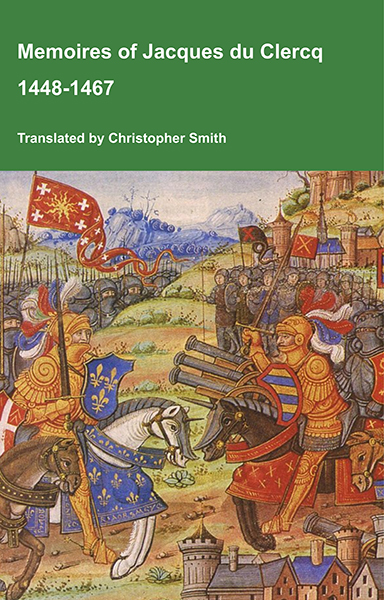
This is a translation of the 'Memoires of Jacques du Clercq', published in 1823 in two volumes, edited by Frederic, Baron de Reissenberg. In his introduction Reissenberg writes: 'Jacques du Clercq tells us that he was born in 1424, and that he was a licentiate in law and a counsellor to Philip the Good, Duke of Burgundy, in the castellany of Douai, Lille, and Orchies. It appears that he established his residence at Arras. In 1446, he married the daughter of Baldwin de la Lacherie, a gentleman who lived in Lille. We read in the fifth book of his Memoirs that his father, also named Jacques du Clercq, had married a lady of the Le Camelin family, from Compiègne. His ancestors, always attached to the counts of Flanders, had constantly served them, whether in their councils or in their armies.' The Memoires cover a period of nineteen years beginning in in 1448, ending in in 1467. It appears that the author had intended to extend the Memoirs beyond that date; no doubt illness or death prevented him from carrying out this plan. As Reissenberg writes the 'merit of this work lies in the simplicity of its narrative, in its tone of good faith, and in a certain air of frankness which naturally wins the reader’s confidence.' Du Clercq ranges from events of national and international importance, including events of the Wars of the Roses in England, to simple, everyday local events such as marriages, robberies, murders, trials and deaths, including that of his own father in Book 5; one of his last entries.
Available at Amazon in eBook and Paperback format.
Paternal Family Tree: Wuffingas
King Æthelwold of East Anglia was born to [his father] Eni Wuffingas.
Around 636 [his brother] King Anna of East Anglia succeeded King East Anglia.
In 654 King Penda of Mercia defeated the East Anglian army at the Battle of Bulcamp at Bulcamp, Blythburgh. [his brother] King Anna of East Anglia and his son [his nephew] Jurmin Wuffingas were killed. Anna's son His uncle [his brother] Æthelhere succeeded King East Anglia.
On 15th November 655 King Oswiu of Northumbria (age 43) defeated the Mercian army (probably) at Cock Beck during the Battle of the Winwaed ending the period of Mercian dominance. The battle is believed to have ended Anglo-Saxon paganism.
On 15th November 655 Æthelwald King Deira (age 13), an ally of King Penda of Mercia, withdrew his forces, one of many Mercian allies to do so, weakening King Penda's army.
King Penda of Mercia and [his brother] King Æthelhere of East Anglia were killed. Penda's son Paeda King South Mercia succeeded King South Mercia.
King Æthelwold of East Anglia succeeded King East Anglia after the death of his father at the Battle of the Winwaed.
In 664 King Æthelwold of East Anglia died. His nephew Ealdwulf succeeded King East Anglia.
Great x 2 Grandfather: Wehha Wuffingas
Great x 1 Grandfather: Wuffa King East Anglia
GrandFather: Tytila King East Anglia
Father: Eni Wuffingas