


The True Chronicles of Jean le Bel Volume 1 Chapters 1-60 1307-1342
The True Chronicles of Jean le Bel offer one of the most vivid and immediate accounts of 14th-century Europe, written by a knight who lived through the events he describes, and experienced some of them first hand. Covering the early decades of the Hundred Years’ War, this remarkable chronicle follows the campaigns of Edward III of England, the politics of France and the Low Countries, and the shifting alliances that shaped medieval warfare. Unlike later historians, Jean le Bel writes with a strong sense of eyewitness authenticity, drawing on personal experience and the testimony of fellow soldiers. His narrative captures not only battles and sieges, but also the realities of military life, diplomacy, and the ideals of chivalry that governed noble society. A key source for Jean Froissart, Le Bel’s chronicle stands on its own as a compelling and insightful work, at once historical record and literary achievement. This translation builds on the 1905 edition published in French by Jules Viard, adding extensive translations from other sources Rymer's Fœdera, the Chronicles of Adam Murimuth, William Nangis, Walter of Guisborough, a Bourgeois of Valenciennes, Geoffrey le Baker of Swinbroke and Richard Lescot to enrich the original text and Viard's notes.
Available at Amazon in eBook and Paperback format.
Paternal Family Tree: Wessex
Around 659 King Cædwalla of Wessex was born to [his father] Cenberht Wessex [aged 39].
In 661 [his father] Cenberht Wessex [aged 41] died.
Bede. 673. Eleutherius was the fourth bishop of the West Saxons; for Birinus was the first, Agilbert the second, and Wine the third. When Coinwalch, in whose reign the said Eleutherius was made bishop, died, his under-rulers took upon them the kingdom of the people, and dividing it among themselves, held it ten years; and during their rule he died, and Heddi succeeded him in the bishopric, having been consecrated by Theodore [aged 71], in the city of London; during whose prelacy, Cadwalla [aged 14], having subdued and removed those rulers, took upon him the government. When he had reigned two years, and whilst the same bishop still governed the church, he quitted his sovereignty for the love of the heavenly kingdom, and, going away to Rome, ended his days there, as shall be said more fully hereafter.
In 685 King Cædwalla of Wessex [aged 26] succeeded King Wessex.
Around 685 King Æthelwealh of Sussex was killed by King Cædwalla of Wessex [aged 26].
Anglo-Saxon Chronicle. 685. This year King Everth [aged 40] commanded Cuthbert [aged 51] to be consecrated a bishop; and Archbishop Theodore [aged 83], on the first day of Easter, consecrated him at York Bishop of Hexham; for Trumbert had been deprived of that see. The same year Everth was slain by the north sea, and a large army with him, on the thirteenth day before the calends of June. He continued king fifteen winters; and his brother Elfrith succeeded him in the government. Everth was the son of Oswy. Oswy of Ethelferth, Ethelferth of Ethelric, Ethelric of Ida, Ida of Eoppa. About this time Ceadwall [aged 26] began to struggle for a kingdom. Ceadwall was the son of [his father] Kenbert, Kenbert of [his grandfather] Chad [aged 95], Chad of Cutha, Cutha of Ceawlin, Ceawlin of Cynric, Cynric of Cerdic. Mull, who was afterwards consigned to the flames in Kent, was the brother of Ceadwall. The same year died Lothhere, King of Kent; and John was consecrated Bishop of Hexham, where he remained till Wilferth was restored, when John was translated to York on the death of Bishop Bosa. Wilferth his priest was afterwards consecrated Bishop of York, and John retired to his monastery [Map]21 in the woods of Delta. This year there was in Britain a bloody rain, and milk and butter were turned to blood.
Note 21. Beverley-minster, in Yorkshire [Map].
Bede. King Ceadwalla having slain Ethelwalch, King of the West Saxons, wasted that Province with tapine and slaughter.
685. In the meantime, Ceadwalla [aged 26], a daring young man, of the royal race of the Gewisse, who had been banished his country, came with an army, slew Ethelwalch, and wasted that country with much slaughter and plundering; but he was soon expelled by Berthun and Andhun, the king's commanders, who afterwards held the government of that province. The first of them was afterwards killed by the same Ceadwalla, when he was king of the Gewisse, and the province was more entirely subdued: Ina [aged 15], likewise, who reigned after Ceadwalla, kept that country under the like servitude for several years; for which reason, during all that time, they had no bishop of their own; but their first bishop, Wilfrid, having been recalled home, they were subject to the bishop of the Gewisse, i. e. the West Saxons, in the city of Winchester, Hampshire [Map].
Anglo-Saxon Chronicle. 686. This year Ceadwall [aged 27] and his brother Mull spread devastation in Kent and the Isle of Wight. This same Ceadwall gave to St. Peter's minster, at Medhamsted, Hook; which is situated in an island called Egborough. Egbald at this time was abbot, who was the third after Saxulf; and Theodore [aged 84] was archbishop in Kent.
In 686 [his brother] Mul King of Kent was appointed King of Kent.
Bede. 686. After Ceadwalla [aged 27] had possessed himself of the kingdom of the Gewisse, he also took the Isle of Wight [Map], which till then was entirely given over to idolatry, and by cruel slaughter endeavoured to destroy all the inhabitants thereof, and to place in their stead people from his own province; having bound himself by a vow, though he was not yet, as is reported, regenerated in Christ, to give the fourth part of the land, and of the booty, to our Lord, if he took the island, which he performed by giving the same for our Lord to the use of Bishop Wilfrid, who happened at the time to have accidentally come thither out of his own nation. The measure of that island, according to the computation of the English, is of twelve hundred families, and accordingly the bishop had given him land of three hundred families. The part which he received, he committed to one of his clerks called Bernwin, who was his sister's son, assigning him a priest, whose name was Hiddila, who might administer the word and baptism of salvation to all that would be saved.
In 687 King Cædwalla of Wessex [aged 28] ravaged Kent in revenge for the death of his brother.
Anglo-Saxon Chronicle. 687. This year was [his brother] Mull consigned to the flames in Kent, and twelve other men with him; after which, in the same year, Ceadwall [aged 28] overran the kingdom of Kent.
In 687 [his brother] Mul King of Kent was killed. King Wihtred of Kent [aged 17] succeeded King of Kent.
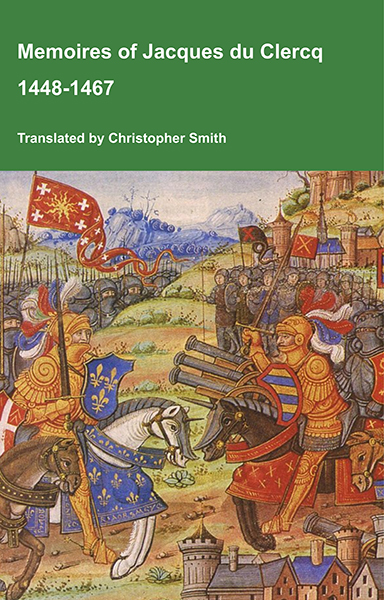
This is a translation of the 'Memoires of Jacques du Clercq', published in 1823 in two volumes, edited by Frederic, Baron de Reissenberg. In his introduction Reissenberg writes: 'Jacques du Clercq tells us that he was born in 1424, and that he was a licentiate in law and a counsellor to Philip the Good, Duke of Burgundy, in the castellany of Douai, Lille, and Orchies. It appears that he established his residence at Arras. In 1446, he married the daughter of Baldwin de la Lacherie, a gentleman who lived in Lille. We read in the fifth book of his Memoirs that his father, also named Jacques du Clercq, had married a lady of the Le Camelin family, from Compiègne. His ancestors, always attached to the counts of Flanders, had constantly served them, whether in their councils or in their armies.' The Memoires cover a period of nineteen years beginning in in 1448, ending in in 1467. It appears that the author had intended to extend the Memoirs beyond that date; no doubt illness or death prevented him from carrying out this plan. As Reissenberg writes the 'merit of this work lies in the simplicity of its narrative, in its tone of good faith, and in a certain air of frankness which naturally wins the reader’s confidence.' Du Clercq ranges from events of national and international importance, including events of the Wars of the Roses in England, to simple, everyday local events such as marriages, robberies, murders, trials and deaths, including that of his own father in Book 5; one of his last entries.
Available at Amazon in eBook and Paperback format.
Bede. 688. How Caedwalla king of the West Saxons went to Rome to be baptized; and his successor Ini also devoutly journeyed to the same threshold of the holy Apostles. [688 a.d.]
In the third year of the reign of Aldfrid, Caedwalla [aged 29], king of the West Saxons, having most vigorously governed his nation for two years, quitted his crown for the sake of the Lord and an everlasting kingdom, and went to Rome, Italy [Map], being desirous to obtain the peculiar honour of being cleansed in the baptismal font at the threshold of the blessed Apostles, for he had learned that in Baptism alone the entrance into the heavenly life is opened to mankind; and he hoped at the same time, that being made clean by Baptism, he should soon be freed from the bonds of the flesh and pass to the eternal joys of Heaven; both which things, by the help of the Lord, came to pass according as he had conceived in his mind. For coming to Rome, at the time that Sergius was pope, he was baptized on the Holy Saturday before Easter Day, in the year of our Lord 689, and being still in his white garments, he fell sick, and was set free from the bonds of the flesh on the 20th of April [689], and obtained an entrance into the kingdom of the blessed in Heaven. At his baptism, the aforesaid pope had given him the name of Peter, to the end, that he might be also united in name to the most blessed chief of the Apostles, to whose most holy body his pious love had led him from the utmost bounds of the earth. He was likewise buried in his church, and by the pope's command an epitaph was written on his tomb, wherein the memory of his devotion might be preserved for ever, and the readers or hearers thereof might be stirred up to give themselves to religion by the example of what he had done.
In 688 King Cædwalla of Wessex [aged 29] Abdicated as King Wessex. In 688 His second cousin once removed Ine [aged 18] succeeded King Wessex.
Bede. 689. How when Archbishop Theodore died Bertwald succeeded him as archbishop and among many others whom he ordained he made the learned Tobias bishop of the church of Rochester. [690 a.d.]
The year after that in which Caedwalla [aged 30] died at Rome, Italy [Map], that is, 690 after the Incarnation of our Lord, Archbishop Theodore [aged 87], of blessed memory, departed this life, being old and full of days, for he was eighty-eight years of age; which number of years he had been wont long before to foretell to his friends that he should live, the same having been revealed to him in a dream. He held the bishopric twenty-two years, and was buried in St. Peter's church [Map], where all the bodies of the bishops of Canterbury are buried. Of whom, as well as of his fellows of the same degree, it may rightly and truly be said, that their bodies are buried in peace, and their names shall live to all generations. For to say all in few words, the English Churches gained more spiritual increase while he was archbishop, than ever before. His character, life, age, and death, are plainly and manifestly described to all that resort thither, by the epitaph on his tomb, in thirty-four heroic verses. The first whereof are these:
"Here in the tomb rests the body of the holy prelate, called now in the Greek tongue Theodore. Chief pontiff, blest high priest, pure doctrine he set forth to his disciples.".
The last are as follow:
"For September had reached its nineteenth day, when his spirit went forth from the prison-bars of the flesh. Mounting in bliss to the gracious fellowship of the new life, he was united to the angelic citizens in the heights of Heaven.".
On 20th April 689 King Cædwalla of Wessex [aged 30] died. He was buried at St Peter's Basilica.
Anglo-Saxon Chronicle. This year Ceadwall [aged 30] went to Rome, and received baptism at the hands of Sergius the pope, who gave him the name of Peter; but in the course of seven nights afterwards, on the twelfth day 20th April 689 before the calends of May, he died in his crisom-cloths, and was buried in the church of St. Peter. To him succeeded Ina [aged 19] in the kingdom of Wessex, and reigned thirty-seven winters. He founded the monastery of Glastonbury [Map]; after which he went to Rome, and continued there to the end of his life. Ina was the son of Cenred, Cenred of Ceolwald; Ceolwald was the brother of Cynegils; and both were the sons of Cuthwin, who was the son of Ceawlin; Ceawlin was the son of Cynric, and Cynric of Cerdic.
Bede. Here I think it ought not to be omitted that, as the first fruits of the natives of that island that by believing were saved, two royal youths, brothers to Atwald, king of the island, were honoured by the particular grace of God. For the enemy approaching, they made their escape out of the island, and passed over into the neighbouring province of the Jutes. Where being conducted to the place called, At the Stone, as they thought to be concealed from the victorious king, they were betrayed and ordered to be killed. This being made known to a certain abbot and priest, whose name was Cynebert, who had a monastery not far from thence, at a place called Reodford, that is, the Ford of Reeds, he came to the king, who then lay privately in those parts, to be cured of the wounds which he had received whilst he was fighting in the Isle of Wight, and begged of him, that if the lads must inevitably be killed, he might be allowed first to instruct them in the mysteries of the faith. The king consented, and the bishop having taught them the word of truth, and cleansed their souls by baptism, made the entrance into the kingdom of heaven sure to them. Then the executioner being at hand, they joyfully underwent the temporal death, through which they did not doubt they were to pass to the life of the soul which is everlasting. Thus, after all the provinces of the island of Britain had embraced the faith of Christ, the Isle of Wight also received the same; yet being under the affliction of foreign subjection, no man there received the ministry, or rank of a bishop, before Daniel, who is now bishop of the West Saxons.
Bede. The epitaph was this:
"High estate, wealth, offspring, a mighty kingdom, triumphs, spoils, chieftains, strongholds, the camp, a home; whatsoever the valour of his sires, whatsoever himself had won, Caedwal, mighty in war, left for the love of God, that, a pilgrim king, he might behold Peter and Peter's seat, receive at his font pure waters of life, and in bright draughts drink of the shining radiance whence a quickening glory streams through all the world. And even as he gained with eager soul the prize of the new life, he laid aside barbaric rage, and, changed in heart, he changed his name with joy. Sergius the Pope bade him be called Peter, himself his father, when he rose born anew from the font, and the grace of Christ, cleansing him, bore him forthwith clothed in white raiment to the heights of Heaven. O wondrous faith of the king, but greatest of all the mercy of Christ, into whose counsels none may enter! For he came in safety from the ends of the earth, even from Britain, through many a nation, over many a sea, by many a path, and saw the city of Romulus and looked upon Peter's sanctuary revered, bearing mystic gifts. He shall walk in white among the sheep of Christ in fellowship with them; for his body is in the tomb, but his soul on high. Thou mightest deem he did but change an earthly for a heavenly sceptre, whom thou seest attain to the kingdom of Christ.".
"Here was buried Caedwalla, called also Peter, king of the Saxons, on the twentieth day of April, in the second indiction, aged about thirty years, in the reign of our most pious lord, the Emperor Justinian, in the fourth year of his consulship, in the second year of the pontificate of our Apostolic lord, Pope Sergius.".
Bede. When Caedwalla went to Rome, Italy [Map], Ini succeeded to the kingdom, being of the blood royal; and having reigned thirty-seven years over that nation, he in like manner left his kingdom and committed it to younger men, and went away to the threshold of the blessed Apostles, at the time when Gregory was pope, being desirous to spend some part of his pilgrimage upon earth in the neighbourhood of the holy places, that he might obtain to be more readily received into the fellowship of the saints in heaven. This same thing, about that time, was wont to be done most zealously by many of the English nation, nobles and commons, laity and clergy, men and women.
Kings Wessex: Great x 2 Grand Son of Ceawlin King Wessex
Great x 4 Grandfather: Cerdic King Wessex
Great x 3 Grandfather: Cynric King Wessex
Great x 2 Grandfather: Ceawlin King Wessex
Great x 1 Grandfather: Cuthwine
GrandFather: Cedda Wessex
Father: Cenberht Wessex