

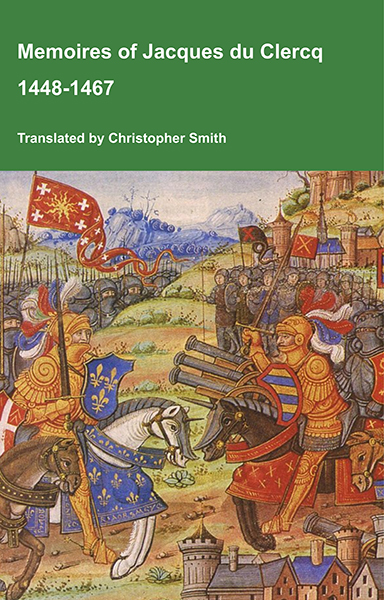
This is a translation of the 'Memoires of Jacques du Clercq', published in 1823 in two volumes, edited by Frederic, Baron de Reissenberg. In his introduction Reissenberg writes: 'Jacques du Clercq tells us that he was born in 1424, and that he was a licentiate in law and a counsellor to Philip the Good, Duke of Burgundy, in the castellany of Douai, Lille, and Orchies. It appears that he established his residence at Arras. In 1446, he married the daughter of Baldwin de la Lacherie, a gentleman who lived in Lille. We read in the fifth book of his Memoirs that his father, also named Jacques du Clercq, had married a lady of the Le Camelin family, from Compiègne. His ancestors, always attached to the counts of Flanders, had constantly served them, whether in their councils or in their armies.' The Memoires cover a period of nineteen years beginning in in 1448, ending in in 1467. It appears that the author had intended to extend the Memoirs beyond that date; no doubt illness or death prevented him from carrying out this plan. As Reissenberg writes the 'merit of this work lies in the simplicity of its narrative, in its tone of good faith, and in a certain air of frankness which naturally wins the reader’s confidence.' Du Clercq ranges from events of national and international importance, including events of the Wars of the Roses in England, to simple, everyday local events such as marriages, robberies, murders, trials and deaths, including that of his own father in Book 5; one of his last entries.
Available at Amazon in eBook and Paperback format.
Andrew Marvel's Works is in Stewart Books.
1671. The King [aged 40] having, upon pretence of the great preparations of his neighbours, demanded three hundred thousand pounds for his navy, (though in conclusion he hath not sent out any) and that the Parliament should pay his debts, which the ministers would never particularize to the House of Commons, our house gave several bills. You see how far things were stretched beyond reason, there being no satisfaction how these debts were contracted, and all men foreseeing that what was given would not be applied to discharge the debts, which I hear are at this day risen to four millions.
Nevertheless, such was the number of the constant courtiers, increased by the apostate patriots, who were bought off for that turn, some at six, others at ten, one at fifteen thousand pounds, in money; besides which, offices, lands, and reversions to others, that it is a mercy they gave not away the whole land and liberty of England. The Duke of Buckingham [aged 42] is again one hundred and forty thousand pounds in debt, and, by this prorogation, his creditors have time to tear all his lands in pieces. The House of Commons have run almost to the end of their time, and are grown extremely chargeable to the King, and odious to the people. They have signed and sealed ten thousand pounds a-year more to the Duchess of Cleveland [aged 30], who has likewise ten thousand pounds out of the excise of beer and ale; five thousand pounds a year out of the post-office; and, they say, the reversion of all the king's leases, the reversion of all the places in the Customhouse, and, indeed, what not? All promotions, spiritual and temporal, pass under her cognizance.