

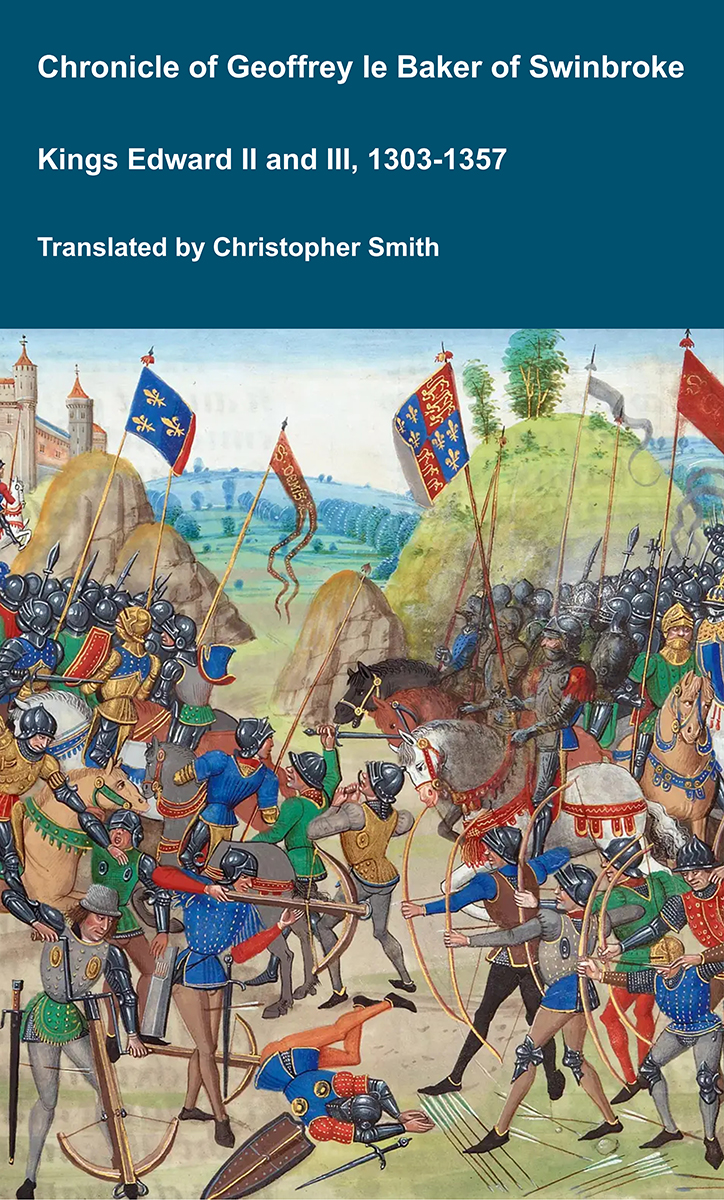
Chronicle of Geoffrey le Baker of Swinbroke
Baker was a secular clerk from Swinbroke, now Swinbrook, an Oxfordshire village two miles east of Burford. His Chronicle describes the events of the period 1303-1356: Gaveston, Bannockburn, Boroughbridge, the murder of King Edward II, the Scottish Wars, Sluys, Crécy, the Black Death, Winchelsea and Poitiers. To quote Herbert Bruce 'it possesses a vigorous and characteristic style, and its value for particular events between 1303 and 1356 has been recognised by its editor and by subsequent writers'. The book provides remarkable detail about the events it describes. Baker's text has been augmented with hundreds of notes, including extracts from other contemporary chronicles, such as the Annales Londonienses, Annales Paulini, Murimuth, Lanercost, Avesbury, Guisborough and Froissart to enrich the reader's understanding. The translation takes as its source the 'Chronicon Galfridi le Baker de Swynebroke' published in 1889, edited by Edward Maunde Thompson.
Available at Amazon in eBook and Paperback format.
Calendar of State Papers Charles II 1664 is in Calendar of State Papers Charles II.
April 1664. 94. Statement of articles in the Covenant proposed by the Commissioners for the Royal fishing to Sir Ant. Desmarces and Co., in reference to the regulation of lotteries, which are very unreasonable, and of the objections thereto. Endorsed [by Williamson] "Lottery, our exceptions."
14th July 1664. 64. News letter. There are great rumours in Holland of a war with England. They are preparing many ships and raising 6,000 men, and have no doubt of conquering by sea. If the King would find employment for his seamen, he need not make proclamations for them to return home; does not hear of any returning on the proclamation, and there are thousands in service abroad, for want of employment at home. 'The writer asks some seaport command, so as not to have to remain in a country that may be an enemy to his King. A wise man says the States know how to master England, by sending moneys into Scotland for them to rebel, and also to the discontented in England, so as to place the King in the same straits as his father was, and bring him to agree with Holland.
14th July 1664. 65. Duke of Albemarle [aged 55] to Capt. Basset, officer-in-chief of the King's troop. He is to send a corporal to receive from Sir Henry Bennet [aged 46] orders to the Lieutenant of the Tower to deliver to him Robert Atkinson, and to the Keeper of the Gatehouse to deliver Rich. Oldroyd, and appoint six troopers to convey them to Northampton, and there deliver them to the chief officer of Col. Frescheville's [aged 56] troop, to convey them to York. Sec. Bennet will deliver him moneys for the whole journey, and post warrants for horses, which he is to transfer to Col. Frescheville. [Copy.]


17th July 1664. Elizabeth Falkener to Sam. Pepys. Announces the death of her dear and loving husband. Begs interest, that she may be in something considered by the person succeeding her husband in his employment, which has occasioned great expenses. [Adm. Paper]
13th November 1664. 93. William Coventry [aged 36] to [Sec. Bennet [aged 46]]. Hopes the wind will change, and bring the Charles and the other ships out of the river; will not then fear what Opdam can do, though the men are raw, and need a little time at sea. The Ruby and Happy Return have brought some supernumeraries, but 500 more are wanted; 200 are expected from Plymouth, but till some runaways are hanged, the ships cannot be kept well manned. Sends a list of some fit to be made examples of in the several counties where they were pressed, with the names of those who pressed them. The Dutch ship named before is brought in, and two others are stayed at Cowes, Isle of Wight by virtue of the embargo, the order in Council making no exception for foreigners, The King's pleasure should be known therein, as the end, which is to gather seamen, does not seem to require the stopping of foreigners. Prize officers mustbe sent speedily to [Portsmouth], Dover, and Deal. Those at Deal, Kent [Map] should have men in readiness to carry prizes up the river, that the men belonging to the fleet be not scattered. Persons should also be hastened to 'take care of the sick and wounded. The Duke [aged 31] intends to appoint Erwin captain of the ship hired to go to St. Helena; he is approved by the East India Company, which is important, trade being intermixed with convoy, and they find fault if a commander of the King's ships bring home any little matter privately bought. The Duke has divided the fleet into squadrons, assigning to each a vice and rear adiniral; Sir John Lawson [aged 49] and Sir William Berkeley to his own, Mennes [aged 65] and Sansum to Prince Rupert's [aged 44], Sir George Aiscue [aged 48] [Ayscough] and Teddeman to the Earl of Sandwich. Hopes in a few days to be in much better order, if good men can be got. Will send a list of the squadrons. The Guernsey is damaged by running aground. Rear-Admiral Teddeman, with 4 or 5 ships, has gone to course in the Channel, and if he meet any refractory Dutchmen, will teach them their duty. The King's declaration for encouraging seamen has much revived the men, and added to their courage. [Four pages.]
14th November 1664. 103. Commissioner Peter Pett [aged 54] to Sam. Pepys [aged 31]. The Triumph has sailed with 70 men from the Kent, and 50 soldiers that came from Hull. Progress of ships. [Adm. Paper.]


14th November 1664. 104. William Coventry [aged 36] to [Sec. Bennet. [aged 46]] Believes nothing short of hanging will secure the pressed men. Lord St. John's news can hardly be believed, but the report will do no harm, for if the Dutch begin so roughly, seamen will be unwilling to go on merchantmen, and so cannot live without going on men-of-war. Hears that Taylor was objected to by the Committee [for Maritime Affairs] as a [Navy] Commissioner; he was chosen without contradiction by Sir John Mennes [aged 65], Sir John Lawson [aged 49], and Sir William Penn [aged 43], and the warrants sent for him and others to the Attorney-General, as was usual in Lord Northumberland's time. Thinks the King will not easily consent to his rejection, as he is a man of great abilities and dispatch, and was formerly laid aside at Chatham [Map], on the Duchess of Albemarle's [aged 45] earnest interposition for another. He is a fanatic, it is true, but all hands will be needed for the work cut out; there is less danger of them in harbour than at sea, and profit will convert most of them. The weather is bad; wonders the Scotchmen have not got to the Hope. The new ship is nearly ready, but has no guns; some spare ones should be sent in some man-of-war. [Two pages.]
24th December 1644. Warrant for a commission to Sir Henry Bennet [aged 26] to be Comptroller of all manner of prize ships and goods, adjudged in the Admiralty Court to belong to the King; he is to assist the Commissioners, have what officers he requires under him, keep counterparts of all indentures, inventories, &c., and accounts of all expenses, [Ent. Book 16, pp. 299-300. ]
24th December 1644. Warrant for a commission to Anthony Lord Ashley [aged 23] to be Treasurer of the prize goods, paying all salaries and expenses; the balance to be paid to the Exchequer, or to the Navy Treasurer or Lieutenant of Ordnance on warrants. [Hnt. Book 16, pp. 300-1.]


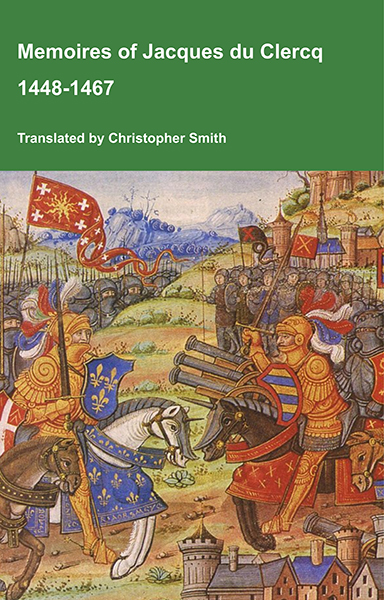
This is a translation of the 'Memoires of Jacques du Clercq', published in 1823 in two volumes, edited by Frederic, Baron de Reissenberg. In his introduction Reissenberg writes: 'Jacques du Clercq tells us that he was born in 1424, and that he was a licentiate in law and a counsellor to Philip the Good, Duke of Burgundy, in the castellany of Douai, Lille, and Orchies. It appears that he established his residence at Arras. In 1446, he married the daughter of Baldwin de la Lacherie, a gentleman who lived in Lille. We read in the fifth book of his Memoirs that his father, also named Jacques du Clercq, had married a lady of the Le Camelin family, from Compiègne. His ancestors, always attached to the counts of Flanders, had constantly served them, whether in their councils or in their armies.' The Memoires cover a period of nineteen years beginning in in 1448, ending in in 1467. It appears that the author had intended to extend the Memoirs beyond that date; no doubt illness or death prevented him from carrying out this plan. As Reissenberg writes the 'merit of this work lies in the simplicity of its narrative, in its tone of good faith, and in a certain air of frankness which naturally wins the reader’s confidence.' Du Clercq ranges from events of national and international importance, including events of the Wars of the Roses in England, to simple, everyday local events such as marriages, robberies, murders, trials and deaths, including that of his own father in Book 5; one of his last entries.
Available at Amazon in eBook and Paperback format.
25th December 1644 38. Capt. Thomas Allin [aged 32] to [Sir Rich. Fanshaw [aged 36]]. On the 19th, ' The Plymouth, attacked with his 7 ships left, a Dutch fleet of 14, three of which were men-of-war; sunk two vessels, and took two others, one a rich prize from Smyrna; the others retired much battered. Haus also taken a Dutch prize laden with iron and plank, coming from Lisbon. Is waiting the repair of the Bonaventure, damaged off Gibraltar. The Dover, sailing for Tangiers, has taken three prizes. [Copy, one and a half pages.]

