


The True Chronicles of Jean le Bel Volume 1 Chapters 1-60 1307-1342
The True Chronicles of Jean le Bel offer one of the most vivid and immediate accounts of 14th-century Europe, written by a knight who lived through the events he describes, and experienced some of them first hand. Covering the early decades of the Hundred Years’ War, this remarkable chronicle follows the campaigns of Edward III of England, the politics of France and the Low Countries, and the shifting alliances that shaped medieval warfare. Unlike later historians, Jean le Bel writes with a strong sense of eyewitness authenticity, drawing on personal experience and the testimony of fellow soldiers. His narrative captures not only battles and sieges, but also the realities of military life, diplomacy, and the ideals of chivalry that governed noble society. A key source for Jean Froissart, Le Bel’s chronicle stands on its own as a compelling and insightful work, at once historical record and literary achievement. This translation builds on the 1905 edition published in French by Jules Viard, adding extensive translations from other sources Rymer's Fœdera, the Chronicles of Adam Murimuth, William Nangis, Walter of Guisborough, a Bourgeois of Valenciennes, Geoffrey le Baker of Swinbroke and Richard Lescot to enrich the original text and Viard's notes.
Available at Amazon in eBook and Paperback format.
Chronicle of Greyfriars 1538 is in Chronicle of Greyfriars.
25th February 1538. Also this yere the 25th day of February [1538] was drawn from the Tower to Tyburn, Henry Hartford gentleman and Thomas Hever merchant, and there hanged and quartered for treason.
Also this year was made an Act of Parliament that no lord, knight, squire, gentleman, nor yeoman serving-man should disobey any offecer, constable, baliff, or any officer within the city of London as sargeant or yeoman, for to draw any weapon to any man, upon pain of death, or casting of any foyne [?].
22nd May 1538. Also this same yaer the 22nd day of May was burned in Smithfield friar John Forrest of Greenwich, and a rode that came out of Wales called Delvergaddar.
Note 1. The shrine of Darvel Gadarn was at Llandervel, co. Merioneth. On the destruction of the image see Wright's Letters on the Suppression of Monasteries, pp. 189, 208; Ellis's Letters, Third Series, letter 330; Ellis's Brand, vol. i. p. 202, edit. 1841.
7th August 1538. Also the 7th day of August was put to death Willyam Conysby gentleman.
Note 1. Stowe says, Edmond Conesby one of the grooms of the king's chamber for counter-feiting the king's seal manual.
2nd September 1538. And the 2nd day of September was put to death master Clefforde.
Note 1. Edward Clifford gentleman for counterfeiting the king's privy signet.—Stowe.
3rd September 1538. And the first Sunday of September was hanged at Clerkenwell at the wrestling place the hangman that was before, and two with him, for stealing in Bartholemew Fair.
22nd November 1538. This year the 22nd day of November was one Lambert, otherwise called Nicolas, was burned in Smithfield for great heresy.
And the 29th of November was burned in Smithfield John Mattessey a Dutchman, Peter Franke and his wife, for heresy.
9th December 1538. And this yere in December was beheddyd at the Towre-hyll lorde Henry markes of Exceter (age 42), lorde Henry Montegew (age 46), and sir Edward Nevelle (age 67).
November 1538. Also this year were all the places of religion within the city of London suppressed in November.
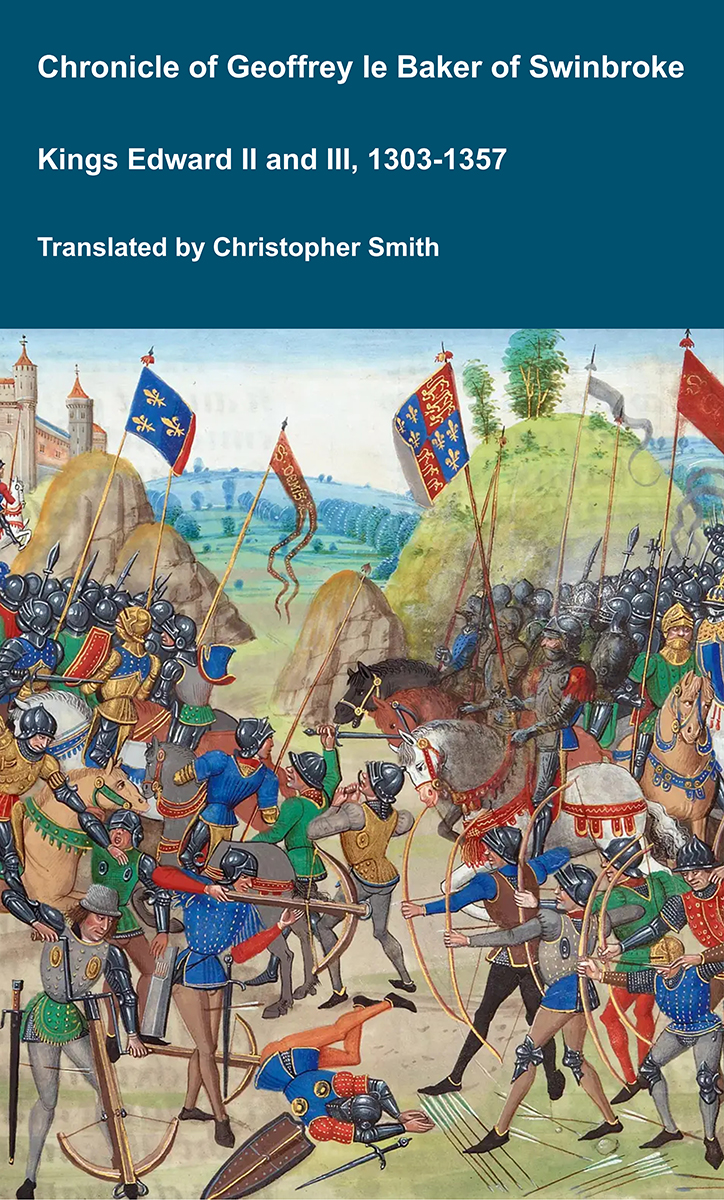
Chronicle of Geoffrey le Baker of Swinbroke
Baker was a secular clerk from Swinbroke, now Swinbrook, an Oxfordshire village two miles east of Burford. His Chronicle describes the events of the period 1303-1356: Gaveston, Bannockburn, Boroughbridge, the murder of King Edward II, the Scottish Wars, Sluys, Crécy, the Black Death, Winchelsea and Poitiers. To quote Herbert Bruce 'it possesses a vigorous and characteristic style, and its value for particular events between 1303 and 1356 has been recognised by its editor and by subsequent writers'. The book provides remarkable detail about the events it describes. Baker's text has been augmented with hundreds of notes, including extracts from other contemporary chronicles, such as the Annales Londonienses, Annales Paulini, Murimuth, Lanercost, Avesbury, Guisborough and Froissart to enrich the reader's understanding. The translation takes as its source the 'Chronicon Galfridi le Baker de Swynebroke' published in 1889, edited by Edward Maunde Thompson.
Available at Amazon in eBook and Paperback format.
23rd December 1538. Also this year the 23rd day of December was burned in Smithfield Richard Turner weaver, and Peter Florens butcher.