

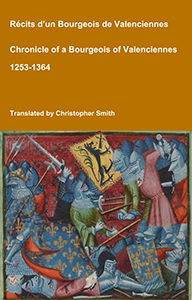
Chronicle of a Bourgeois of Valenciennes
Récits d’un bourgeois de Valenciennes aka The Chronicle of a Bourgeois of Valenciennes is a vivid 14th-century vernacular chronicle written by an anonymous urban chronicler from Valenciennes in the County of Hainaut. It survives in a manuscript that describes local and regional history from about 1253 to 1366, blending chronology, narrative episodes, and eyewitness-style accounts of political, military, and social events in medieval France, Flanders, and the Low Countries. The work begins with a chronological framework of events affecting Valenciennes and its region under rulers such as King Philip VI of France and the shifting allegiances of local nobility. It includes accounts of conflicts, sieges, diplomatic manoeuvres, and the impact of broader struggles like the Hundred Years’ War on urban life in Hainaut. Written from the perspective of a burgher (bourgeois) rather than a monastery or royal court, the chronicle offers a rare lay viewpoint on high politics and warfare, reflecting how merchants, townspeople, and civic institutions experienced the turbulence of the 13th and 14th centuries. Its narrative style combines straightforward reporting of events with moral and civic observations, making it a valuable source for readers interested in medieval urban society, regional politics, and the lived experience of war and governance in pre-modern Europe.
Available at Amazon in eBook and Paperback format.
Chronicon Pontificum et Imperatorum by Martin Polonus is in Late Medieval Books.
In the year of our Lord 1264, a comet appeared so remarkable that no one then living had ever seen the like. For, rising in the east with great brightness, it drew a shining tail as far as the middle of the sky towards the west; and although it may perhaps have signified many things in different parts of the world, this one thing is certainly known, that since it lasted for more than three months, when it first appeared Pope Urban began to fall ill, and on the same night on which the pope died [2nd October 1264], the comet disappeared.
Anno Domini 1264. Cometes taın notabilis apparuit, qualem nullus tune vivens ante vidit. Ab oriente enim cum magno fulgore surgens, usque ad medium emisperii versus occidentem comam perlucidam protrahebat, et licet in diversis partibus mundi forte multa significaverit, hoc tamen unum pro certo conpertum est, ut cum plus quam per tres menses duraverit, ipso primo apparente papa Urbanus cepit infirmarı, et eadem nocte qua papa expiravit et cometes disparuit.