The Deeds of the Dukes of Normandy
The Gesta Normannorum Ducum [The Deeds of the Dukes of Normandy] is a landmark medieval chronicle tracing the rise and fall of the Norman dynasty from its early roots through the pivotal events surrounding the Norman Conquest of England. Originally penned in Latin by the monk William of Jumièges shortly before 1060 and later expanded at the behest of William the Conqueror, the work chronicles the deeds, politics, battles, and leadership of the Norman dukes, especially William’s own claim to the English throne. The narrative combines earlier historical sources with firsthand information and oral testimony to present an authoritative account of Normandy’s transformation from a Viking settlement into one of medieval Europe’s most powerful realms. William’s history emphasizes the legitimacy, military prowess, and governance of the Norman line, framing their expansion, including the conquest of England, as both divinely sanctioned and noble in purpose. Later chroniclers such as Orderic Vitalis and Robert of Torigni continued the history, extending the coverage into the 12th century, providing broader context on ducal rule and its impact. Today this classic work remains a foundational source for understanding Norman identity, medieval statesmanship, and the historical forces that reshaped England and Western Europe between 800AD and 1100AD.
Available at Amazon in eBook and Paperback format.
Conversations with Lord Byron is in Victorian Books.
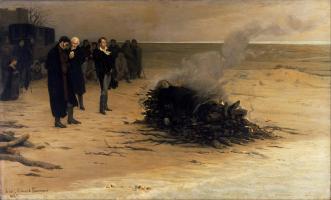
18th August 1822. —On the occasion of Shelley's melancholy fate I revisited Pisa, and on the day of my arrival learnt that Lord Byron was gone to the sea-shore, to assist in performing the last offices to his friend. We came to a spot marked by an old and withered trunk of a fir-tree; and near it, on the beach, stood a solitary hut covered with reeds. The situation was well calculated for a poet's grave. A few weeks before I had ridden with him and Lord Byron to this very spot, which I afterwards visited more than once. In front was a magnificent extent of the blue and windless Mediterranean, with the Isles of Elba and Gorgona,—Lord Byron's yacht at anchor in the offing: on the other side an almost boundless extent of sandy wilderness, uncultivated and uninhabited, here and there interspersed in tufts with underwood curved by the sea-breeze, and stunted by the barren and dry nature of the soil in which it grew. At equal distances along the coast stood high square towers, for the double purpose of guarding the coast from smuggling, and enforcing the quarantine laws. This view was bounded by an immense extent of the Italian Alps, which are here particularly picturesque from their volcanic and manifold appearances, and which being composed of white marble, give their summits the resemblance of snow. As a foreground to this picture appeared as extraordinary a group. Lord Byron (age 34) and Trelawney (age 29) were seen standing over the burning pile, with some of the soldiers of the guard; and Leigh Hunt, whose feelings and nerves could not carry him through the scene of horror, lying back in the carriage, —the four post-horses ready to drop with the intensity of the noonday sun. The stillness of all around was yet more felt by the shrill scream of a solitary curlew, which, perhaps attracted by the body, wheeled in such narrow circles round the pile that it might have been struck with the hand, and was so fearless that it could not be driven away. Looking at the corpse, Lord Byron said, "Why, that old black silk handkerchief retains its form better than that human body!"
Scarcely was the ceremony concluded, when Lord Byron, agitated by the spectacle he had witnessed, tried to dissipate, in some degree, the impression of it by his favourite recreation. He took off his clothes therefore, and swam off to his yacht, which was riding a few miles distant. The heat of the sun and checked perspiration threw him into a fever, which he felt coming on before he left the water, and which became more violent before he reached Pisa. On his return he immediately ordered a warm bath. "I have been very subject to fevers," said he, "and am" not in the least alarmed at this. It will yield to my usual remedy, the bath."