The Deeds of the Dukes of Normandy
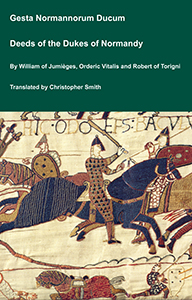
The Gesta Normannorum Ducum [The Deeds of the Dukes of Normandy] is a landmark medieval chronicle tracing the rise and fall of the Norman dynasty from its early roots through the pivotal events surrounding the Norman Conquest of England. Originally penned in Latin by the monk William of Jumièges shortly before 1060 and later expanded at the behest of William the Conqueror, the work chronicles the deeds, politics, battles, and leadership of the Norman dukes, especially William’s own claim to the English throne. The narrative combines earlier historical sources with firsthand information and oral testimony to present an authoritative account of Normandy’s transformation from a Viking settlement into one of medieval Europe’s most powerful realms. William’s history emphasizes the legitimacy, military prowess, and governance of the Norman line, framing their expansion, including the conquest of England, as both divinely sanctioned and noble in purpose. Later chroniclers such as Orderic Vitalis and Robert of Torigni continued the history, extending the coverage into the 12th century, providing broader context on ducal rule and its impact. Today this classic work remains a foundational source for understanding Norman identity, medieval statesmanship, and the historical forces that reshaped England and Western Europe between 800AD and 1100AD.
Available at Amazon in eBook and Paperback format.
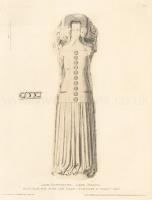
Effigy of Joam Burwaschs, Lady Mohun is in Monumental Effigies of Great Britain.
JOAN BURWASCHs, or de Burghersh, was the daughter of Bartholomew de Burghersh, and wife of John de Mohun, Lord of Dunster, in Somersetshire, who had during his nonage been in the wardship of her father. She founded a chantry in 1395, by indenture between herself and the Prior and Monks of Christchurch, Canterbury. In consideration of the payment of 350 marks, and the gift of certain appendages necessary for her chantry, and of the manor of Selgrave being amortized to them by royal licence, they covenanted that when she died her body should be laid in the tomb which she had already, at her own cost, erected in the Lady Chapel of the undercroft of Canterbury cathedral [Map], and that her remains should never be removed from the monument, which was to be honourably kept up. Hasted says, that the Dean and Chapter possess the manor, but that the tomb was in his day sadly neglected. The effigy of Lady Mohun lies on an altar-tomb under a gothic canopy, adorned with pinnacles and arches terminating in corbelled points. The inscription on the verge of the tomb is here copied from Dart:
"Pour Dieu priez por l'ame Johane Burwaschs, qe feut Dame de Mohun [For God pray for the soul Johane Burwaschs, who was Lady of Mohun]."
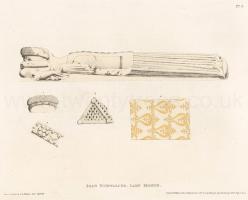
The attire of the Lady Mohun presents us with an example of the fret or reticulated coiffure adopted by court ladies of the fourteenth century; and of the cote hardie, which appears to have been a vestment fitting close to the body, leaving the neck bare, and became much in vogue with the ladies towards the latter end of the fourteenth century. The wimpled attire of Aveline Countess of Lancaster will shew how chary they were of their charms in the preceding age. The wimpled costume seems, indeed, to have been borrowed from the females of the East. Mr. Charles Stothard relates a humorous anecdote of a damsel who wore the cote hardie in one of his original letters inserted in the Memoir of his Lifea.
Details. Plate 1. Jewelled lace on the hips of the cote hardie. Plate II. 1. Top of the coiffure. 5. Portion of the circlet enlarged. 3. Reticulation of the coiffure. 4. Pattern on the cote hardie.
Note a. Memoirs including Original Letters, &c. of C. A. Stothard, F. S. A. by Mrs. Charles Stothard. London, 3823, p. 331.