

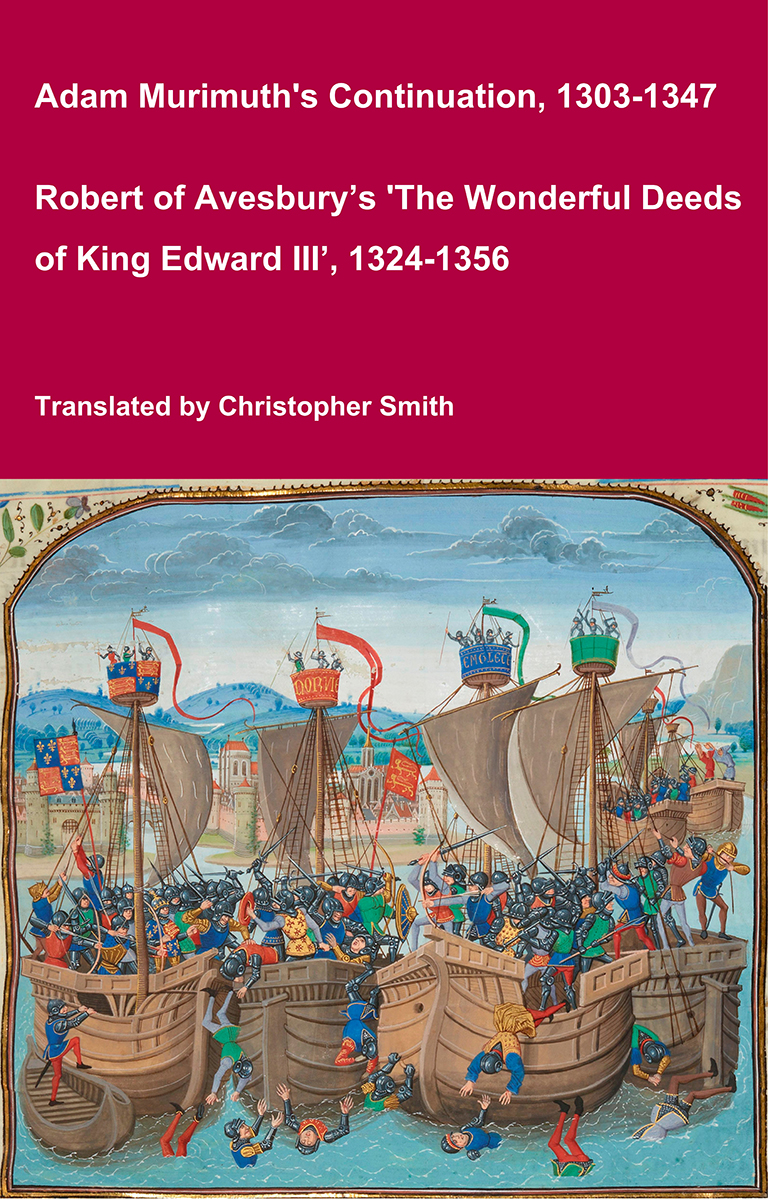
Adam Murimuth's Continuation and Robert of Avesbury’s 'The Wonderful Deeds of King Edward III'
This volume brings together two of the most important contemporary chronicles for the reign of Edward III and the opening phases of the Hundred Years’ War. Written in Latin by English clerical observers, these texts provide a vivid and authoritative window into the political, diplomatic, and military history of fourteenth-century England and its continental ambitions. Adam Murimuth Continuatio's Chronicarum continues an earlier chronicle into the mid-fourteenth century, offering concise but valuable notices on royal policy, foreign relations, and ecclesiastical affairs. Its annalistic structure makes it especially useful for establishing chronology and tracing the development of events year by year. Complementing it, Robert of Avesbury’s De gestis mirabilibus regis Edwardi tertii is a rich documentary chronicle preserving letters, treaties, and official records alongside narrative passages. It is an indispensable source for understanding Edward III’s claim to the French crown, the conduct of war, and the mechanisms of medieval diplomacy. Together, these works offer scholars, students, and enthusiasts a reliable and unembellished account of a transformative period in English and European history. Essential for anyone interested in medieval chronicles, the Hundred Years’ War, or the reign of Edward III.
Available at Amazon in eBook and Paperback format.
Gospel of St Matthew is in Gospels.
John Evelyn's Diary. 24th October 1686. Dr. Warren preached before the Princess [NOTE. Not clear which Princess this is]; possibly at Whitehall, on 5th Matthew, of the blessedness of the pure in heart, most elegantly describing the bliss of the beatifical vision. In the afternoon, Sir George Wheeler [aged 35], knight and baronet, preached on the 4th Matt. upon the necessity of repentance, at St. Margaret's [Map], an honest and devout discourse, and pretty tolerably performed. This gentleman coming from his travels out of Greece, fell in love with the daughter of Sir Thomas Higgins [aged 62], his Majesty's resident at Venice, niece to the Earl of Bath, and married her. When they returned into England, being honored with knighthood, he would needs turn preacher, and took orders. He published a learned and ingenious book of his travels, and is a very worthy person, a little formal and particular, but exceedingly devout.
John Evelyn's Diary. 24th October 1686. Dr. Warren preached before the Princess [NOTE. Not clear which Princess this is]; possibly at Whitehall, on 5th Matthew, of the blessedness of the pure in heart, most elegantly describing the bliss of the beatifical vision. In the afternoon, Sir George Wheeler [aged 35], knight and baronet, preached on the 4th Matt. upon the necessity of repentance, at St. Margaret's [Map], an honest and devout discourse, and pretty tolerably performed. This gentleman coming from his travels out of Greece, fell in love with the daughter of Sir Thomas Higgins [aged 62], his Majesty's resident at Venice, niece to the Earl of Bath, and married her. When they returned into England, being honored with knighthood, he would needs turn preacher, and took orders. He published a learned and ingenious book of his travels, and is a very worthy person, a little formal and particular, but exceedingly devout.
Jesus reached out his hand and touched the man. "I am willing," he said. "Be clean!" And immediately the leprosy left him.
NIV. But I tell you, love your enemies and pray for those who persecute you,.

John Evelyn's Diary. 8th March 1689. Dr. Tillotson [aged 58], Dean of Canterbury, made an excellent discourse on Matt. v. 44, exhorting to charity and forgiveness of enemies; I suppose purposely, the new Parliament being furious about impeaching those who were obnoxious, and as their custom has ever been, going on violently, without reserve, or modification, while wise men were of opinion the most notorious offenders being named and excepted, an Act of Amnesty would be more seasonable, to pacify the minds of men in so general a discontent of the nation, especially of those who did not expect to see the government assumed without any regard to the absent King, or proving a spontaneous abdication, or that the birth of the Prince of Wales was an imposture; five of the Bishops also still refusing to take the new oath.
NIV. 9 "This, then, is how you should pray: "'Our Father(I) in heaven, hallowed be your name, 10 your kingdom come, your will be done, on earth as it is in heaven. 11 Give us today our daily bread. 12 And forgive us our debts, as we also have forgiven our debtors. 13 And lead us not into temptation, but deliver us from the evil one.
John Evelyn's Diary. 23rd May 1658. Dr. Manton, the famous Presbyterian, preached at Covent Garden [Map], on Matthew vi. 10, showing what the kingdom of God was, how pray for it, etc.
For where your treasure is, there will your heart be also.
The light of the body is the eye: if therefore thine eye be single, thy whole body shall be full of light.
The Deeds of the Dukes of Normandy
The Gesta Normannorum Ducum [The Deeds of the Dukes of Normandy] is a landmark medieval chronicle tracing the rise and fall of the Norman dynasty from its early roots through the pivotal events surrounding the Norman Conquest of England. Originally penned in Latin by the monk William of Jumièges shortly before 1060 and later expanded at the behest of William the Conqueror, the work chronicles the deeds, politics, battles, and leadership of the Norman dukes, especially William’s own claim to the English throne. The narrative combines earlier historical sources with firsthand information and oral testimony to present an authoritative account of Normandy’s transformation from a Viking settlement into one of medieval Europe’s most powerful realms. William’s history emphasizes the legitimacy, military prowess, and governance of the Norman line, framing their expansion, including the conquest of England, as both divinely sanctioned and noble in purpose. Later chroniclers such as Orderic Vitalis and Robert of Torigni continued the history, extending the coverage into the 12th century, providing broader context on ducal rule and its impact. Today this classic work remains a foundational source for understanding Norman identity, medieval statesmanship, and the historical forces that reshaped England and Western Europe between 800AD and 1100AD.
Available at Amazon in eBook and Paperback format.
But if thine eye be evil, thy whole body shall be full of darkness. If therefore the light that is in thee be darkness, how great is that darkness!
No man can serve two masters: for either he will hate the one, and love the other; or else he will hold to the one, and despise the other, Ye cannot serve God and Mammon.
John Evelyn's Diary. 30th December 1683. Dr. Sprat [aged 48], now made Deane of Westminster, preached to the King [aged 53] at Whitehall [Map], on 6 Matt. 24. Recollecting the passages of the past yeare, I gave God thanks for his mercies, praying his blessing for the future.
NIV. But seek ye first the kingdom of God, and his righteousness; and all these things shall be added unto you.
John Evelyn's Diary. 10th February 1661. Dr. Baldero preached at Ely-house, on Matthew vi. 33, of seeking early the Kingdom of God; after sermon, the Bishop [aged 75] (Dr. Wren) gave us the blessing, very pontifically.
NIV. Then the whole town went out to meet Jesus. And when they saw him, they pleaded with him to leave their region.
John Evelyn's Diary. 29th January 1651. Dr. Duncan preached on 8 Matt. v. 34, showing the mischief of covetousness. My Lord Marquis of Ormonde [aged 40] and Inchiquin [aged 37], come newly out of Ireland, were this day at chapel.


NIV. The kingdom of heaven is like treasure hidden in a field. When a man found it, he hid it again, and then in his joy went and sold all he had and bought that field.
NIV. After he had dismissed them, he went up on a mountainside by himself to pray. Later that night, he was there alone,.
John Evelyn's Diary. 3rd March 1687. Dr. Meggott, Dean of Winchester, preached before the Princess of Denmark [aged 22], on Matt. xiv. 23. In the afternoon, I went out of town to meet my Lord Clarendon, returning from Ireland.


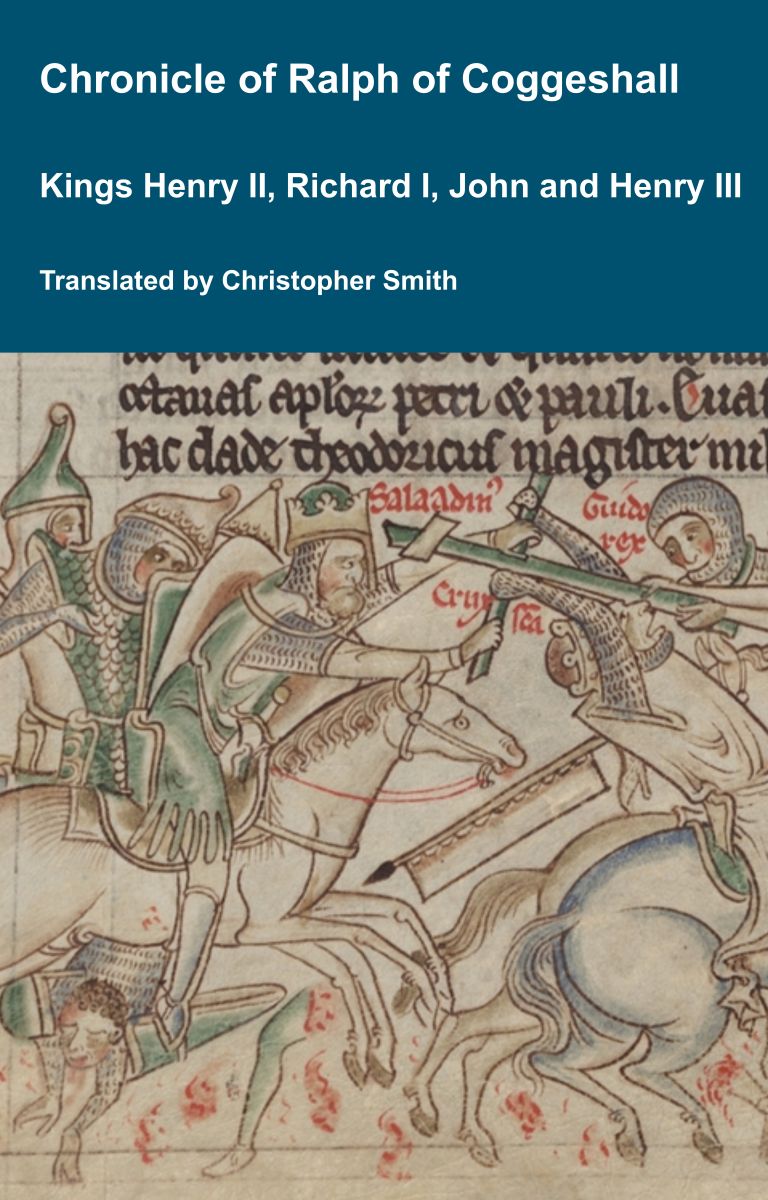
Chronicle of Abbot Ralph of Coggeshall
The Chronicle of Abbot Ralph of Coggeshall (Chronicon Anglicanum) is an indispensable medieval history that brings to life centuries of English and European affairs through the eyes of a learned Cistercian monk. Ralph of Coggeshall, abbot of the Abbey of Coggeshall in Essex in the early 13th century, continued and expanded his community’s chronicle, documenting events from the Norman Conquest of 1066 into the tumultuous reign of King Henry III. Blending eyewitness testimony, careful compilation, and the monastic commitment to record-keeping, this chronicle offers a rare narrative of political intrigue, royal power struggles, and social upheaval in England and beyond. Ralph’s work captures the reigns of pivotal figures such as Richard I and King John, providing invaluable insights into their characters, decisions, and the forces that shaped medieval rule. More than a simple annal, Chronicon Anglicanum conveys the texture of medieval life and governance, making it a rich source for scholars and readers fascinated by English history, monastic authorship, and the shaping of the medieval world.
Available at Amazon in eBook and Paperback format.
NIV. 6 On Herod's birthday the daughter of Herodias danced for the guests and pleased Herod so much 7 that he promised with an oath to give her whatever she asked. 8 Prompted by her mother, she said, "Give me here on a platter the head of John the Baptist.".
NIV. "We have here only five loaves of bread and two fish," they answered.
John Evelyn's Diary. 18th March 1655. Went to London, on purpose to hear that excellent preacher, Dr. Jeremy Taylor [aged 42], on Matt. xiv. 17, showing what were the conditions of obtaining eternal life; also, concerning abatements for unavoidable infirmities, how cast on the accounts of the cross. On the 31st, I made a visit to Dr. Jeremy Taylor, to confer with him about some spiritual matters, using him thenceforward as my ghostly father. I beseech God Almighty to make me ever mindful of, and thankful for, his heavenly assistances!
NIV. And since he could not pay, his master ordered him to be sold, with his wife and children and all that he had, and payment to be made.
John Evelyn's Diary. 27th February 1661. Ash Wednesday. Preached before the King [aged 30] the Bishop of London (Dr. Sheldon [aged 62]) on Matthew xviii. 25, concerning charity and forgiveness.
NIV. Therefore, anyone who swears by the altar swears by it and by everything on it.

John Evelyn's Diary. 23rd November 1679. Dr. Allestree [aged 57] preached before the household on St. Luke xi. 2; Dr. Lloyd [aged 42] on Matt. xxiii. 20, before the King [aged 49], showing with how little reason the Papists applied those words of our blessed Savior to maintain the pretended infallibility they boast of. I never heard a more Christian and excellent discourse; yet were some offended that he seemed to say the Church of Rome was a true church; but it was a captious mistake; for he never affirmed anything that could be more to their reproach, and that such was the present Church of Rome, showing how much it had erred. There was not in this sermon so much as a shadow for censure, no person of all the clergy having testified greater zeal against the errors of the Papists than this pious and most learned person. I dined at the Bishop of Rochester's [aged 54], and then went to St. Paul's to hear that great wit, Dr. Sprat [aged 44], now newly succeeding Dr. Outram, in the cure of St. Margaret's [Map]. His talent was a great memory, never making use of notes, a readiness of expression in a most pure and plain style of words, full of matter, easily delivered.
NIV. I tell you, I will not drink from this fruit of the vine from now on until that day when I drink it new with you in my Father's kingdom.
KJB. But I say unto you, I will not drink henceforth of this fruit of the vine, until that day when I drink it new with you in my Father's kingdom.
John Evelyn's Diary. 28th March 1686. Dr White, Bp. of Peterboro' [aged 58], preach'd in a very eloquent style, on 26 Matthew 29, submission to the will of God on all accidents and at all times.
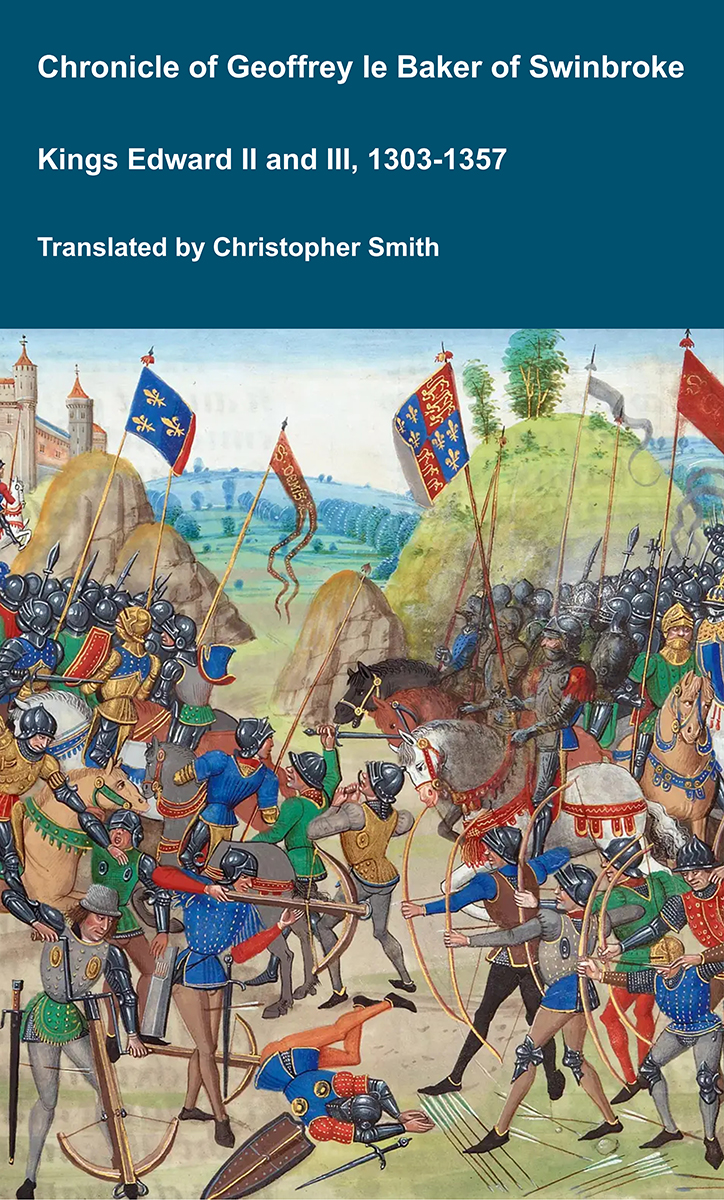
Chronicle of Geoffrey le Baker of Swinbroke
Baker was a secular clerk from Swinbroke, now Swinbrook, an Oxfordshire village two miles east of Burford. His Chronicle describes the events of the period 1303-1356: Gaveston, Bannockburn, Boroughbridge, the murder of King Edward II, the Scottish Wars, Sluys, Crécy, the Black Death, Winchelsea and Poitiers. To quote Herbert Bruce 'it possesses a vigorous and characteristic style, and its value for particular events between 1303 and 1356 has been recognised by its editor and by subsequent writers'. The book provides remarkable detail about the events it describes. Baker's text has been augmented with hundreds of notes, including extracts from other contemporary chronicles, such as the Annales Londonienses, Annales Paulini, Murimuth, Lanercost, Avesbury, Guisborough and Froissart to enrich the reader's understanding. The translation takes as its source the 'Chronicon Galfridi le Baker de Swynebroke' published in 1889, edited by Edward Maunde Thompson.
Available at Amazon in eBook and Paperback format.
NIV. "Teacher, which is the greatest commandment in the Law?" 37 Jesus replied: "Love the Lord your God with all your heart and with all your soul and with all your mind. 38 This is the first and greatest commandment. 39 And the second is like it: 'Love your neighbor as yourself. 40 All the Law and the Prophets hang on these two commandments.".

John Evelyn's Diary. 20th March 1687. The Bishop of Bath and Wells [aged 49] (Dr. Ken) preached at St. Martin's [Map] to a crowd of people not to be expressed, nor the wonderful eloquence of this admirable preacher; the text was Matt. xxvi. 36 to verse 40, describing the bitterness of our Blessed Savior's agony, the ardor of his love, the infinite obligations we have to imitate his patience and resignation; the means by watching against temptations, and over ourselves with fervent prayer to attain it, and the exceeding reward in the end. Upon all which he made most pathetical discourses. The Communion followed, at which I was participant. I afterward dined at Dr. Tenison's [aged 50] with the Bishop and that young, most learned, pious, and excellent preacher, Mr. Wake [aged 30]. In the afternoon, I went to hear Mr. Wake at the newly built church of St. Anne, on Mark viii. 34, upon the subject of taking up the cross, and strenuously behaving ourselves in time of persecution, as this now threatened to be.