

Abbot John Whethamstede’s Chronicle of the Abbey of St Albans
Abbot John Whethamstede's Register aka Chronicle of his second term at the Abbey of St Albans, 1451-1461, is a remarkable text that describes his first-hand experience of the beginning of the Wars of the Roses including the First and Second Battles of St Albans, 1455 and 1461, respectively, their cause, and their consequences, not least on the Abbey itself. His text also includes Loveday, Blore Heath, Northampton, the Act of Accord, Wakefield, and Towton, and ends with the Coronation of King Edward IV. In addition to the events of the Wars of the Roses, Abbot John, or his scribes who wrote the Chronicle, include details in the life of the Abbey such as charters, letters, land exchanges, visits by legates, and disputes, which provide a rich insight into the day-to-day life of the Abbey, and the challenges faced by its Abbot.
Available at Amazon in eBook and Paperback format.
 John Evelyn's Diary January 1658
 John Evelyn's Diary February 1658
 John Evelyn's Diary March 1658
 John Evelyn's Diary May 1658
 John Evelyn's Diary June 1658
 John Evelyn's Diary July 1658
 John Evelyn's Diary August 1658
 John Evelyn's Diary September 1658
 John Evelyn's Diary October 1658
 John Evelyn's Diary December 1658
John Evelyn's Diary 1658 is in John Evelyn's Diary 1650s.
27th January 1658. After six fits of a quartan ague, with which it pleased God to visit him, died my dear son, Richard [aged 5], to our inexpressible grief and affliction, five years and three days old only, but at that tender age a prodigy for wit and understanding; for beauty of body, a very angel; for endowment of mind, of incredible and rare hopes. To give only a little taste of them, and thereby glory to God, who "out of the mouths of babes and infants does sometimes perfect his praises", he had learned all his catechism; at two years and a half old, he could perfectly read any of the English, Latin, French, or Gothic letters, pronouncing the first three languages exactly. He had, before the fifth year, or in that year, not only skill to read most written hands, but to decline all the nouns, conjugate the verbs regular, and most of the irregular; learned out "Puerilis", got by heart almost the entire vocabulary of Latin and French primitives and words, could make congruous syntax, turn English into Latin, and vice versâ, construe and prove what he read, and did the government and use of relatives, verbs, substantives, ellipses, and many figures and tropes, and made a considerable progress in Comenius's "Janua"; began himself to write legibly, and had a strong passion for Greek. The number of verses he could recite was prodigious, and what he remembered of the parts of plays, which he would also act; and, when seeing a Plautus in one's hand, he asked what book it was, and, being told it was comedy, and too difficult for him, he wept for sorrow. Strange was his apt and ingenious application of fables and morals; for he had read Æsop; he had a wonderful disposition to mathematics, having by heart divers propositions of Euclid that were read to him in play, and he would make lines and demonstrate them. As to his piety, astonishing were his applications of Scripture upon occasion, and his sense of God; he had learned all his catechism early, and understood the historical part of the Bible and New Testament to a wonder, how Christ came to redeem mankind, and how, comprehending these necessaries himself, his godfathers were discharged of their promise.
27th January 1658. These and the like illuminations, far exceeding his age and experience, considering the prettiness of his address and behavior, cannot but leave impressions in me at the memory of him. When one told him how many days a Quaker had fasted, he replied that was no wonder; for Christ had said that man should not live by bread alone, but by the Word of God. He would of himself select the most pathetic psalms, and chapters out of Job, to read to his maid during his sickness, telling her, when she pitied him, that all God's children must suffer affliction. He declaimed against the vanities of the world, before he had seen any. Often he would desire those who came to see him to pray by him, and a year before he fell sick, to kneel and pray with him alone in some corner. How thankfully would he receive admonition! how soon be reconciled! how indifferent, yet continually cheerful! He would give grave advice to his brother, John, bear with his impertinences, and say he was but a child. If he heard of or saw any new thing, he was unquiet till he was told how it was made; he brought to us all such difficulties as he found in books, to be expounded. He had learned by heart divers sentences in Latin and Greek, which, on occasion, he would produce even to wonder. He was all life, all prettiness, far from morose, sullen, or childish in anything he said or did. The last time he had been at church (which was at Greenwich), I asked him, according to custom, what he remembered of the sermon; two good things, Father, said he, bonum gratiæ and bonum gloriæ, with a just account of what the preacher said.
27th January 1658. The day before he died, he called to me: and in a more serious manner than usual, told me that for all I loved him so dearly I should give my house, land, and all my fine things to his brother Jack, he should have none of them; and, the next morning, when he found himself ill, and that I persuaded him to keep his hands in bed, he demanded whether he might pray to God with his hands unjoined; and a little after, while in great agony, whether he should not offend God by using his holy name so often calling for ease. What shall I say of his frequent pathetical ejaculations uttered of himself: "Sweet Jesus, save me, deliver me, pardon my sins, let thine angels receive me!" So early knowledge, so much piety and perfection! But thus God, having dressed up a saint fit for himself, would not longer permit him with us, unworthy of the future fruits of this incomparable hopeful blossom. Such a Child I never saw: for such a child I bless God, in whose bosom he is! May I and mine become as this little child, who now follows the child Jesus that Lamb of God in a white robe, whithersoever he goes; even so, Lord Jesus, fiat voluntas tua! Thou gavest him to us, thou hast taken him from us, blessed be the name of the Lord! That I had anything acceptable to thee was from thy grace alone, seeing from me he had nothing but sin, but that thou hast pardoned! blessed be my God for ever, Amen.
27th January 1658. In my opinion, he was suffocated by the women and maids that attended him, and covered him too hot with blankets as he lay in a cradle, near an excessive hot fire in a close room. I suffered him to be opened, when they found that he was what is vulgarly called liver-grown. I caused his body to be coffined in lead, and deposited on the 30th at eight o'clock that night in the church at Deptford, accompanied with divers of my relations and neighbours, among whom I distributed rings with this motto: "Dominus abstulit;" intending, God willing, to have him transported with my own body to be interred in our dormitory in Wotton Church, in my dear native county of Surrey, and to lay my bones and mingle my dust with my fathers, if God be gracious to me, and make me as fit for him as this blessed child was. The Lord Jesus sanctify this and all other my afflictions, Amen.
27th January 1658. Here ends the joy of my life, and for which I go even mourning to the grave.
15th February 1658. The afflicting hand of God being still upon us, it pleased him also to take away from us this morning my youngest son, George, now seven weeks languishing at nurse, breeding teeth, and ending in a dropsy. God's holy will be done! He was buried in Deptford Church, the 17th following.
25th February 1658. Came Dr. Jeremy Taylor [aged 45], and my brothers, with other friends, to visit and condole with us.

7th March 1658. To London, to hear Dr. Taylor [aged 45] in a private house on Luke xiii. 23, 24. After the sermon, followed the blessed Communion, of which I participated. In the afternoon, Dr. Gunning [aged 44], at Exeter House [Map], expounding part of the Creed.
7th March 1658. This had been the severest winter that any man alive had known in England. The crows' feet were frozen to their prey. Islands of ice inclosed both fish and fowl frozen, and some persons in their boats.
15th May 1658. was a public fast, to avert an epidemical sickness, very mortal this spring.
20th May 1658. I went to see a coach race in Hyde Park [Map], and collationed in Spring Garden.
23rd May 1658. Dr. Manton, the famous Presbyterian, preached at Covent Garden [Map], on Matthew vi. 10, showing what the kingdom of God was, how pray for it, etc.
23rd May 1658. There was now a collection for persecuted and sequestered Ministers of the Church of England, whereof divers are in prison. A sad day! The Church now in dens and caves of the earth.
31st May 1658. I went to visit my Lady Peterborough [aged 55], whose son, Mr. Mordaunt [aged 31], prisoner in the Tower [Map], was now on his trial, and acquitted but by one voice; but that holy martyr, Dr. Hewer, was condemned to die without law, jury, or justice, but by a mock Council of State, as they called it. A dangerous, treacherous time!
Abbot John Whethamstede’s Chronicle of the Abbey of St Albans
Abbot John Whethamstede's Register aka Chronicle of his second term at the Abbey of St Albans, 1451-1461, is a remarkable text that describes his first-hand experience of the beginning of the Wars of the Roses including the First and Second Battles of St Albans, 1455 and 1461, respectively, their cause, and their consequences, not least on the Abbey itself. His text also includes Loveday, Blore Heath, Northampton, the Act of Accord, Wakefield, and Towton, and ends with the Coronation of King Edward IV. In addition to the events of the Wars of the Roses, Abbot John, or his scribes who wrote the Chronicle, include details in the life of the Abbey such as charters, letters, land exchanges, visits by legates, and disputes, which provide a rich insight into the day-to-day life of the Abbey, and the challenges faced by its Abbot.
Available at Amazon in eBook and Paperback format.
2nd June 1658. An extraordinary storm of hail and rain, the season as cold as winter, the wind northerly near six months.
3rd June 1658. A large whale was taken between my land abutting on the Thames and Greenwich, Kent [Map], which drew an infinite concourse to see it, by water, horse, coach, and on foot, from London, and all parts. It appeared first below Greenwich, Kent [Map] at low water, for at high water it would have destroyed all the boats, but lying now in shallow water encompassed with boats, after a long conflict, it was killed with a harping iron, struck in the head, out of which spouted blood and water by two tunnels; and after a horrid groan, it ran quite on shore, and died. Its length was fifty-eight feet, height sixteen; black skinned, like coach leather; very small eyes, great tail, only two small fins, a peaked snout and a mouth so wide, that divers men might have stood upright in it; no teeth, but sucked the slime only as through a grate of that bone which we call whalebone; the throat yet so narrow, as would not have admitted the least of fishes. The extremes of the cetaceous bones hang downward from the upper jaw, and are hairy toward the ends and bottom within side: all of it prodigious; but in nothing more wonderful than that an animal of so great a bulk should be nourished only by slime through those grates.
8th June 1658. That excellent preacher and holy man, Dr. Hewer, was martyred for having intelligence with his Majesty [aged 28], through the Lord Marquis of Ormond [aged 47].


9th June 1658. I went to see the Earl of Northumberland's [aged 55] pictures, whereof that of the Venetian Senators was one of the best of Titian's and another of Andrea del Sarto, viz, a Madonna, Christ, St. John, and an Old Woman; a St. Catherine of Da Vinci, with divers portraits of Vandyck; a Nativity of Georgioni; the last of our blessed Kings (Charles I.), and the Duke of York, by Lely [aged 39], a Rosary by the famous Jesuits of Brussels, and several more. This was in Suffolk House, Suffolk Street: the new front toward the gardens is tolerable, were it not drowned by a too massy and clumsy pair of stairs of stone, without any neat invention.


10th June 1658. I went to see the Medical Garden at Westminster, well stored with plants, under Morgan, a very skillful botanist.
26th June 1658. To Eltham, to visit honest Mr. Owen.
3rd July 1658. To London, and dined with Mr. Henshaw [aged 40], Mr. Dorell, and Mr. Ashmole [aged 41], founder of the Oxford repository of rarities [Map], with divers doctors of physic and virtuosos.


15th July 1658. Came to see my Lord Kilmurry and Lady, Sir Robert Needham, Mr. Offley, and two daughters of my Lord Willoughby, of Parham.
3rd August 1658. Went to Sir John Evelyn at Godstone, Surrey. The place is excellent, but might be improved by turning some offices of the house, and removing the garden. The house being a noble fabric, though not comparable to what was first built by my uncle, who was master of all the powder mills.
5th August 1658. We went to Squirries to visit my Cousin Leech, daughter to Sir John; a pretty, finely wooded, well watered seat, the stables good, the house old, but convenient. 6th. Returned to Wotton, Surrey [Map].
10th August 1658. I dined at Mr. Carew Raleigh's [aged 53], at Horsley, son to the famous Sir Walter.


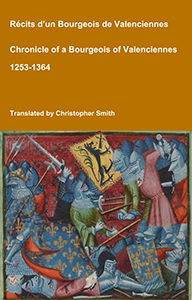
Chronicle of a Bourgeois of Valenciennes
Récits d’un bourgeois de Valenciennes aka The Chronicle of a Bourgeois of Valenciennes is a vivid 14th-century vernacular chronicle written by an anonymous urban chronicler from Valenciennes in the County of Hainaut. It survives in a manuscript that describes local and regional history from about 1253 to 1366, blending chronology, narrative episodes, and eyewitness-style accounts of political, military, and social events in medieval France, Flanders, and the Low Countries. The work begins with a chronological framework of events affecting Valenciennes and its region under rulers such as King Philip VI of France and the shifting allegiances of local nobility. It includes accounts of conflicts, sieges, diplomatic manoeuvres, and the impact of broader struggles like the Hundred Years’ War on urban life in Hainaut. Written from the perspective of a burgher (bourgeois) rather than a monastery or royal court, the chronicle offers a rare lay viewpoint on high politics and warfare, reflecting how merchants, townspeople, and civic institutions experienced the turbulence of the 13th and 14th centuries. Its narrative style combines straightforward reporting of events with moral and civic observations, making it a valuable source for readers interested in medieval urban society, regional politics, and the lived experience of war and governance in pre-modern Europe.
Available at Amazon in eBook and Paperback format.
14th August 1658. We went to Durdans [at Epsom] to a challenged match at bowls for £10, which we won.
18th August 1658. To Sir Ambrose Browne, at Betchworth Castle, in that tempestuous wind which threw down my greatest trees at Sayes Court [Map], and did so much mischief all over England. It continued the whole night; and, till three in the afternoon of the next day, in the southwest, and destroyed all our winter fruit.

Death and Funeral of Oliver Cromwell3rd September 1658. Died that arch-rebel, Oliver Cromwell [aged 59], called Protector.
16th September 1658. Was published my translation of St. Chrysostom on "Education of Children", which I dedicated to both my brothers to comfort them on the loss of their children.
21st September 1658. My Lord Berkeley [deceased], of Berkeley Castle, invited me to dinner.
26th September 1658. Mr. King preached at Ashted, on Proverbs xv. 24; a Quaker would have disputed with him. In the afternoon, we heard Dr. Hacket [aged 66] (since Bishop of Litchfield) at Cheam, Surrey, where the family of the Lumleys lie buried.
27th September 1658. To Beddington, Surrey, that ancient seat of the Carews, a fine old hall, but a scambling house, famous for the first orange garden in England, being now overgrown trees, planted in the ground, and secured in winter with a wooden tabernacle and stoves. This seat is rarely watered, lying low, and environed with good pastures. The pomegranates bear here. To the house is also added a fine park. Thence, to Carshalton, excellently watered, and capable of being made a most delicious seat, being on the sweet downs, and a champaign about it full planted with walnut and cherry trees, which afford a considerable rent.
27th September 1658. Riding over these downs, and discoursing with the shepherds, I found that digging about the bottom near Sir Christopher Buckle's, near Banstead, divers medals have been found, both copper and silver, with foundations of houses, urns, etc. Here, indeed, anciently stood a city of the Romans. See Antonine's "Itineraries"..
29th September 1658. I returned home, after a ten weeks' absence.
2nd October 1658. I went to London, to receive the Holy Sacrament.
3d, Dr. Wild preached in a private place on Isaiah i. 4, showing the parallel between the sins of Israel and those of England. In the afternoon, Mr. Hall (son to Joseph, Bishop of Norwich) on 1 Cor. vi. 2, of the dignity of the Saints; a most excellent discourse.
4th October 1658. I dined with the Holland ambassador, at Derby House: returning, I diverted to see a very WHITE RAVEN, bred in Cumberland; also a porcupine, of that kind that shoots its quills, of which see Claudian; it was headed like a rat, the fore feet like a badger, the hind feet like a bear.
19th October 1658. I was summoned to London, by the commissioners for new buildings; afterward, to the commission of sewers; but because there was an oath to be taken of fidelity to the Government as now constituted without a king, I got to be excused, and returned home.
22nd October 1658. Saw the superb funeral of the protector [deceased]. He was carried from Somerset House [Map] in a velvet bed of state, drawn by six horses, housed with the same; the pall held by his new lords; Oliver lying in effigy, in royal robes, and crowned with a crown, sceptre, and globe, like a king. The pendants and guidons were carried by the officers of the army; the imperial banners, achievements, etc., by the heralds in their coats; a rich caparisoned horse, embroidered all over with gold; a knight of honor, armed cap-a-pie, and, after all, his guards, soldiers, and innumerable mourners. In this equipage, they proceeded to Westminster: but it was the most joyful funeral I ever saw; for there were none that cried but dogs, which the soldiers hooted away with a barbarous noise, drinking and taking tobacco in the streets as they went.
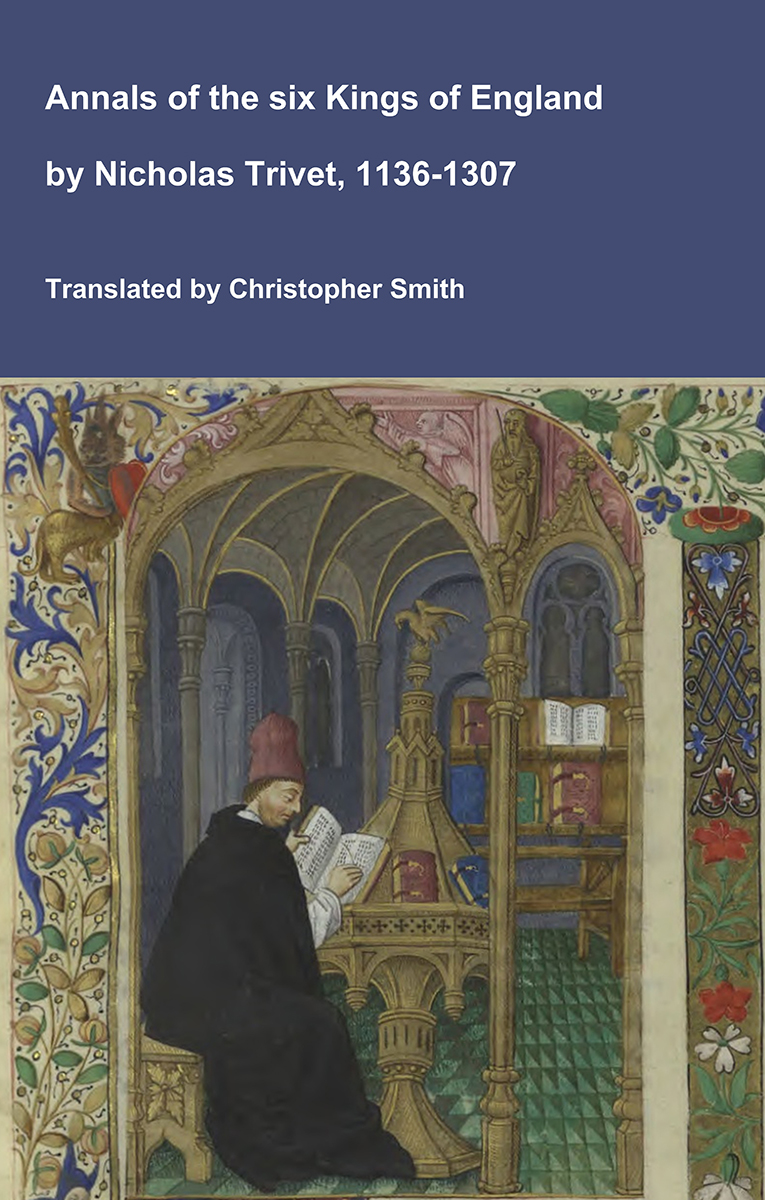
Annals of the six Kings of England by Nicholas Trivet
Translation of the Annals of the Six Kings of England by that traces the rise and rule of the Angevin aka Plantagenet dynasty from the mid-12th to early 14th century. Written by the Dominican scholar Nicholas Trivet, the work offers a vivid account of English history from the reign of King Stephen through to the death of King Edward I, blending political narrative with moral reflection. Covering the reigns of six monarchs—from Stephen to Edward I—the chronicle explores royal authority, rebellion, war, and the shifting balance between crown, church, and nobility. Trivet provides detailed insight into defining moments such as baronial conflicts, Anglo-French rivalry, and the consolidation of royal power under Edward I, whose reign he describes with particular immediacy. The Annals combines careful year-by-year reporting with thoughtful interpretation, presenting history not merely as a sequence of events but as a moral and political lesson. Ideal for readers interested in medieval history, kingship, and the origins of the English state, this chronicle remains a valuable and accessible window into the turbulent world of the Plantagenet kings.
Available at Amazon in eBook and Paperback format.
22nd October 1658. I returned not home till the 17th of November.
22nd October 1658. I was summoned again to London by the commissioners for new foundations to be erected within such a distance of London.
6th December 1658. Now was published my "French Gardener", the first and best of the kind that introduced the use of the olitory garden to any purpose.
23rd December 1658. I went with my wife [aged 23] to keep Christmas at my cousin, George Tuke's, at Cressing Temple, in Essex. Lay that night at Brentwood, Essex [Map].
25th December 1658. Here was no public service, but what we privately used. I blessed God for his mercies the year past; and 1st of January, begged a continuance of them. Thus, for three Sundays, by reason of the incumbent's death, here was neither praying nor preaching, though there was a chapel in the house.