

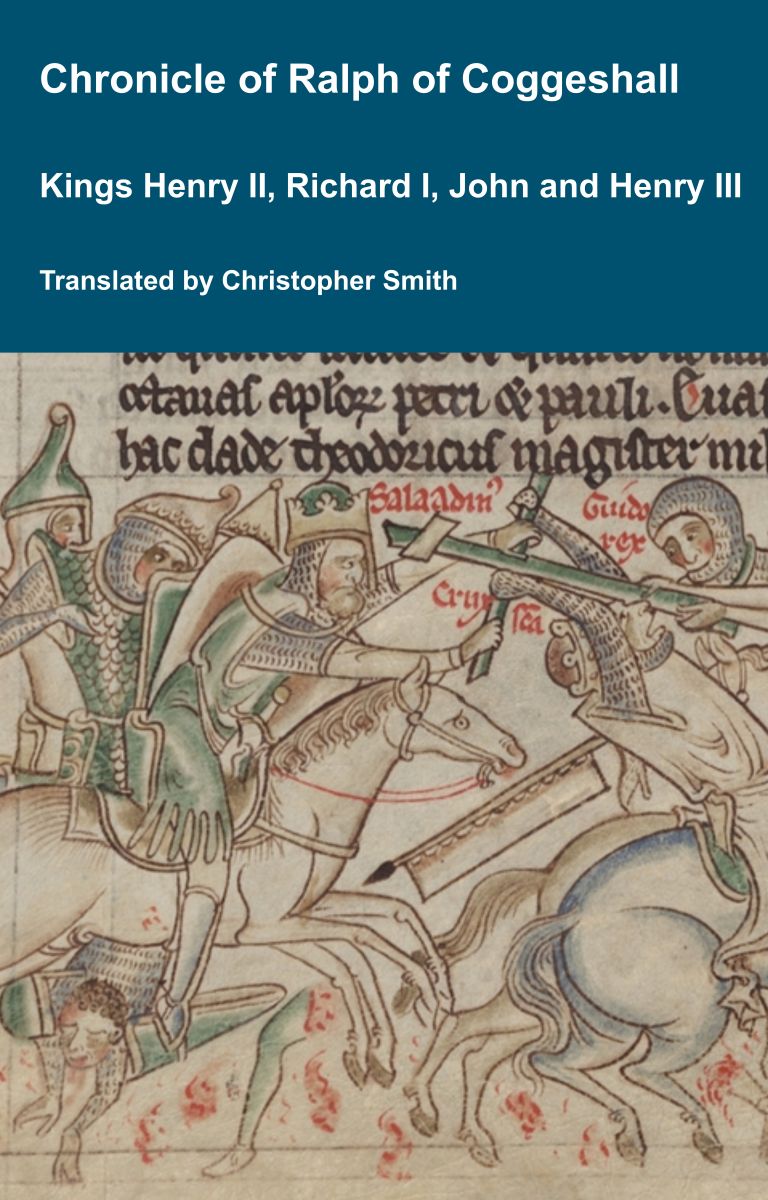
Chronicle of Abbot Ralph of Coggeshall
The Chronicle of Abbot Ralph of Coggeshall (Chronicon Anglicanum) is an indispensable medieval history that brings to life centuries of English and European affairs through the eyes of a learned Cistercian monk. Ralph of Coggeshall, abbot of the Abbey of Coggeshall in Essex in the early 13th century, continued and expanded his community’s chronicle, documenting events from the Norman Conquest of 1066 into the tumultuous reign of King Henry III. Blending eyewitness testimony, careful compilation, and the monastic commitment to record-keeping, this chronicle offers a rare narrative of political intrigue, royal power struggles, and social upheaval in England and beyond. Ralph’s work captures the reigns of pivotal figures such as Richard I and King John, providing invaluable insights into their characters, decisions, and the forces that shaped medieval rule. More than a simple annal, Chronicon Anglicanum conveys the texture of medieval life and governance, making it a rich source for scholars and readers fascinated by English history, monastic authorship, and the shaping of the medieval world.
Available at Amazon in eBook and Paperback format.
Old and New London is in Victorian Books.
St. Thomas à Watering [Map] was once the boundary of the City liberties, and in the "olden time," when the lord mayor and sheriffs "in great state" crossed the water to open Southwark Fair and to inspect the City boundaries, the City magistrates continued either to St. George's Church, Newington Bridge, or "to the stones pointing out the City liberties at St. Thomas à Watering." The precise situation was as near as possible that part of the Old Kent Road which is intersected by the Albany Road, and the memory of the place is still kept alive by St. Thomas's Road, close by, and by the tavern-signs in the neighbourhood. "At the commencement of the present century," writes Mr. Blanch, in his history of "Ye Parishe of Cam[b]erwell," "there was a stream here which served as a common sewer, across which a bridge was built; and in going from Camberwell into Newington or Southwark, it was not unusual for people to say they were going over the water. The current from the Peckham hills was at times so strong as to overflow at least two acres of ground."
St. Thomas à Waterings was situated close to the second milestone on the Old Kent Road, and was so called from a brook or spring, dedicated to St. Thomas à Becket. Chaucer's pilgrims, as we have seen in a previous chapter, passed it on their way to the shrine of St. Thomas à Becket at Canterbury:-
"And forth we riden a litel more than pas,
Unto the watering of Seint Thomàs,
And then our host began his hors arrest."
Ben Jonson, in The New Inn, makes mention of the spot in the following lines:-
"These are the arts
Or seven liberal deadly sciences,
Of pagery, or rather paganism,
Note A. the tides run! to which if he apply him,
He may perhaps take a degree at Tyburn
A year the earlier; come to read a lecture
Upon Aquinas at St. Thomas à Waterings."
This spot was in the old Tudor days the place of execution for the northern parts of Surrey; and here the Vicar of Wandsworth, his chaplain, and two other persons of his household, were hung, drawn, and quartered in 1539 for denying the supremacy of Henry VIII. in matters of faith.
In 1553 (January 3rd) "was caried from the Marshalleshe [Map] unto Saynt Thomas of Wateryng [Map] a talman, and went thedur with the rope a-bowt ys neke, and so he hanggd a whylle, and the rope burst, and a whylle after and then they went for a-nodur rope, and so lyke-wyss he burst ytt and fell to the ground, and so he skapyd with his lyffe."

3rd October 1559. On the 3rd of October, 1559, a "nuw payre of galows was sett up at Sant Thomas of Watering [Map];" and on the 12th of February, 1650-1, "was reynyd [arraigned] in Westmynster Hall v men, iij was for burglare, and ij were cutpurses, and cast to be hanged at Sant Thomas of Watering [Map]: one was a gentyllman."
One of the quarters of Sir Thomas Wyatt, who was beheaded for rebellion in April, 1554, was exposed at this place;
18th June 1556. And on the 18th of June, 1556, a younger son [Note. Probably Henry Sandes] of Lord Sandys [aged 59] was executed here [Map] for robbing a cart, coming from a fair, at Beverley. The booty was estimated at about four thousand pounds.
In 1559 five men were executed here [Map]. Macbyn, in his Diary, thus records the event:-"The ix day of Feybruary at after-none a-bowt iij of the cloke, v men wher hangyd at Sant Thomas of watherynges; one was captyn Jenkes, and (blank) Warde, and (blank) Walles, and (blank) Beymont, and a-nodur man, and they were browth [brought] up in ware [war] all their lyffes,-for a grett robere done."
1593. John Henry, the author of some of the "Martin Mar-Prelate Tracts," was hung here [Map] in 1593; and Franklin, one of the agents implicated in the murder of Sir Thomas Overbury [aged 12], was executed at the same place in 1615.
1740. The last persons executed at St. Thomas à Watering [Map] were a father and son, who suffered the penalty of the law for murder about the year 1740.