

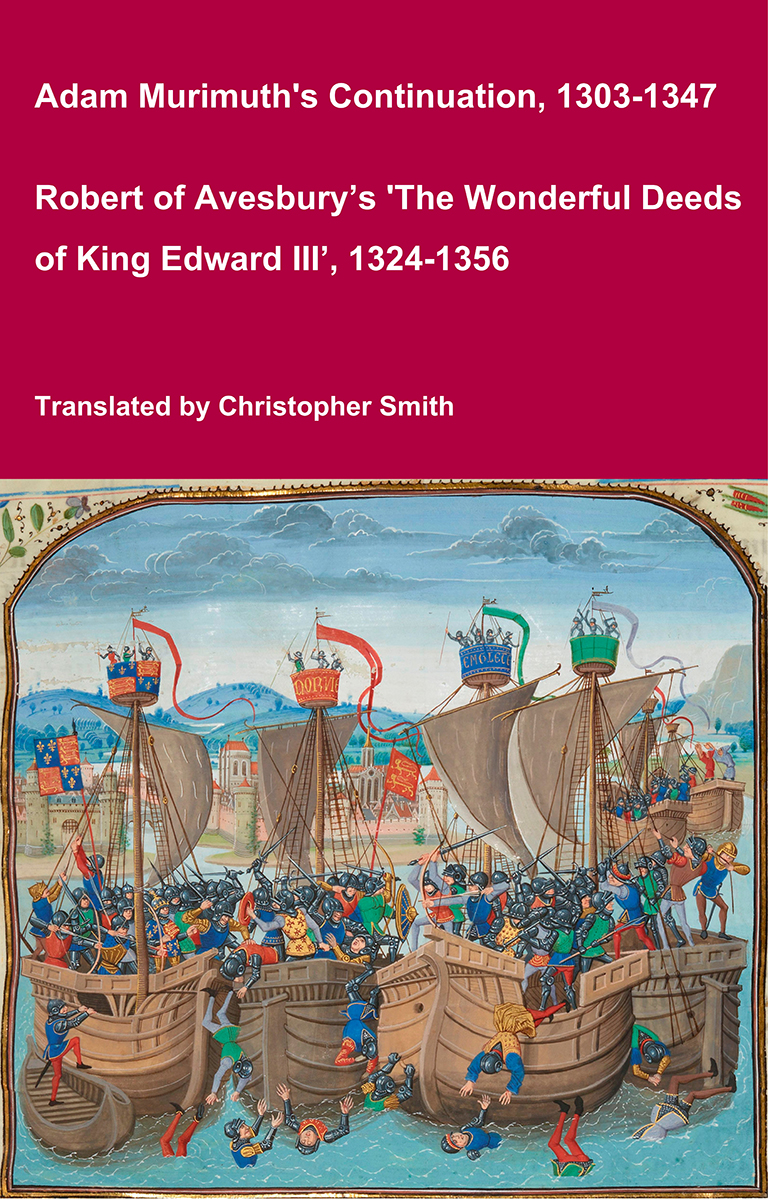
Adam Murimuth's Continuation and Robert of Avesbury’s 'The Wonderful Deeds of King Edward III'
This volume brings together two of the most important contemporary chronicles for the reign of Edward III and the opening phases of the Hundred Years’ War. Written in Latin by English clerical observers, these texts provide a vivid and authoritative window into the political, diplomatic, and military history of fourteenth-century England and its continental ambitions. Adam Murimuth Continuatio's Chronicarum continues an earlier chronicle into the mid-fourteenth century, offering concise but valuable notices on royal policy, foreign relations, and ecclesiastical affairs. Its annalistic structure makes it especially useful for establishing chronology and tracing the development of events year by year. Complementing it, Robert of Avesbury’s De gestis mirabilibus regis Edwardi tertii is a rich documentary chronicle preserving letters, treaties, and official records alongside narrative passages. It is an indispensable source for understanding Edward III’s claim to the French crown, the conduct of war, and the mechanisms of medieval diplomacy. Together, these works offer scholars, students, and enthusiasts a reliable and unembellished account of a transformative period in English and European history. Essential for anyone interested in medieval chronicles, the Hundred Years’ War, or the reign of Edward III.
Available at Amazon in eBook and Paperback format.
Wriothesley's Chronicle 1540 is in Wriothesley's Chronicle.

This yeare, the 28th dale of Julie [1540] Sir Thomas Crumwell [aged 55], Earle of Essex, was beheaded at the Tower Hill, and Walter Lord named Hungerforde [aged 37] was beheaded with him, also for treason of boggery,d their heades sett on London Bridge, and their bodies were buried within the Tower of London; they were condemned by the whole bodie of this last Perliament,e Thomas Cromwell for heresie, treason, and fellonie, and extortion.f
Note d. Lord Hungerford at the hour of his death seemed so unquiet that many judged him rather frenzied than otherwise; he suffered, as it was said, for buggery. Stow.
Note e. The unanimity of Parliament is attested by the entries on the Journals, "Hodie (June 19) lecta est pro secundo et tertio, villa attincturs Thorns Comitis Essex, et communi omnium procerum tunc prssentium concessu, nemine discrepante, expedita est."
Note f. The summary process of an attainder without a trial, which Crumwell had first devised against the aged Countess of Salisbury [aged 66], was resorted to against himself. He was declared by his peers a manifold traitor and detestable heretic, but his real crime was having urged his royal master, as a means of advancing his grand Protestant scheme, to solicit the hand of Anne of Cleves.
30th July 1540. This yeare, the thirtith daie of Julie, 1540,g were drawen from the Tower of London into Smythfield theise persons follwinge, that is to saie: Doctor Barnes,h Richard Fetherston, William Jerome, Vicar of Stepney, Doctor Edward Powell, Thomas Jerrard, Parson of Honi Lane, and Thomas Abell,a priestes, of which three of them, that is to say, Barnes, Jherome, and Garrarde, were brent for heresie,b condemned by the whole bodie of the Perliament,c and Fetherston, Powell, and Abell were hanged, their bowells brenned, headed and quartered, in the said place of Smythfield, for treason against the Kinges Majestie,d and condemned of the same by the whole Perliament.
Note g. The King's councils being at this time directed by Norfolk and Gardiner, the law of the Six Articles was enforced with rigour against the Protestants.
Note h. Robert Barnes, D.D. who had been the cause of Lambert's execution. He had drawn upon himself the resentment of Bishop Gardiner by his sermon at Paul's Cross, in which he had bitterlj inreighed against that prelate as a bigoted Roman Catholic.
Note a. Thomas Abley in Fuller's Church History.
Note b. A stranger, standing by, did wonder, as well he might, of what religion the King was, his sword cutting on both sides, Protestants being burnt for heretics, and Papists hanged for traitors.— Fuller's Church History, p. 285.
Note c. They were condemned by a bill of attainder in parliament, without trial.
Note d. For denying the King's supremacy, and affirming his marriage with Queen Katharine to be good, of the which argument Dr. Powell wrote a book, printed in quarto, and I'have seen it. — Stow.
4th August 1540. This yeare, the fowerth daie of Awgust, were drawen from the Tower of London to Tiburne [Map], Giles Heron [deceased], gentleman, Clement Philpott, gentleman, late of Callis, and servant to the Lord Lile [aged 76]e, Darbie Gynning, Edrnonde Bryndholme, priest, William Horn, late a lay brother of the Charter Howse of London, and another,f with six persons more, were there hanged drawen, and quartered, and one Charles Carow, gentleman, was that daie hanged for robbing of my Ladie Carowe, all which persons were attaynted by the whole Parliament for treason.
Note e. Arthur Plantagenet, Viscount Lisle, was Deputy of Calais from 1533 to 1540, when he was recalled, and died a prisoner in the Tower 1542.
Note f. These names differ considerably from those given in Stow, viz. Giles Home, gentleman, Clement Phillip, gentleman, of Calais, and servant to the Lord Lisle, Darby Gening, Edmond Bromholme, priest, chaplain to the Lord Lisle, William Home, Laurence Cooke, Prior of Doncaster, and Bobert Bird.
This yeare, the eight daie of Awgust [1540], being Sondaie, the King [aged 49] was maried to [Note. The marriage was made public] Katherin Hawarde [aged 17], daughter of the late Edmond Hawarda deceased, and brother to the Duke of Norfolke [aged 67]b, at his manner of Hampton Court [Map], and that dale she dined in her great chamber under the cloath of estate, and was their proclaymed Queene of Englande.
Note a. By Joyce, daughter of Sir Richard Culpepper, knt. She was also cousin to Anne Boleyn, but of very different character and persuasion, being a zealous partisan of the Church of Rome, and wholly under the guidance of her bigoted uncle the Duke of Norfolk.
Note b. Lord Edmund Howard was son of Thomas second Duke of Norfolk, and brother to Thomas third Duke.


Also this yeare at the last Perliament, which was dissolved in Julie last past, was granted to the King 4 xvthes and tow subsidies of 12d. the of landes and goodes, and 2s. the for strangers, and for moveables six pence the £, and strangers 12d.; to be paid the xvthes in fower yeares next ymediatlie ensewinge, and the subsedie in tow yeares next ensuing this Perliamente, the King to take the best landes in moveables; also the spiritualtie hath granted a dismee of 4s. the pound, to be paide in tow yeares ymediatlie after this Perliament.
7th September 1540. This yeare, on the eaven of the Nativitie of Our Ladie, was taken in the Thames about Dartforde by Greene wych, dolphines, tow females and one male, which said females had followed the male out of the sea, and were first spied about Erith, and so followed by fishermen with nettes, and were taken all together.
11th September 1540. Also the 11th daie of September was hanged in the Morefield [Map] before Betchlem Bridgee a stranger, named James Rynacyacyf, a Florentine borne, which said James had slaine one Capon, a Florentine borne, in a garden at Bethlem, on Bartholomew evin last past, very wilfullie, and had stabbed him in divers partes of his bodie with a dagger, having one wounde in his backe of six inches deepe.
Note e. Bethlehem Hospital originally stood on the east side of that part of the mere or moor afterwards known as Moorfields, from which it was divided by a large and deep ditch, over which was a bridge.
Note f. Stow calls him "Rinatian".
This yeare was a hott sommer and drie, so that no raine fell from June till eight daies after Michaelmas, so that in divers partes of this realme the people caried their cattle six or seven miles to watter them, and also much cattle died; and also their rayned strang sicknes among the people in this realme, as laskes a and hott agues, and also pestilence, wherof many people died; wherfore the Kinges Majestie sent out commissions through this realme to everie par[ticular] bishopp to exhort the people to fall to prayer and to go in procession in everie parish in the hole realme; and also my Lord Mayer and the Bishopp of London caused generall procession to be once in the weeke through the cittie, which beganne the 17th daie of September, being Fridaie in the Ember weeke, and had a sermon made in Paules quire before the procession went, and used it so everie Fridaie, which was a godlie waie.
HENRICI VIII. Anno 32.
This yeare the Terme was rejornede till Crastino Animarum; and also the major tooke his oth at the Tower.
This yeare, the tenthc of December, Rafe Egerton, of London, being one of my Lord Chauncelors servantes, and one Thomas Hermane, sometyme servant with Fleetwood, one of my Lord Chancelors gentlemen, were drawen from the Towre of London to Tiburne [Map], and there hanged and quartered for counterfeeting the Kinges Great Seale.
Note c. The 22nd of December. Stow.
Note e. Thomas Harman, servant to Master Flight-wood. Stow.