

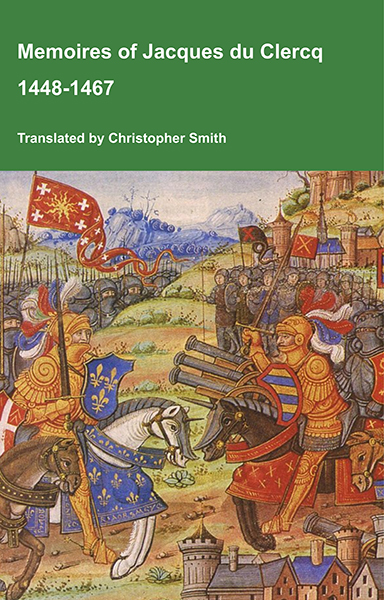
This is a translation of the 'Memoires of Jacques du Clercq', published in 1823 in two volumes, edited by Frederic, Baron de Reissenberg. In his introduction Reissenberg writes: 'Jacques du Clercq tells us that he was born in 1424, and that he was a licentiate in law and a counsellor to Philip the Good, Duke of Burgundy, in the castellany of Douai, Lille, and Orchies. It appears that he established his residence at Arras. In 1446, he married the daughter of Baldwin de la Lacherie, a gentleman who lived in Lille. We read in the fifth book of his Memoirs that his father, also named Jacques du Clercq, had married a lady of the Le Camelin family, from Compiègne. His ancestors, always attached to the counts of Flanders, had constantly served them, whether in their councils or in their armies.' The Memoires cover a period of nineteen years beginning in in 1448, ending in in 1467. It appears that the author had intended to extend the Memoirs beyond that date; no doubt illness or death prevented him from carrying out this plan. As Reissenberg writes the 'merit of this work lies in the simplicity of its narrative, in its tone of good faith, and in a certain air of frankness which naturally wins the reader’s confidence.' Du Clercq ranges from events of national and international importance, including events of the Wars of the Roses in England, to simple, everyday local events such as marriages, robberies, murders, trials and deaths, including that of his own father in Book 5; one of his last entries.
Available at Amazon in eBook and Paperback format.
Alfred Gatley is in Sculptors.
On 15th January 1816 Alfred Gatley was born at Spring Cottage aka House, Kerridge.
In 1839 Alfred Gatley (age 22) became a student at the Royal Academy, where he gained silver medals for modelling from the antique, and in 1841 for the first time exhibited a "Bust of a Gentleman".
1847. Alfred Gatley (age 30). Elizabeth Swindells. Town Hall, Bollington.
1847. Alfred Gatley (age 30). George Swindells. Town Hall, Bollington.
1850 to 1853. Alfred Gatley (age 33). "Echo", 1850 1853, Gawsworth Hall, Cheshire [Map]. Gatley sculpted at least three versions of Echo on request from clients. One of these is at Gawsworth, another is thought to be in Ireland, and the present whereabouts of the third is not known. One copy was sold at Christies in 1993, and sold on in 1997 by Lord & Lady White of Hull to an unidentified buyer for $29,900.


1851. Alfred Gatley (age 34). Memorial to Elizabeth Clayton of the Kerridge mining family headed by William Clayton, 1851, in Norbury church.
In 1851 Alfred Gatley (age 34) produced a bust in marble of Augustus Henry Vernon 6th Baron Vernon (age 21) of Sudbury Hall, Derbyshire [Map].
In 1852 Alfred Gatley (age 35) moved to Rome where he took a studio on the Pincian Hill.
In 1862 Alfred Gatley (age 45) exhibted his bas-relief of 'Pharaoh and his Hosts' at the International Exhibition in London. His last visit to England.
This is a translation of the 'Memoires of Jacques du Clercq', published in 1823 in two volumes, edited by Frederic, Baron de Reissenberg. In his introduction Reissenberg writes: 'Jacques du Clercq tells us that he was born in 1424, and that he was a licentiate in law and a counsellor to Philip the Good, Duke of Burgundy, in the castellany of Douai, Lille, and Orchies. It appears that he established his residence at Arras. In 1446, he married the daughter of Baldwin de la Lacherie, a gentleman who lived in Lille. We read in the fifth book of his Memoirs that his father, also named Jacques du Clercq, had married a lady of the Le Camelin family, from Compiègne. His ancestors, always attached to the counts of Flanders, had constantly served them, whether in their councils or in their armies.' The Memoires cover a period of nineteen years beginning in in 1448, ending in in 1467. It appears that the author had intended to extend the Memoirs beyond that date; no doubt illness or death prevented him from carrying out this plan. As Reissenberg writes the 'merit of this work lies in the simplicity of its narrative, in its tone of good faith, and in a certain air of frankness which naturally wins the reader’s confidence.' Du Clercq ranges from events of national and international importance, including events of the Wars of the Roses in England, to simple, everyday local events such as marriages, robberies, murders, trials and deaths, including that of his own father in Book 5; one of his last entries.
Available at Amazon in eBook and Paperback format.
On 28th June 1863 Alfred Gatley (age 47) died. He was buried in the Protestant aka English Cemetery, Rome. His grave carries the Latin inscription: "... great in his works, a loyal citizen, beloved by many and respected by all. He had a kindness of heart, and a hatred of all that was false."