

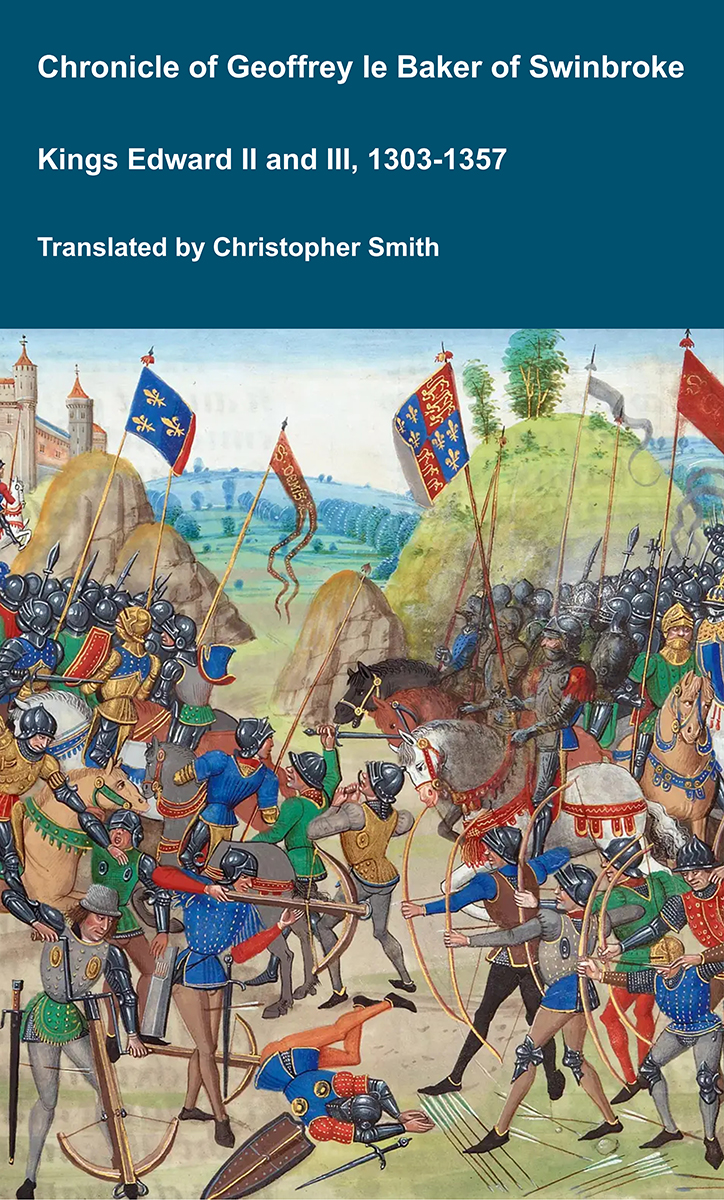
Chronicle of Geoffrey le Baker of Swinbroke
Baker was a secular clerk from Swinbroke, now Swinbrook, an Oxfordshire village two miles east of Burford. His Chronicle describes the events of the period 1303-1356: Gaveston, Bannockburn, Boroughbridge, the murder of King Edward II, the Scottish Wars, Sluys, Crécy, the Black Death, Winchelsea and Poitiers. To quote Herbert Bruce 'it possesses a vigorous and characteristic style, and its value for particular events between 1303 and 1356 has been recognised by its editor and by subsequent writers'. The book provides remarkable detail about the events it describes. Baker's text has been augmented with hundreds of notes, including extracts from other contemporary chronicles, such as the Annales Londonienses, Annales Paulini, Murimuth, Lanercost, Avesbury, Guisborough and Froissart to enrich the reader's understanding. The translation takes as its source the 'Chronicon Galfridi le Baker de Swynebroke' published in 1889, edited by Edward Maunde Thompson.
Available at Amazon in eBook and Paperback format.
Paternal Family Tree: Paulett
Around 1457 Amyas Paulett was born to William Paulett [aged 52].
In or before 1480 Amyas Paulett [aged 22] and Margaret Paulet [aged 17] were married. They were second cousin once removed.
Around 1480 [his wife] Margaret Paulet [aged 18] died.
In or after 1480 Amyas Paulett [aged 23] and Laura Kellaway [aged 17] were married.
In October 1488 [his father] William Paulett [aged 83] died.
Polydore Vergil [1470-1555]. Around 20th September 1497. Learning of his enemies' departure, Henry [aged 40] headed straight for Taunton, Somerset [Map]. Duke Edward of Buckingham [aged 19] arrived there, a young man endowed with great spirit and virtue of character, and he was followed by a host of right noble knights with armour and all the other things requisite for warfare. In that number were Giles Briggs, Alexander Baynham, Maurice Berkeley, Robert Tames, John Guise, Robert Point, Henry Vernon, John Mortimer, Thomas Tremayle, Edward Sutton, Amyas Powlet [aged 40], John Bicknell, John Sapcot, Hugh Luterell, John Wadham and his son Nicholas, John Speck, Richard Beauchamp of St. Amand, Francis Cheney, Rogerd Tokett, Thomas Long, Nicholas Lattimer, John d'Urbeville, William Storton, Roger Newberg, William Martin, Thomas Lind, Henry Rogers, Walter Hungerford, John Semery, Edward Carell, Maurice Borroughs, William Norris, John Langford, Richard Corbett, Thomas Blount, Richard Lacon, Thomas Cornwallis, and many other excellent soldiers. Meanwhile, when the king had come up, either to avoid delaying the fight or fearing the fortune of war, he sent ahead Robert Lord Broke, Richard Thomas, and Giles Daubney [aged 46] to begin the battle, while he followed after, so that, when he saw the battle begin, he could either come to the aid of his men or launch a simultaneous attack on the enemy rear. But the king's plan was unnecessary. For Peter [aged 23] was so far from standing his ground, that after he learned the enemy were in arms, he furtively slipped away in the night and quickly fled to the asylum at Beaulieu Abbey [Map]. Whether he did this out of cowardice (with which he was well supplied), or because he suspected trickery, is not known, but it is well enough agreed that it was a good thing for the king that he was not compelled to come to blows with the Cornishmen, whose strength was so enhanced by despair that they had all determined on conquering or dying to the last man in that battle.


Polydore Vergil [1470-1555]. [After 4th October 1497]. A rumor came to Flanders that Peter [aged 23] had achieved nothing, but rather was in chains, and this brought Princess Margaret [aged 51] many tears, for she had spent many fearful nights waiting news of his doings. Having done these things with success, Henry [aged 40], not unaware that the greatest enticement to wrongdoing is the hope of impunity, quickly held an inquisition so that he might henceforth keep his subjects loyal more easily. He discovered that there were many men, both in Devonshire and Someret, who had helped the Cornishmen with their money and provisions when they were undertaking this war, and afterwards when they were routed and fleeing homeward. And he decided to mulct these people of as much as they could pay, in proportion to the gravity of their offence. He assigned this responsibility to Sir Amyas Powlet [aged 40], who soon thereafter was given Robert Scherburn [aged 44], Dean of St. Paul's, as a colleague. They first swept like a gale through the fortunes of virtual the inhabitants of both counties, so that no man implicated in that capital affair could evade his deserved punishment. But they dealt more mildly with many men who had committed their misdeeds out of fear or compulsion, rather than free will.
In or before 1509 [his son] Hugh Paulett was born to Amyas Paulett [aged 51] and [his wife] Laura Kellaway [aged 45] at Hinton St George, Somerset. He married (1) 1528 Philippa Pollard and had issue (2) after 29th January 1559 Elizabeth Blount.
Around 1528 [his son] Hugh Paulett [aged 19] and [his daughter-in-law] Philippa Pollard were married.
On 25th June 1538 Amyas Paulett [aged 81] died.
Jean de Waurin's Chronicle of England Volume 6 Books 3-6: The Wars of the Roses
Jean de Waurin was a French Chronicler, from the Artois region, who was born around 1400, and died around 1474. Waurin’s Chronicle of England, Volume 6, covering the period 1450 to 1471, from which we have selected and translated Chapters relating to the Wars of the Roses, provides a vivid, original, contemporary description of key events some of which he witnessed first-hand, some of which he was told by the key people involved with whom Waurin had a personal relationship.
Available at Amazon in eBook and Paperback format.
In 1576 Nicholas Hilliard [aged 29] travelled to France where he stayed with the English Ambassdor to France Amyas Paulett.

Around 1577 Nicholas Hilliard [aged 30] painted a portrait of Amyas Paulett.
On 1st February 1587 Queen Elizabeth I [aged 53] signed the Death Warrant of Mary Queen of Scot's [aged 44] (her first cousin once-removed). Elizabeth gave orders of Mary's jailor Amyas Paulett to complete the task.

8th February 1587. Robert Beale [aged 46] was an eye-witness to the Execution of Mary Queen of Scots. Those indicated include 1 George Talbot 6th Earl of Shrewsbury [aged 59], 2 Henry Grey 6th Earl Kent [aged 46], 3 Amyas Paulett. The drawing appears to show three events rather than a moment in time: her being led into the Hall, her being disrobed and being beheaded.
Great x 1 Grandfather: John Paulett
GrandFather: Thomas Paulett
Father: William Paulett