

William of Worcester's Chronicle of England
William of Worcester, born around 1415, and died around 1482 was secretary to John Fastolf, the renowned soldier of the Hundred Years War, during which time he collected documents, letters, and wrote a record of events. Following their return to England in 1440 William was witness to major events. Twice in his chronicle he uses the first person: 1. when writing about the murder of Thomas, 7th Baron Scales, in 1460, he writes '… and I saw him lying naked in the cemetery near the porch of the church of St. Mary Overie in Southwark …' and 2. describing King Edward IV's entry into London in 1461 he writes '… proclaimed that all the people themselves were to recognize and acknowledge Edward as king. I was present and heard this, and immediately went down with them into the city'. William’s Chronicle is rich in detail. It is the source of much information about the Wars of the Roses, including the term 'Diabolical Marriage' to describe the marriage of Queen Elizabeth Woodville’s brother John’s marriage to Katherine, Dowager Duchess of Norfolk, he aged twenty, she sixty-five or more, and the story about a paper crown being placed in mockery on the severed head of Richard, 3rd Duke of York.
Available at Amazon in eBook and Paperback format.
Before 1455 Andrew Trollope and Elizabeth Mundeford were married.
Chronicle of Gregory. 1459. Also alle that seson the Erle of Warwyke [aged 30] with sowdyers of Calysse were comynge unto the Duke of Yorke [aged 47], and he come ovyr-wharte Colsylle be-syde Covyntre, and the Duke of Somerset [aged 22] whythe his men rode a-longe thoroughe the towne, and yet non of them mette whythe othyr as it happyd, or by lyckely hode they wold have made a newe fraye. Ande the same day Androwe Throllope consayvyd [Note. conceived] that the Erle of Warwyke was goyng unto the Duke of Yorke and not unto the King, and utterly forsoke him and come unto the King and was pardonyd; and that made the duke full sore a-frayde when he wyste that some olde soudyers went from him unto the King, &c.
On 12th October 1459 the Battle of Ludford Bridge nearly took place at Ludlow [Map]. In the event a large number of the Calais garrison led by Andrew Trollope refused to fight against King Henry VI of England and II of France [aged 37] who was present.
The Yorkist Richard Plantagenet 3rd Duke of York [aged 48], the future King Edward IV of England [aged 17], Edmund York 1st Earl of Rutland [aged 16], Richard "Kingmaker" Neville Earl Warwick, 6th Earl Salisbury [aged 30], Richard Neville Earl Salisbury [aged 59] left overnight before the battle.
John Dynham 1st Baron Dynham [aged 26] and Thomas Parr [aged 52] were present.
The Lancastrian army included Humphrey Stafford 1st Duke of Buckingham [aged 57] and William Fitzalan 9th or 16th Earl of Arundel [aged 41].
Richard Grey 3rd Earl Tankerville [aged 22] was present on the Yorkist side for which he was subsequently attainted. Earl Tankerville forfeit.
Chronicle of Robert Fabyan [-1512]. 12th October 1459. Where of hearing the said Duke [aged 48], then being with his people near unto the town of Ludlow, picked there a sure and strong field, that none of his foes might upon any part enter. Where he so lying, came to him from Calais, the Earl of Warwick [aged 30] with a strong band of men, among the which was Andrew Trollope, and many other of the best soldiers of Calais. The Duke thus keeping his field upon that one party, and the king with his people upon that other, upon the night preceding the day that both houses should have met, the forenamed Andrewe Trollope, with all the chief soldiers of Calais, secretly departed from the Duke's host and went unto the kings, where they were joyously received. When this thing to the Duke and the other lords was ascertained, they were therewith sore dismayed, and especially, for the said lordes had to the said Andrew showed the whole of their entities, which then they knew well should be clearly discovered unto their enemies: wherefore, after counsel for a remedie taken, they concluded to flee, and to leave the field standing as they had been present and still abidyng. And so incontently the saide Duke with his two sons, and a few other persons, fled towarde Wales, and from thence passed safely into Irelande. And the earls of Salesbury [aged 59], of Marche, and of Warwick, and other, with a secret company also departed and took the way into Devonshire, where a squire named John Dynham [aged 26], which after was a lorde and High Treasurer of England, and so lastly in Henry the VII's days and sixteenth year of his reign died, [which John Dynham foresaid]1 bought a ship for aa hundredn and ten markys, or eleven score nobles; and in the same ship the said lords went, and so sailed into Gernesey. And when they had a season there sojourned and refreshed themselves, they departed thence, as in the beginning of the next mayor's year shall be clearly shown. Upon the morrow, when all this couyne was known to the kyng and the lords upon his party, there was sending and running with all speed toward every coast to take these lords, but none might be found. And forthwith the King rode unto Ludlow and despoiled the town and castle, and sent the Duchess of York, with her children, unto the Duchesse of Buckingham her sister, where she rested long after.
On 24th March 1460 Andrew Trollope was appointed Bailiff of Guînes Castle. He was forced to surrender the castle to the Yorkists shortly after as a consequence of Osbert Mundeford not providing a relief force.
On 16th December 1460 a Lancastrian force ambushed the forces of the Richard Plantagenet 3rd Duke of York [aged 49] near Worksop, Nottinghamshire. Andrew Trollope fought for the Lancastrians. The only source for the battle is William of Worcester's book Annales rerum Anglicarum. See our translation from the Latin text to English on Amazon.
 Chronicle of Jean de Waurin Books 3-5 [1400-1474]. Chapter 3.40. How the Duke of York [aged 49] and the Earl of Salisbury [aged 60] were defeated and killed through the treachery of Andrew Trollope and several other noble men.
The Duke of York, therefore, being retreated to Wakefield, upon hearing news that Queen Margaret was coming with a great force of armed men to fight him, accompanied by the Duke of Somerset, was greatly astonished, as he did not have sufficient troops at the moment to resist such great power. He and the Earl of Salisbury, along with others in their company, spoke together to conclude their affairs. They sent for men from all sides, fortifying themselves to the best of their ability within the town. However, all this was in vain because at the moment they were attacked, most of their men had gone out for foraging. Additionally, Andrew Trollope, who was a very cunning military man, told the Duke of Somerset that he knew well that they could not force the Duke of York out of the town without a great loss of men. He found a way throughout the night to dress his men in coats bearing the badge of the Ragged Staff, which belonged to the Earl of Warwick [aged 32] and were recognized as such, thus they appeared to be four hundred of the bravest men, well-instructed in what they had to do secretly. Their plan was to go straight to the town and tell the Duke of York that they came from the county of Lancashire to aid him.
When the Duke of York, who never suspected treachery, saw these companions approaching, he was very joyful and allowed them inside the town. That same night, the Duke of York ordered a strong guard because he knew well that the Duke of Somerset was in the fields, intending to confront him with all his might.
But when day broke, Andrew Trollope, accompanied by other soldiers all wearing the badge of the Ragged Staff, sent word to the Duke of York, without revealing his identity, that they were a large force come to his aid. The Duke was overjoyed and marched out of the town with the intention of engaging his enemies. At that moment, Andrew Trollope, the traitor, knowing that the Duke of Somerset was nearby, initiated the skirmish, and the Duke of Somerset, ready for action, charged fiercely upon the Duke of York and his men. Quickly, Andrew Trollope and his group, as well as those who had been sent by him into the town that night, turned against the Duke of York and his followers. In this battle, the Duke of York, the Earl of Rutland his son [aged 17], the Earl of Salisbury, Sir Thomas Neville [aged 30] his son, and many other noble men of their company were killed. This battle took place outside the town of Wakefield on the penultimate day of December in the year fourteen sixty. Queen Margaret was very joyful upon hearing this news, as were all those supporting her cause. On the other hand, the Earls of March and Warwick, who had lost their fathers in this battle, were deeply saddened and angered, but for the time being, they could not rectify the situation.
Chronicle of William of Worcester. On the 29th of December1, at Wakefield, while the soldiers of the Duke of York [aged 49] were wandering through the country seeking provisions, a dreadful battle occurred between the said Duke of Somerset [aged 24], the Earl of Northumberland [aged 39], and Lord Neville [aged 50] with a large army, and the opposing party, where the Duke of York, Thomas Neville [aged 30], son of the Earl of Salisbury [aged 60], Thomas Harington [aged 60], Thomas Parr, Edward Bourchier, James Pickering, and Henry Radford, as well as many other knights and esquires, and about two thousand commoners, were killed on the field. In the retreat after the battle, Lord Clifford killed, some say murdered, Lord Edmund, Earl of Rutland [aged 17], son of the Duke of York, on the bridge at Wakefield [Map]. And on the same night, the Earl of Salisbury was captured by the servant of Andrew Trollope. On the next day, at Pontefract, the Bastard of Exeter killed the said Earl of Salisbury, where, by the counsel of the lords, the lifeless bodies of the Duke of York, the Earl of Salisbury, and Rutland, Thomas Neville, Edward Bowcher, Thomas Harington, Thomas Parre, James Pykeryng, and John Harrowe of London, mercer, were beheaded, and their heads were placed on various parts of York. They crowned the head of the Duke of York with a paper crown in mockery.
xxix. die mensis Decembris apud Wakfelde, gentibus ducis Eborum vagantibus per patriam pro victualibus quærendis, factum est execrabile bellum inter dictum ducem Somercetiæ, comitem Northumbriæ ac dominum Nevylle cum magno exercitu et partem aliam; ubi occubuerunt in campo dux Eboracensis, Thomas Nevil, filius comitis Sarum, Thomas Haryngtone, Thomas Parre, Edwardus Bowcher, Jacobus Pykeryng, et Henricus Rathforde, ac etiam multi alii milites et armigeri, et plebs ad duo millia. Et in fugiendo post campum super pontem apud Wakefelde dominus de Clyfforde occidit dominum Edmundum, comitem de Rutlande, filium ducis Eboraci. Et eadem nocte comes Sarum captus est per servientem Andreæ Trolloppe. Et in crastino apud Pountfrett bastardus Exoniæ occidit dictum comitem Sarum, ubi per consilium dominorum decollaverunt corpora mortua ducis Eboracensis, et comitis Sarum et Ruttland, Thomas Nevyle, Edwardi Boucher, Thomas Haryngton, Thomæ Parre, Jacobi Pykeryng, et Johannis Harrowe de London, mercer, posueruntque capita eorum super diversas partes Eboraci. Caput quoque ducis Eboraci in despectu coronaverunt carta.
Note. The Battle of Wakefield took place on the 30th of December 1460.
Paston Letters Volume 3 430. 23rd January 1461. 3.430. Clement Paston To John Paston
To hys rythe worchypfwll broder, John Paston.
Rythe reverent and worchypfwl broder, I recomawnde to yow, certyfyyng yow that yowr letter was delyveryd to me the xxiii. day of Januar abowthe none seasson, and Rychard Calle rode in the mornyng, and therfor I brak [opened] yowr letter, if ther wer any aftr mater; and I dede Christofer Hauswan goo to my Lord of Cawnterbure2 to tell him, as yowr letter rehersyd, and my Lord seyd he hadde spokyn with yowr man ther of the day be fore, and if the Byshop of Norwyche wod not doo so mwche for him, he hys the les behold to him. Notwithstandyng, he sayd, he wold save yow harmles agens John Yowng; but and ye do well remember thys Lord have many maters to thynge on, and if it be forgeten, the harm is yowrs, and also if the word [world] torn, John Yong will not doo at hys prayer.
And my Lord Fitzwater [aged 35]3 is ryden northewards, and it is sayd in my Lord of Cawnterberys howse that he hethe takyn ijc. [200] of Andrew Troloppys4 men. And as for Colt,5 and Sir Jamys Strangwysse, and Sir Thomas Pykeryng, they be takyn or ellys dede. The comyn voysse is that they be de dede. Hopton6 and Hastyngs7 be with the Erle of Marche, and wer no at the fewlde.8 Wat word that ever he have fro my Lords that be here, it is well doo, and best for yow, to see that the contre be allweys redy to come bothe fote men and hors men, qwen they be sent for; for I have herd seyde the ferthere Lords will be here soner that men wen, I have arde sayde, er iij. weks to an ende; and also that ye xwld come with more men, and clenlier arayed than anoder man of yowr cwntre xwld, for it ly the more up on yowr worchyp, and towcheythe yow more nere than odermen of that cwntre, and also ye be mor had in favour with my Lords here. In this cwntre every man is well wyllyng to goo with my Lords here, and I hope God xall helpe hem, for the pepill in the northe robbe and styll, and ben apoyntyd to pill all thys cwntre, and gyffe a way menys goods and lufflods in all the sowthe cwntre, and that wyll ask a myscheffe. My Lords that ben here have as moche as they may do to kep down all thys cwntre more than iiij. or v. schers, for they wold be up on the men in northe, for it ys for the welle of all the sowthe.
I pray yow recomawnde me to my moder, and that I prayed her of her blyssyng. I pray yow exscwse me to her that I wryte her no letter, for thys was y now a doo. I dare not pray yow to recomawnde me to my swster yowr wyff, and the masenger I trow be so wysse he can not doyt. Ye mwst pay him for hys labor, for he taryd all nyt in thys town for thys letter.
Wrytyn the xxiij. day of Janware in haste, wan I was not well at hesse. God have [you] in Hys keping.
By Clement Paston, Yowr broder.
Note 1. [From Fenn, i. 202.] This letter appears to have been written after the battle of Wakefield, when the victorious army, led on by Margaret of Anjou, was marching southwards.
Note 2, Archbishop Bourchier.
Note 3, Sir John Radcliff of Attleborough, styled Lord Fitzwalter in right of his wife [Elizabeth Fitzwalter Baroness Dinham 8th Baroness Fitzwalter [aged 30]], only daughter and heiress of Walter Fitzwalter, seventh lord. This John was at the battle of Ferrybridge on the 29th March 1461, and died, probably of his wounds, on the 6th April following.—See G. E. C.'s Complete Peerage.
Note 4. Andrew Trollope, whose desertion of the Duke of York at Ludlow in 1459 caused the dispersion of the Yorkist leaders. He was killed at the battle of Towton in March 1461, fighting on the Lancastrian side.
Note 5. Thomas Colt.—See Rolls of Parliament, v. 348.
Note 6. Walter Hopton.—See Rolls of Parliament, v. 368.
Note 7. William, son of Sir Leonard Hastings.—See Rolls of Parliament, ib.
Note 8. The battle of Wakefield.
Chronicle of Gregory. 17th February 1461. Ande at the nyght aftyr the batayle the King [aged 39] blessyd his son the Prynce [aged 7], and Doctor Morton [aged 41] brought forthe a boke that was full of orysons, and there the boke was oppenyd, and blessyd that yong chylde cum pinguedine terre et cum rore celi1, and made him knyght. And the yong knyght weryd a payre of bregant yerys i-coveryd with purpylle velvyt i-bete with golde-smythe is worke. And the Prynce made many knyghtys. The fryste that he made was Androwe Trolloppe, for he was hurte and might not goo for a calletrappe in his fote; and he said, "My lorde, I have not deservyd hit for I slowe but xv men, for I stode stylle in oo place and they come unto me, but they bode stylle with me." And then come Whytyngam [aged 32], Tresham [aged 41], and many moo othyr, and were made knyghtys that same tyme.
Note 1. "with the richness of the earth and with the dew of heaven".
On 29th March 1461 the Battle of Towton was a decisive victory for King Edward IV of England [aged 18] bringing to an end the first war of the Wars of the Roses. Said to be the bloodiest battle on English soil 28000 were killed mainly during the rout that followed the battle.
The Yorkist army was commanded by King Edward IV of England with John Mowbray 3rd Duke of Norfolk [aged 45], William Neville 1st Earl Kent [aged 56], William Hastings 1st Baron Hastings [aged 30] (knighted), Walter Blount 1st Baron Mountjoy [aged 45], Henry Bourchier 2nd Count of Eu 1st Earl Essex [aged 57], John Scrope 5th Baron Scrope of Bolton [aged 23] and John Wenlock 1st Baron Wenlock [aged 61].
The Lancastrian army suffered significant casualties including Richard Percy [aged 35], Ralph Bigod Lord Morley [aged 50], John Bigod [aged 28], Robert Cromwell [aged 71], Ralph Eure [aged 49], John Neville 1st Baron Neville of Raby [aged 51], John Beaumont [aged 33], Thomas Dethick [aged 61], Everard Simon Digby, William Plumpton [aged 25] and William Welles [aged 51] who were killed.
Henry Percy 3rd Earl of Northumberland [aged 39] was killed. Earl of Northumberland, Baron Percy of Alnwick, Baron Percy of Topcliffe forfeit.
Ralph Dacre 1st Baron Dacre Gilsland [aged 49] was killed. He was buried at the nearby Saxton church where his chest tomb is extant. Baron Dacre Gilsland extinct.
Lionel Welles 6th Baron Welles [aged 55] was killed. His son Richard [aged 33] succeeded 7th Baron Welles.
The Lancastrian army was commanded by Henry Beaufort 2nd or 3rd Duke of Somerset [aged 25], Henry Holland 3rd Duke Exeter [aged 30], Henry Percy 3rd Earl of Northumberland and Andrew Trollope.
Henry Holland 3rd Duke Exeter was attainted after the battle; Duke Exeter, Earl Huntingdon forfeit.
Those who fought for the Lancaster included William Tailboys 7th Baron Kyme [aged 46], William Plumpton, John Sutton 1st Baron Dudley [aged 60], William Norreys [aged 20], Thomas Grey 1st Baron Grey of Richemont [aged 43], Robert Hungerford 3rd Baron Hungerford 1st Baron Moleyns [aged 30], John Talbot 3rd Earl of Shrewsbury [aged 12], Richard Welles 7th Baron Welles, Baron Willoughby, Richard Woodville 1st Earl Rivers [aged 56], James Butler 1st Earl Wiltshire 5th Earl Ormonde [aged 40], John Butler 6th Earl Ormonde [aged 39], William Beaumont 2nd Viscount Beaumont [aged 22], Henry Roos and Thomas Tresham [aged 41]. Cardinal John Morton [aged 41] were captured.
John Heron of Ford Castle Northumberland [aged 45], Robert Dethick [aged 86], Andrew Trollope and his son David Trollope were killed.
Chronicle of Jean de Waurin Books 3-5 [1400-1474]. Then each of them, hearing the amiable request made by the young Earl, whom they already regarded as King, all responded with one voice that they would assist him with their bodies and their wealth until death. Upon receiving this response, the Earl thanked them, then dismounted from his horse and told them, with sword or bare hands, that he wished to live and die with them on that day, to give them greater courage. He then positioned himself in front of his standard, facing his enemies, who were advancing powerfully with great noise, shouting loudly, "King Henry." On the day of this encounter, there was a great slaughter between the two parties, and for a long time, it was unclear who would emerge victorious, so furious was the battle and so great and pitiful was the carnage, as fathers did not spare sons nor sons fathers. But in the end, through the great prowess primarily of the Earl of March, God granted him victory, and he won the day over his enemies, whom he completely defeated.
Indeed, if one were to recount and describe all the individual feats of arms that occurred on that day, both on one side and the other, it would be too much to cover. Therefore, I will be as brief as possible, but I can assure you that the greatest clash of the battle occurred near the quarters of the Earl of Warwick, who was severely wounded there. However, in the end, those on the side of the King, the Queen, and the Duke of Somerset were completely defeated, and the Earl of March remained victorious. As I was informed by credible sources who were at the battle, all the greatest lords with the King and the Queen were either killed or captured: first, the Earl of Northumberland [aged 39], the Earl of Clifford, the Lord of Mauley [aged 50], the Lord of Willoughby [aged 55], the Lord of Muelles, the son of the Duke of Buckingham [Henry Stafford [aged 36]], the Lord Scales, the Lord Gray, Andrew Trollope, the Lord Roos, the Lord of Percy, Sir Grauan and his son, and several other knights and esquires, which was a pity, as well as thirty-six thousand men who died that day, not counting the prisoners and the wounded, who were numerous, including the Lord of Rivers and his son. The King Henry and Queen Margaret, his spouse, the Duke of Somerset, and the Duke of Exeter fled to York.
Alors chascun deulz, oians la requeste tant amyable que leur faisoit le jenne comte lequel desja tenoient pour roy, respondirent tous dune voix que jusques au morir ilz lui aideroient de corpz et davoir; de laquele responce le comte les remercya, si descendy de son coursier en leur disant, lespee ou poing, que ce jour voulloit vivre et morir avec eulz, adfin de leur donner plus grant courage, et lors se vint il mettre devant son estandart regardant ses annemis, qui marchoient puissamment, menant moult grant bruit, cryant a haulte voix: "King Henry," si eut au jour de cest aprochement moult grant occision entre les deux parties, et fut une longue espace que len ne scavoit a qui donner la victore, tant fut la bataille furieuse et la tuyson grande et pitoiable, car le pere ne deportoit le filz ne le filz le pere; mais en fin, par la grant proesse principalement du comte de La Marche, Dieu luy donna la victore, et guaigna la journee sur ses annemis, lesquelz il mist a plaine descomfiture.
A la verite qui volroit declarer et dire toutes les proescheuses apartises darmes qui ce jour se firent tant dun coste comme dautre, len y porroit trop mettre, et pourtant men passeray le plus brief que faire porray, mais je vous ose bien affermer que la plus grant froisse de la bataille saborda vers le quartier du comte de Warewic lequel y fut durement navre; mais en fin ceulz de la partie du roy, de la royne et du duc de Sombresset furent menez a plaine descomfiture et demoura victorien le comte de La Marche, et comme je fus imforme par gens de credence qui a la bataille furent, tous les plus grans princes davec le roy et la royne y demourerent mors ou prins: premierement le comte de Northumbelland, le comte de Clifford, le seigneur de Muelle, le seigneur de Willebic, le seigneur de Muelles, le filz du duc de Bouquinghuem, le seigneur de Scalles, le seigneur de Gray, et Andrieu Trolot, le seigneur de Ros, le seigneur de Persy, messire Grauan et son filz, et plusieurs autres chevalliers et escuyers, dont ce fut pitie, telement quil y morut ce jour bien trente six mille hommes sans les prisonniers et navrez qui y furent en moult grant nombre, entre lesquelz estoient le seigneur de Riviere et son filz; si sen fuyrent a Yorc le roy Henry et la royne Marguerite son espeuse, le duc de Sombresset et le duc dExcestre.
Chronicle of Gregory. 29th March 1461. Ande the xxix [29] day of the same monythe of Marche, that was þe Palme Sunday, the kyng [aged 18] mette with the lordys of the Northe at Schyrborne. And there was on Harrys party that was King-
Prynce Edwarde [aged 7], Kyng Harrys son.
The Duke of Exceter [aged 30].
The Duke of Somersett [aged 25].
The Erle of Northehumberlond [aged 39].
The Erle of Devynschyre [aged 29].
The lord Bemound [aged 33].
The lord Clyfforde [deceased].
The lord Nevyle.
The lord Wellys [aged 51].
The lord Wylby [aged 40].
The lord Harry of Bokyngham.
The lord Rivers [aged 56].
The lord Schalys.
The lord Maule [aged 50].
The lord Ferys of Groby [aged 23].
The lord Foschewe. [Possibly John Fortescue [aged 67]]
The lord Lovelle [aged 28].
Syr Thomas Hammys, captayne of alle the fote men.
Syr Androwe Thorlloppe.
Syr Thomas Tressam [aged 41].
Syr Robert Whytyngham [aged 32].
Syr John Dawne.
And the yonge Lord of Schrouysbury [aged 12], and many moo othyr, bothe lordys, knyghtys, and squyers.
Here ben the namys of the lordys that were slayne in the felde in King Harrys [aged 39] party.
The lord Nevyle [aged 51],
And many moo then I can reherse; but whythe [t]es and othyr that were slayne in the fylde is a grete nombyr, by syde xlij [42] knyghtys that were slayne aftyr; the hoole nombyr is XXXV M1 [35000] of comeners. Jhesu be þou marcyfulle unto her soulys. Amen.
And the lordys before wretyn fledde, the substance in to Schotlond with the King Harry and Quene Margarete [aged 31], and son the Prynce with hym, full of sorowe and hevynys, no wondyr. God knowythe, but every man deme the beste tylle the trought be tryde owte. For many a lady lost her beste be lovyd in that batayle.
Chronicle of William of Worcester. 29th March 1461 ... and on the following day [29th March 1461], a most grievous battle was fought between Edward [aged 18] and his lords, namely the Duke of Norfolk [aged 45], the Earl of Warwick [aged 32], Lord Fauconberg [aged 56], etc., and Henry VI with his lords, where King Henry lost the field, resulting in the destruction of his entire faction, and he fled with his followers; wherein the Earl of Northumberland [aged 39], Lord Clifford [deceased], Andrew Trollope, and many other lords, knights, squires, and gentlemen perished, some in battle and some in flight, totalling over nine thousand men in all.
et die sequenti commissum est gravissimum prœlium inter Edwardum cum suis dominis, scilicet, duce Norfolchiæ, comite Warwici, domino Facunbrygge, etc., et inter Henricum VI. cum suis dominis, ubi rex Henricus perdidit campum in destructionem totius suæ partis, et fugit cum suis; ubi comes Northumbriæ, dominus Clifford, Andreas Trollop, et multi alii domini, milites, armigeri et generosi occubuerunt, quidam in prœlio et quidam fugiendo, ultra ix. m. hominum in toto.
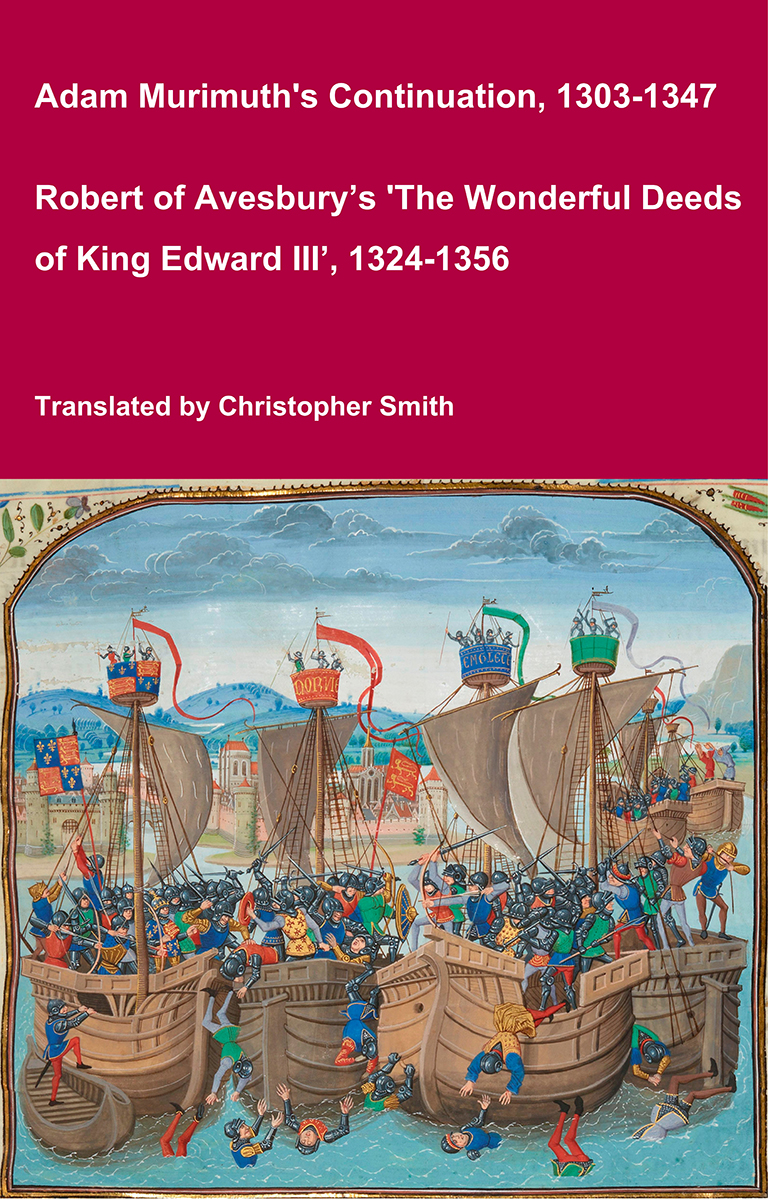
Adam Murimuth's Continuation and Robert of Avesbury’s 'The Wonderful Deeds of King Edward III'
This volume brings together two of the most important contemporary chronicles for the reign of Edward III and the opening phases of the Hundred Years’ War. Written in Latin by English clerical observers, these texts provide a vivid and authoritative window into the political, diplomatic, and military history of fourteenth-century England and its continental ambitions. Adam Murimuth Continuatio's Chronicarum continues an earlier chronicle into the mid-fourteenth century, offering concise but valuable notices on royal policy, foreign relations, and ecclesiastical affairs. Its annalistic structure makes it especially useful for establishing chronology and tracing the development of events year by year. Complementing it, Robert of Avesbury’s De gestis mirabilibus regis Edwardi tertii is a rich documentary chronicle preserving letters, treaties, and official records alongside narrative passages. It is an indispensable source for understanding Edward III’s claim to the French crown, the conduct of war, and the mechanisms of medieval diplomacy. Together, these works offer scholars, students, and enthusiasts a reliable and unembellished account of a transformative period in English and European history. Essential for anyone interested in medieval chronicles, the Hundred Years’ War, or the reign of Edward III.
Available at Amazon in eBook and Paperback format.
[his son] David Trollope was born to Andrew Trollope and Elizabeth Mundeford.