

Henrici Quinti, Angliæ Regis, Gesta, is a first-hand account of the Agincourt Campaign, and subsequent events to his death in 1422. The author of the first part was a Chaplain in King Henry's retinue who was present from King Henry's departure at Southampton in 1415, at the siege of Harfleur, the battle of Agincourt, and the celebrations on King Henry's return to London. The second part, by another writer, relates the events that took place including the negotiations at Troye, Henry's marriage and his death in 1422.
Available at Amazon in eBook and Paperback format.
Anna Alma-Tadema is in Painters.
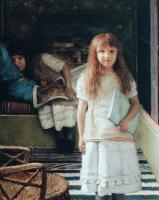
1863. [her father] Lawrence Alma-Tadema (age 26). A portrait of the artist's daughters Laurense and Anna Alma-Tadema.
Life of Lawrence Alma-Tadema by Helen Zimmern. Four years after joining her son [[her father] Lawrence Alma-Tadema (age 28)], Madame Tadema died. It is sad to think that this good parent did not live to witness her son's world-wide fame, but pleasant to know that she still heard the praise aroused by some of his first exhibited pictures, and to see him the recipient of his first gold medal, that accorded to him at Amsterdam in 1862. In 1865 Tadema married a French lady, and removed to Brussels, where he remained until his wife's death. This occurred in 1869, when he was left alone with his sister and two little girls, the eldest, Laurence, who has developed into a gifted writer, and the second, Anna, the delicate, dainty artist who has inherited so much of her father's power for reproducing detail.
It was during the lifetime of his first wife that Alma Tadema paid his first visit to Italy and saw with his own eyes the homes of those Romans who were destined to become his most familiar friends.
Lawrence Alma-Tadema and [her mother] Marie-Pauline Gressin-Dumoulin were married at the City Hall in Antwerp.
On 16th May 1867 Anna Alma-Tadema was born to [her father] Lawrence Alma-Tadema (age 31) and [her mother] Marie-Pauline Gressin-Dumoulin.
Life of Lawrence Alma-Tadema by Helen Zimmern. An accident brought Tadema to London in 1870, and here he at once took root. A year later he remarried1, his wife this time being Miss [her step-mother] Laura Theresa Epps (age 19), a woman of rare beauty, and herself a painter of distinction.
Note 1. In July 1871 [her father] Lawrence Alma-Tadema (age 35) and Laura Theresa Epps were married.


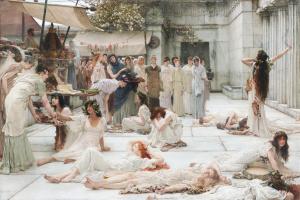

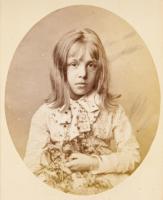
1877. Robert Faulkner (age 54). Photograph of Anna Alma-Tadema (age 9).
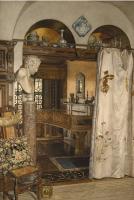
1884 Anna Alma-Tadema (age 16). "The Gold Room".
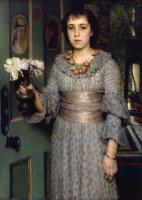
1885. [her father] Lawrence Alma-Tadema (age 48). Portrait of the artist's daughter Anna Alma-Tadema (age 17).
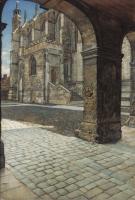
1885 Anna Alma-Tadema (age 17). "Eton College Chapel [Map]".
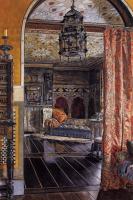
1885 Anna Alma-Tadema (age 17). "The Drawing Room, Townshend House".
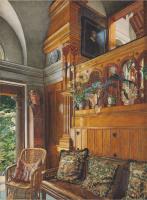
1886-7. Anna Alma-Tadema (age 18). "The Garden Studio".
The History of William Marshal was commissioned by his son shortly after William’s death in 1219 to celebrate the Marshal’s remarkable life; it is an authentic, contemporary voice. The manuscript was discovered in 1861 by French historian Paul Meyer. Meyer published the manuscript in its original Anglo-French in 1891 in two books. This book is a line by line translation of the first of Meyer’s books; lines 1-10152. Book 1 of the History begins in 1139 and ends in 1194. It describes the events of the Anarchy, the role of William’s father John, John’s marriages, William’s childhood, his role as a hostage at the siege of Newbury, his injury and imprisonment in Poitou where he met Eleanor of Aquitaine and his life as a knight errant. It continues with the accusation against him of an improper relationship with Margaret, wife of Henry the Young King, his exile, and return, the death of Henry the Young King, the rebellion of Richard, the future King Richard I, war with France, the death of King Henry II, and the capture of King Richard, and the rebellion of John, the future King John. It ends with the release of King Richard and the death of John Marshal.
Available at Amazon in eBook and Paperback format.
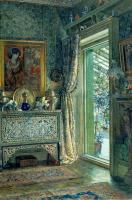
1887. Anna Alma-Tadema (age 19). "Drawing Room, 1a Holland Park".
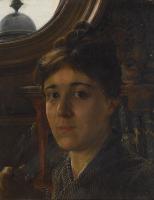
Around 1892 Anna Alma-Tadema (age 24). Self-portrait.

1900 Anna Alma-Tadema (age 32). "The idler's harvest".

1900 Anna Alma-Tadema (age 32). "The Closing Door".

1902 Anna Alma-Tadema (age 34). "Girl in a Bonnet with her Head on a Blue Pillow".
On 25th June 1912 [her father] Lawrence Alma-Tadema (age 76) died at Kaiserhof Spa, Wiesbaden, Germany where he had travelled with his daughter Anne (age 45) for treatment of his stomach ulcers. He was buried in the crypt of St Paul's Cathedral [Map].
On 5th July 1943 Anna Alma-Tadema (age 76) died unmarried.
Father: Lawrence Alma-Tadema
GrandFather: Eugène Gressin-Dumoulin
Mother: Marie-Pauline Gressin-Dumoulin