

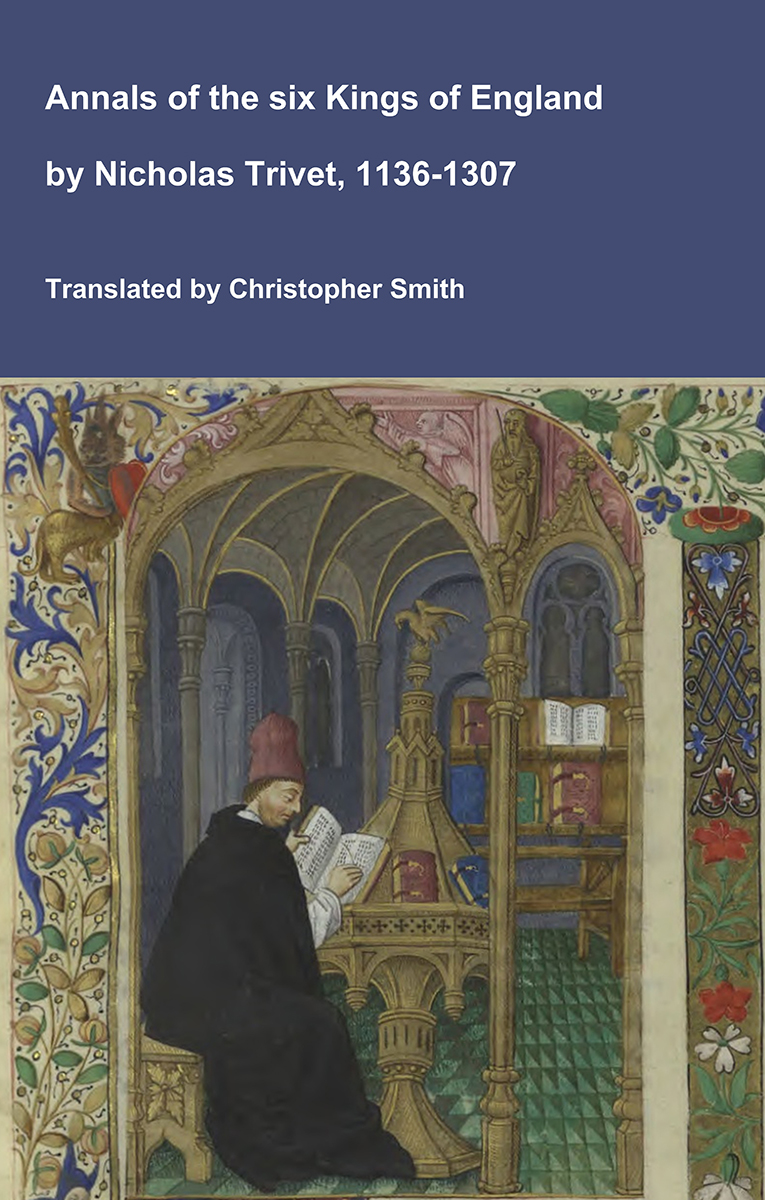
Annals of the six Kings of England by Nicholas Trivet
Translation of the Annals of the Six Kings of England by that traces the rise and rule of the Angevin aka Plantagenet dynasty from the mid-12th to early 14th century. Written by the Dominican scholar Nicholas Trivet, the work offers a vivid account of English history from the reign of King Stephen through to the death of King Edward I, blending political narrative with moral reflection. Covering the reigns of six monarchs—from Stephen to Edward I—the chronicle explores royal authority, rebellion, war, and the shifting balance between crown, church, and nobility. Trivet provides detailed insight into defining moments such as baronial conflicts, Anglo-French rivalry, and the consolidation of royal power under Edward I, whose reign he describes with particular immediacy. The Annals combines careful year-by-year reporting with thoughtful interpretation, presenting history not merely as a sequence of events but as a moral and political lesson. Ideal for readers interested in medieval history, kingship, and the origins of the English state, this chronicle remains a valuable and accessible window into the turbulent world of the Plantagenet kings.
Available at Amazon in eBook and Paperback format.
In 1691 Lancelot Blackburne became a Canon of Exeter, and in 1705 Dean of Exeter
On 10th December 1658 Lancelot Blackburne was born.
On 25th September 1681 Lancelot Blackburne [aged 22] was ordained a deacon at Christ Church by John Fell [aged 56], Bishop of Oxford, and travelled to the West Indies.
On 2nd September 1684 Lancelot Blackburne [aged 25] and Catherine Talbot were married at the Savoy Chapel Royal [Map].
Before 1685 [his brother-in-law] Bishop William Talbot [aged 26] and Mary Stoughton were married.
In 1699 [his brother-in-law] Bishop William Talbot [aged 41] was appointed Bishop of Oxford.
In 1715 Lancelot Blackburne [aged 56] was appointed Archdeacon of Cornwall.
In 1716 Lancelot Blackburne [aged 57] travelled to Hanover as the personal chaplain to King George I.
In 1717 Archdeacon Lancelot Blackburne [aged 58] was appointed Bishop of Exeter.
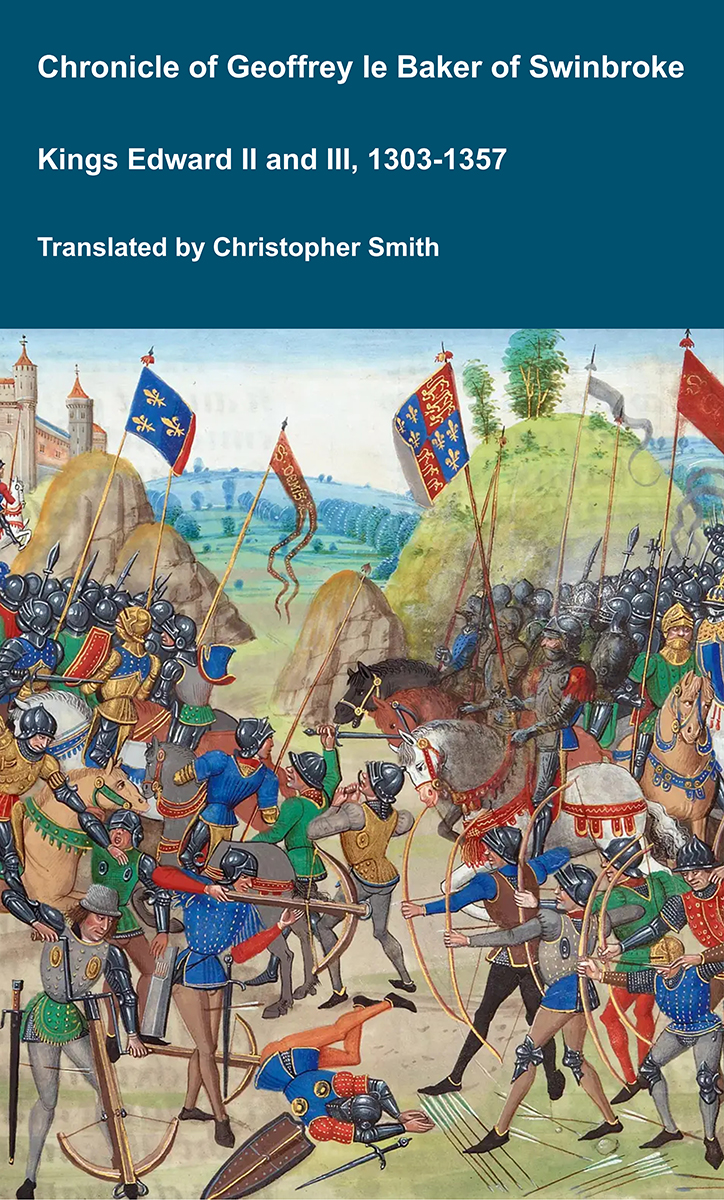
Chronicle of Geoffrey le Baker of Swinbroke
Baker was a secular clerk from Swinbroke, now Swinbrook, an Oxfordshire village two miles east of Burford. His Chronicle describes the events of the period 1303-1356: Gaveston, Bannockburn, Boroughbridge, the murder of King Edward II, the Scottish Wars, Sluys, Crécy, the Black Death, Winchelsea and Poitiers. To quote Herbert Bruce 'it possesses a vigorous and characteristic style, and its value for particular events between 1303 and 1356 has been recognised by its editor and by subsequent writers'. The book provides remarkable detail about the events it describes. Baker's text has been augmented with hundreds of notes, including extracts from other contemporary chronicles, such as the Annales Londonienses, Annales Paulini, Murimuth, Lanercost, Avesbury, Guisborough and Froissart to enrich the reader's understanding. The translation takes as its source the 'Chronicon Galfridi le Baker de Swynebroke' published in 1889, edited by Edward Maunde Thompson.
Available at Amazon in eBook and Paperback format.
In the year 1719 William Borlase [aged 22] was admitted, by Lancelot, Bishop of Exeter [aged 60], to déacon’s orders, and by the same ordained priest in 1720.
In 1723 Bishop Lancelot Blackburne [aged 64] was appointed Lord High Almoner which office he held for life.
In 1724 Bishop Lancelot Blackburne [aged 65] was appointed Archbishop of York.
On 9th June 1726 [his wife] Catherine Talbot died.
On 23rd March 1743 Archbishop Lancelot Blackburne [aged 84] died at his home in Downing Street.
Letters of Horace Walpole. [11th December 1780] I believe, Sir, that I may have been over-candid to Hogarth, and fail his spirit and youth and talent may have hurried him into more real caricatures than I specified . yet he certainly restrained his bent that way pretty early. Charteris403 I have seen; but though Some years older than you, Sir, I cannot say I have at all a perfect idea of him: nor did I ever hear the curious anecdote you tell me of the banker and my father. I was much better acquainted with bishop Blackbourne. He lived within two doors of my father in Downing Street, and took much notice of me when I was near man. It is not to be ungrateful and asperse him, but to amuse you, if I give you some account of him from what I remember404. He was perfectly a fine gentleman to the last, to eighty-four; his favourite author was Waller, whom he frequently quoted. In point of decorum, he was not quite so exact as you have been told, Sir. I often dined with him, his mistress, Mrs. Conwys, sat at the head of the table, and Hayter405, his natural son by another woman, and very like him, at the bottom, as chaplain: he was afterwards Bishop of London. I have heard, but do not affirm it, that Mrs. Blackbourne, before she died, complained of Mrs. Conwys being brought under the same roof. To his clergy he was, I have heard, very imperious. One story I recollect, which showed how much he was a man of this world: and which the Queen herself repeated to my father. On the King's last journey to Hanover, before Lady Yarmouth came over, the Archbishop being With her Majesty, said to her, "Madam, I have been with your minister Walpole, and he tells me that you are a wise woman, and do not mind your husband's having a mistress." He was a little hurt at not being raised to Canterbury on Wake's death, and said to my father, "You did not think on me: but it is true, I am too old, I am too old." Perhaps, Sir, these are gossiping stories, but at least they hurt nobody now.
Note 403. The notorious Colonel Francis Charteris, to whom Hogarth has accorded a conspicuous place in the first plate of his Harlot's Progress. Pope describes him as "a man infamous for all manner of vices," and thus introduces him into his third Moral Essay:
"Riches in effect,
No grace of Heaven, or token of th' Elect;
Given to the fool, the mad, the vain, the evil,
To Ward, to Waters, Chartres, and the devil!"
He died in Scotland, in 1731, at the age of sixty-two. The populace, at his funeral, raised a great riot, almost tore the body out of the coffin, and cast dead dogs, etc. into the grave along with it.-E.
Note 404. See the note to vol. i. p. 314, letter 101.-E.
Note 405. For a refutation of Walpole's assertion, that Bishop Hayter was a natural son of bishop Blackbourn's, see vol. ii. p. 100, letter 39.-E.