

Jean de Waurin's Chronicle of England Volume 6 Books 3-6: The Wars of the Roses
Jean de Waurin was a French Chronicler, from the Artois region, who was born around 1400, and died around 1474. Waurin’s Chronicle of England, Volume 6, covering the period 1450 to 1471, from which we have selected and translated Chapters relating to the Wars of the Roses, provides a vivid, original, contemporary description of key events some of which he witnessed first-hand, some of which he was told by the key people involved with whom Waurin had a personal relationship.
Available at Amazon in eBook and Paperback format.
In May 1286 Bishop John Langton was appointed Master of the Rolls.
In 1292 Bishop John Langton was appointed Lord Chancellor.
On 5th April 1305 Bishop John Langton was elected Bishop of Chichester.
On 19th September 1305 Bishop John Langton was consecrated Bishop of Chichester.
In 1307 Bishop John Langton was appointed Lord Chancellor.
Close Rolls Edward II 1307-1313. 8th January 1308 King Edward II of England [aged 23] To the Sheriff of Leicester. Order to cause a coroner for that county to be elected in place of John de Noveray, of Burton, lately elected in the late King's reign, who is insufficiently qualified.
Memorandum, that on Sunday before the Feast of St Vincent the Martyr [22 Jan], at Dover, Kent [Map] in the King's chamber in the Priory of St Martin, Dover [Map], in the evening (crepsusculo noctis), in the presence of William Inge, knight, William de Melton and Adam de Osgoodby, clerks, Bishop John Langton, the King's Chancellor, delivered under his seal to the said King his great seal; and the King received the said seal in his own hands, and delivered it to Sir William Melton [aged 33] to be carried with him in the wardrobe beyond sea; and the King straightaway delivered by his own hand another seal of his shortly before made anew at London for the government of the realm in the King's absence in a red bag (bursa) sealed with the seal of William Inge to the chancellor. With which seal the chancellor caused writs to be sealed, after the King's passage, in the hospital of Domus Dei, under the testimony of Piers Gaveston 1st Earl Cornwall [aged 24] then Keeper of the realm of England, on the Monday next following, on which day the King in the early morning (summo mane) passed the sea at Dover, Kent [Map].
Fine Rolls. On 7th February 1308 King Edward II of England [aged 23] and Isabella of France Queen Consort England [aged 13] returned from their wedding in Boulogne sur Mer [Map] to Dover, Kent [Map].
7th February 1308. Be it remembered that on Wednesday after the Purification, Edward II, the king, returning from beyond seas, to wit, from Boulogne sur Mer [Map], where he took to wife Isabel, daughter of the king of France [aged 39], touched at Dover, Kent [Map] in his barge about the ninth hour [1500], Hugh le Despenser [aged 46] and the lord of Castellione of Gascony being in his company, and the Queen a little afterward touched there with certain ladies accompanying her, and because the great seal which had been taken with him beyond seas then remained in the keeping of the keeper of the wardrobe who could not arrive on that day, no writ was sealed from the hour of the king's coming until Friday following on which day the bishop of Chichester, chancellor, about the ninth hour [1500] delivered to the king in his chamber in Dover castle [Map] the seal used in England during the king's absence, and the king, receiving the same, delivered it to William de Melton [aged 33], controller of the wardrobe, and forthwith delivered with his own hand to the chancellor the great seal under the seal of J. de Benstede, keeper of the wardrobe, and Master John Painter Fraunceis, in the presence of Thomas, Earl of Lancaster [aged 30], Peter, Earl of Cornwall [aged 24], and Hugh le Despenser, William Martyn and William Inge, knights, and Adam de Osgodby, clerk; and the chancellor on that day after lunch in his room (hospicio) in God's House, Dover, sealed writs with the great seal.
In 1310 Bishop John Langton was appointed Lord Ordainer.
Annales Paulini. On Sunday, on the feast of Saint Vincent the Martyr [22nd January 1329], the archbishop [Simon Mepeham] was enthroned at Canterbury; and on the following Friday [27th January 1329], he summoned the entire clergy of the whole province to hold a council in London at the Church of Saint Paul. Early in the morning, a Mass of the Holy Spirit was celebrated by the Bishop of Chichester, with the archbishop and the other bishops, abbots, and prelates standing apart, all vested in their pontificals. After the Mass, the hymn Veni Creator was sung, and the archbishop delivered a long sermon to the clergy. Then a certificate from the Bishop of London was read aloud, confirming the citation of the clergy; and thus the provincial council began. Nothing else was done on the first day, but the council continued for several days, and each day they gathered there to discuss the statutes of the English Church.
Die Dominica in festo Sancti Vincentii martyris intronizatus est archiepiscopus apud Cantuariam; et die Veneris proxima sequente fecit convocari omnem clerum totius provincie ad concilium faciendum Londoniis in ecclesia Sancti Pauli; et primo mane fuit Missa de Sancto Spiritu celebrata ab episcopo Cicestrensi, archiepiscopo et ceteris episcopis cum abbatibus et prelatis seorsum astantibus indutis pontificalibus; et post Missam cantato hympno "Veni Creator," fecit archiepiscopus longum sermonem ad clerum. Deinde lecta fuit litera certificatoria episcopi Londoniensis de citatione cleri; et hoc modo incepit concilium provinciale: et nihil aliud est actum primo die, sed continuatur per plures dies, et qualibet die convenerunt ibi tractantes de statutis ecclesim Anglican.
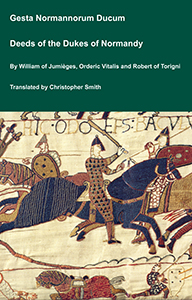
The Deeds of the Dukes of Normandy
The Gesta Normannorum Ducum [The Deeds of the Dukes of Normandy] is a landmark medieval chronicle tracing the rise and fall of the Norman dynasty from its early roots through the pivotal events surrounding the Norman Conquest of England. Originally penned in Latin by the monk William of Jumièges shortly before 1060 and later expanded at the behest of William the Conqueror, the work chronicles the deeds, politics, battles, and leadership of the Norman dukes, especially William’s own claim to the English throne. The narrative combines earlier historical sources with firsthand information and oral testimony to present an authoritative account of Normandy’s transformation from a Viking settlement into one of medieval Europe’s most powerful realms. William’s history emphasizes the legitimacy, military prowess, and governance of the Norman line, framing their expansion, including the conquest of England, as both divinely sanctioned and noble in purpose. Later chroniclers such as Orderic Vitalis and Robert of Torigni continued the history, extending the coverage into the 12th century, providing broader context on ducal rule and its impact. Today this classic work remains a foundational source for understanding Norman identity, medieval statesmanship, and the historical forces that reshaped England and Western Europe between 800AD and 1100AD.
Available at Amazon in eBook and Paperback format.
On 19th July 1337 Bishop John Langton died.