

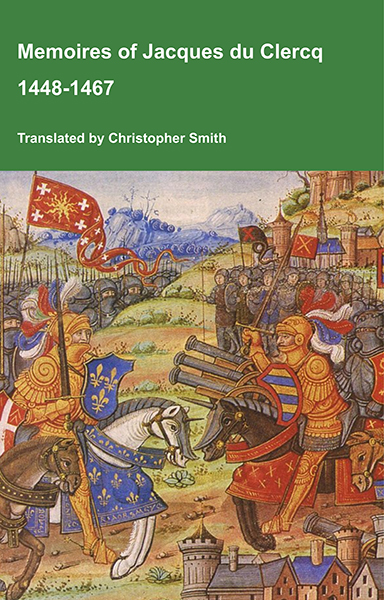
This is a translation of the 'Memoires of Jacques du Clercq', published in 1823 in two volumes, edited by Frederic, Baron de Reissenberg. In his introduction Reissenberg writes: 'Jacques du Clercq tells us that he was born in 1424, and that he was a licentiate in law and a counsellor to Philip the Good, Duke of Burgundy, in the castellany of Douai, Lille, and Orchies. It appears that he established his residence at Arras. In 1446, he married the daughter of Baldwin de la Lacherie, a gentleman who lived in Lille. We read in the fifth book of his Memoirs that his father, also named Jacques du Clercq, had married a lady of the Le Camelin family, from Compiègne. His ancestors, always attached to the counts of Flanders, had constantly served them, whether in their councils or in their armies.' The Memoires cover a period of nineteen years beginning in in 1448, ending in in 1467. It appears that the author had intended to extend the Memoirs beyond that date; no doubt illness or death prevented him from carrying out this plan. As Reissenberg writes the 'merit of this work lies in the simplicity of its narrative, in its tone of good faith, and in a certain air of frankness which naturally wins the reader’s confidence.' Du Clercq ranges from events of national and international importance, including events of the Wars of the Roses in England, to simple, everyday local events such as marriages, robberies, murders, trials and deaths, including that of his own father in Book 5; one of his last entries.
Available at Amazon in eBook and Paperback format.
In 1260 Bishop Nicholas Ely was appointed Lord Chancellor.
On 19th September 1266 Bishop Nicholas Ely was consecrated Bishop of Worcester.
On 26th September 1266 Bishop Nicholas Ely was enthroned Bishop of Worcester at Worcester Cathedral [Map].
On 31st October 1266 the Dictum of Kenilworth was issued. The Dictum was a peace agreement between King Henry III of England [aged 59] and the rebels who were besieged in the impregnable Kenilworth Castle [Map]. The committee included: Bishop Walter Branscombe [aged 46], Archbishop Walter Giffard [aged 41], Bishop Nicholas Ely, Gilbert de Clare 8th Earl Gloucester 7th Earl Hertford, Humphrey Bohun 2nd Earl Hereford 1st Earl Essex [aged 62], Philip Basset [aged 82], John Balliol [aged 58], Robert Walerand, Alan Zouche [aged 63], Roger Somery 2nd Baron Dudley [aged 76], and Warin Bassingbourne.
Robert Ferrers 6th Earl of Derby [aged 27] and Henry Hastings [aged 31] were fined seven times their annual income. The Dictum, however, required the rebels to pay their fines before being restored to their lands; something of a Catch-22 since if they weren't restored to their lands, they would have no income to pay the fine.
On 2nd March 1268 Bishop Nicholas Ely was translated to Bishop of Winchester at Worcester Cathedral [Map] by Pope Clement IV.
On 27th May 1268 Bishop Nicholas Ely was enthroned as Bishop of Winchester at Winchester Cathedral [Map].
On 12th February 1280 Bishop Nicholas Ely died.