

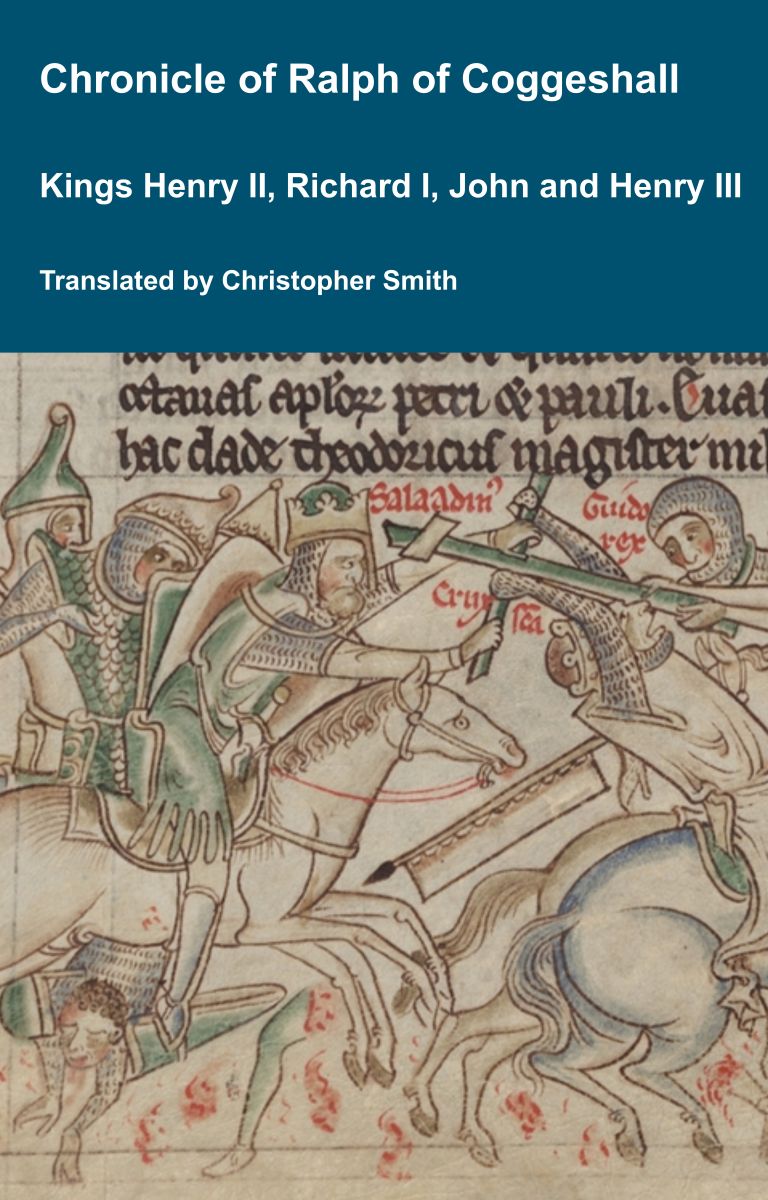
Chronicle of Abbot Ralph of Coggeshall
The Chronicle of Abbot Ralph of Coggeshall (Chronicon Anglicanum) is an indispensable medieval history that brings to life centuries of English and European affairs through the eyes of a learned Cistercian monk. Ralph of Coggeshall, abbot of the Abbey of Coggeshall in Essex in the early 13th century, continued and expanded his community’s chronicle, documenting events from the Norman Conquest of 1066 into the tumultuous reign of King Henry III. Blending eyewitness testimony, careful compilation, and the monastic commitment to record-keeping, this chronicle offers a rare narrative of political intrigue, royal power struggles, and social upheaval in England and beyond. Ralph’s work captures the reigns of pivotal figures such as Richard I and King John, providing invaluable insights into their characters, decisions, and the forces that shaped medieval rule. More than a simple annal, Chronicon Anglicanum conveys the texture of medieval life and governance, making it a rich source for scholars and readers fascinated by English history, monastic authorship, and the shaping of the medieval world.
Available at Amazon in eBook and Paperback format.
On 25th January 1828 Charles Allston Collins was born to William Collins [aged 40]. His middle name 'Allston' the surname of his father's friend the American painter Washington Allston.

Before 1847. Charles Allston Collins [aged 18]. Portrait of William Collins [aged 58], the artist's father.
William Collins: In 1788 he was born. In 1847 he died.
In 1847 [his father] William Collins [aged 59] died.

1850. Charles Allston Collins [aged 21]. "Berengaria's Alarm for the Safety of Her Husband, Richard Coeur de Lion, Awakened by the Sight of His Girdle Offered for Sale at Rome".
Around 1851 in an undated letter, Charles Allston Collins [aged 22] wrote to Holman Hunt: "I have been very much occupied lately having taken the trouble of persuading a young lady [Sarah Eliza Hackett [aged 19]] to sit, who struck both Millais and myself as having possessed a very beautiful head – she was a friend of a friend of mine so after some trouble I managed to secure her, but I have been obliged to hurry very much as her time was limited. I had to pursue her to her own house and take sittings there, getting up very early for this purpose."

1851. Charles Allston Collins [aged 22]. "A Good Harvest of 1854".

1851. Charles Allston Collins [aged 22]. "May, in the Regent's Park".

1851 to 1852. Charles Allston Collins [aged 22]. "The Devout Childhood of Saint Elizabeth of Hungary". Detroit Institute of Arts, United States of America.

Before 13th May 1851. Charles Allston Collins [aged 23]. Study for Convent Thoughts.
Abbot John Whethamstede’s Chronicle of the Abbey of St Albans
Abbot John Whethamstede's Register aka Chronicle of his second term at the Abbey of St Albans, 1451-1461, is a remarkable text that describes his first-hand experience of the beginning of the Wars of the Roses including the First and Second Battles of St Albans, 1455 and 1461, respectively, their cause, and their consequences, not least on the Abbey itself. His text also includes Loveday, Blore Heath, Northampton, the Act of Accord, Wakefield, and Towton, and ends with the Coronation of King Edward IV. In addition to the events of the Wars of the Roses, Abbot John, or his scribes who wrote the Chronicle, include details in the life of the Abbey such as charters, letters, land exchanges, visits by legates, and disputes, which provide a rich insight into the day-to-day life of the Abbey, and the challenges faced by its Abbot.
Available at Amazon in eBook and Paperback format.
Before 13th May 1851. Letter from Charles Allston Collins [aged 23] to William Holman Hunt [aged 24] regarding the picture "Convent Thoughts".


In or after June 1851. Charles Allston Collins [aged 23]. "Convent Thoughts". The passion flower symbolising the Passion of Christ. The missal in her left hand shows the Annunciation and Crucifixion. The model Sarah Eliza Hackett [aged 19]. The artist had borrowed the same costume fot the nun that William Holman Hunt [aged 24] has used for Claudio and Isabella. The flowers were all painted from nature in the garden of Thomas Combe's home in the quadrangle of the Clarendon Press in Oxford.

1853. Charles Allston Collins [aged 24]. Portrait of (probably) Catherine "Kate" Perugini nee Dickens [aged 13], the artist's wife.
The Diary of George Price Boyce 1853. 6th January 1853. To Rossetti's [aged 24], Blackfriars Bridge. Met there W. Holman Hunt [aged 25], J. E. Millais [aged 23], J. P. Seddon [aged 25], Clayton [aged 25], Munro [aged 27], whose charming group of Francesca and her lover was in Rossetti's studio, Stephens, Blanchard, C. Lucy, a Scotchman and a foreigner. Millais somewhat egotistical and little real, his attention being easily distracted. He jerked out some good remarks. Spoke highly of Ruskin [aged 33] as a friend of Art; said that Mrs. R [aged 24]. was sitting for one of his pictures. Hunt struck me as a thoroughly genuine, humorous, good-hearted, straightforward English-like fellow. Said he was bound for Syria before long. Millais spoke highly of Charles Collins [aged 24] as a good religious man?
In 1860 Charles Allston Collins [aged 31] and Catherine "Kate" Perugini nee Dickens [aged 20] were married.


Around 1865. Charles Allston Collins [aged 36]. Portrait of Wilkie Collins, the artist's brother.
On 9th April 1873 Charles Allston Collins [aged 45] died of cancer. He was buried at Brompton Cemetery, Kensington.
On 4th June 1874 Charles Edward Perugini [aged 34] and [his former wife] Catherine "Kate" Perugini nee Dickens [aged 34] were married at St. Paul's Church in Wilton Place, Knightsbridge. The guests included Georgina Hogarth, Mamie Dickens, Francis Jeffrey Dickens, Henry Fielding Dickens and Sir John Everett Millais [aged 44]. They had married earlier, 1st September 1839, at a registry office, with witnesses, and strangers, Henry Thomas Mitcham and Ernest Edward Earle.
On 9th May 1929 [his former wife] Catherine "Kate" Perugini nee Dickens [aged 89] died.