


Biography of Charles Allston Collins 1828-1873
Charles Allston Collins 1828-1873 is in Painters.
On 25 Jan 1828 Charles Allston Collins was born to William Collins (age 40).
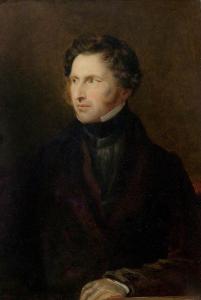
Before 1847. Charles Allston Collins (age 18). Portrait of [his father] William Collins (age 58), the artist's father.
William Collins: In 1788 he was born. In 1847 he died.
In 1847 [his father] William Collins (age 59) died.
 1850. Charles Allston Collins (age 21). "Berengaria's Alarm for the Safety of Her Husband, Richard Coeur de Lion, Awakened by the Sight of His Girdle Offered for Sale at Rome".
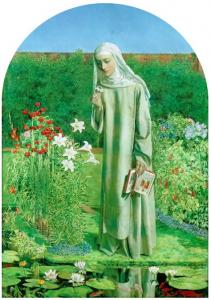 1851. Charles Allston Collins (age 22). "Convent Thoughts". The passion flower symbolising the Passion of Christ. The missal in her left hand shows the Annuciation and Crucifixion. The model either, or both, Sarah Eliza Hackett and Sarah Eliza Hackett.
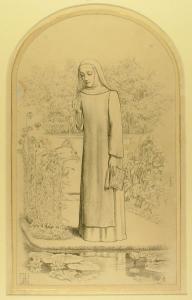 1851. Charles Allston Collins (age 22). Study for Convent Thoughts.
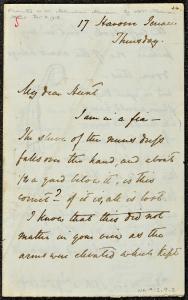 1851. Letter from Charles Allston Collins (age 22) to William Holman Hunt (age 23) regarding the picture "Convent Thoughts".
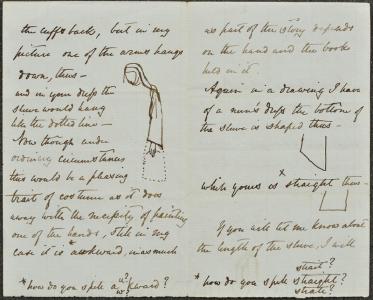 1851. Letter from Charles Allston Collins (age 22) to William Holman Hunt (age 23) regarding the picture "Convent Thoughts".
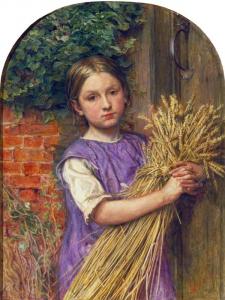 1851. Charles Allston Collins (age 22). "A Good Harvest of 1854".
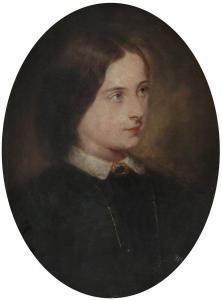 1853. Charles Allston Collins (age 24). Portrait of (probably) [his future wife] Catherine "Kate" Perugini nee Dickens (age 13), the artist's wife.
The Diary of George Price Boyce 1853. 06 Jan 1853. To Rossetti's (age 24), Blackfriars Bridge. Met there W. Holman Hunt (age 25), J. E. Millais (age 23), J. P. Seddon (age 25), Clayton (age 25), Munro (age 27), whose charming group of Francesca and her lover was in Rossetti's studio, Stephens, Blanchard, C. Lucy, a Scotchman and a foreigner. Millais (age 23) somewhat egotistical and little real, his attention being easily distracted. He jerked out some good remarks. Spoke highly of Ruskin (age 33) as a friend of Art; said that Mrs. R (age 24). was sitting for one of his pictures1. Hunt (age 25) struck me as a thoroughly genuine, humorous, good-hearted, straightforward English-like fellow. Said he was bound for Syria before long. Millais spoke highly of Charles Collins (age 24) as a good religious man?
Note 1. Probably "The Order of Release".
In 1860 Charles Allston Collins (age 31) and Catherine "Kate" Perugini nee Dickens (age 20) were married.
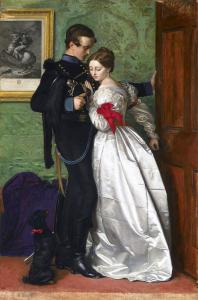
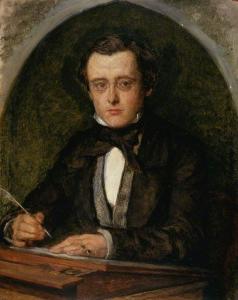 Around 1865. Charles Allston Collins (age 36). Portrait of Wilkie Collins, the artist's brother.
On 09 Apr 1873 Charles Allston Collins (age 45) died of cancer.
In 1874 Charles Edward Perugini (age 34) and [his former wife] Catherine "Kate" Perugini nee Dickens (age 34) were married.
On 09 May 1929 [his former wife] Catherine "Kate" Perugini nee Dickens (age 89) died.