

Abbot John Whethamstede’s Chronicle of the Abbey of St Albans
Abbot John Whethamstede's Register aka Chronicle of his second term at the Abbey of St Albans, 1451-1461, is a remarkable text that describes his first-hand experience of the beginning of the Wars of the Roses including the First and Second Battles of St Albans, 1455 and 1461, respectively, their cause, and their consequences, not least on the Abbey itself. His text also includes Loveday, Blore Heath, Northampton, the Act of Accord, Wakefield, and Towton, and ends with the Coronation of King Edward IV. In addition to the events of the Wars of the Roses, Abbot John, or his scribes who wrote the Chronicle, include details in the life of the Abbey such as charters, letters, land exchanges, visits by legates, and disputes, which provide a rich insight into the day-to-day life of the Abbey, and the challenges faced by its Abbot.
Available at Amazon in eBook and Paperback format.
Edward Onslow Ford is in Sculptors.
On 27th July 1852 Edward Onslow Ford was born to [his father] Edward Ford and [his mother] Martha Lydia Gardner.
1883. William Ewart Gladstone [aged 73] by Edward Onslow Ford [aged 30]. In the collection of the Lady Lever Art Gallery [Map].

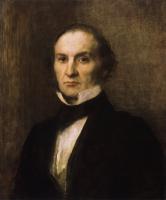

1883. Marble bust of William Ewart Gladstone [aged 73] by Edward Onslow Ford [aged 30]. In the collection of the Lady Lever Art Gallery [Map].

1890. "Dancing". Edward Onslow Ford [aged 37]. In the collection of the Lady Lever Art Gallery [Map]. Originally displayed at Lord Lever's London home The Hill, Hampstead. In 1922 it was moved to the Lady Lever Art Gallery [Map] and displayed outside the south entrance.

1890. "Linus". Edward Onslow Ford [aged 37]. In the collection of the Lady Lever Art Gallery [Map]. Originally displayed at Lord Lever's London home The Hill, Hampstead. In 1922 it was moved to the Lady Lever Art Gallery [Map] and displayed outside the south entrance.
The Royal Academy Conversazione, 1891, by George Henry Grenville Manton [aged 36].


John Seymour Lucas, Dame Alice Ellen Terry [aged 43], Sir William Quiller Orchardson, Rachel, Countess of Dudley [aged 23], Marcus Stone, Henry Stacy Marks, Sir Henry Irving, Unidentified man, Unidentified man, Sir John Everett Millais [aged 61], William Charles Thomas Dobson.

Unidentified woman, James Sant, William Powell Frith, Sir Hubert von Herkomer [aged 41], Unidentified woman, Briton Riviere, Unidentified man, John Pettie, Sir Lawrence Alma-Tadema [aged 54], Frederic Leighton [aged 60], Baron Leighton.

Philip Hermogenes Calderon, Walter William Ouless, Thomas Faed, Robert Walker Macbeth, Edward Onslow Ford [aged 38], William Frederick Yeames, Unidentified woman, Sir Edward Coley Burne-Jones [aged 57], Unidentified man.

Mary Anderson, John Calcott Horsley, possibly Joanna Margaret Hadley, Unidentified man, Henry Tanworth Wells, possibly Alice Joanna Street, Marion Harry Spielmann, Unidentified woman.

1895. Bust of James Lever [aged 85], father of William Lever 1st Viscount Leverhulme [aged 43] by Edward Onslow Ford [aged 42]. In the collection of the Lady Lever Art Gallery [Map].
James Lever: In 1810 he was born. Before 19th September 1851 he and Eliza Hesketh were married. On 25th May 1897 he died.
1895. "Echo" by Edward Onslow Ford [aged 42]. In the collection of the Lady Lever Art Gallery [Map].


1900. Marble bust of William Lever 1st Viscount Leverhulme [aged 48] by Edward Onslow Ford [aged 47]. In the collection of the Lady Lever Art Gallery [Map].


1901. "Snowdrift". Marble, green onyx for base, with lapis lazuli below with silver mounts, and black marble below. The last work of Edward Onslow Ford [aged 48]. Completed following his death. In the collection of the Lady Lever Art Gallery [Map].


On 23rd December 1901 Edward Onslow Ford [aged 49] died.