

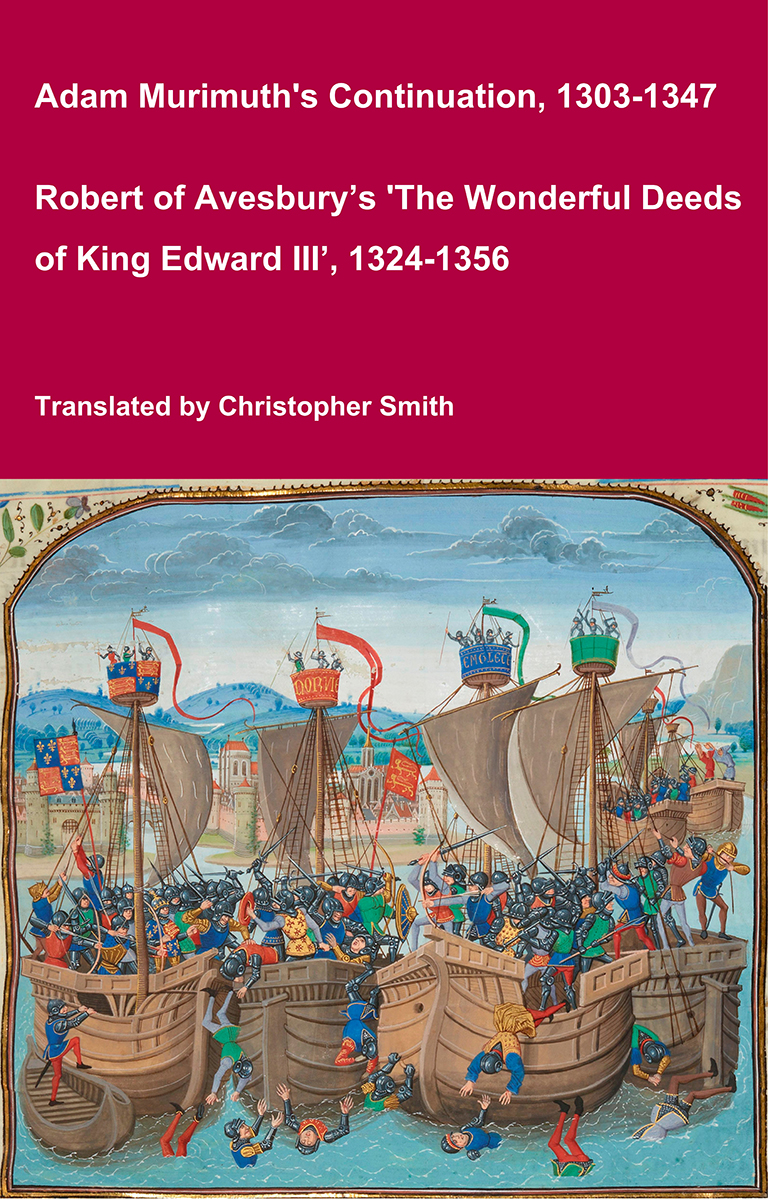
Adam Murimuth's Continuation and Robert of Avesbury’s 'The Wonderful Deeds of King Edward III'
This volume brings together two of the most important contemporary chronicles for the reign of Edward III and the opening phases of the Hundred Years’ War. Written in Latin by English clerical observers, these texts provide a vivid and authoritative window into the political, diplomatic, and military history of fourteenth-century England and its continental ambitions. Adam Murimuth Continuatio's Chronicarum continues an earlier chronicle into the mid-fourteenth century, offering concise but valuable notices on royal policy, foreign relations, and ecclesiastical affairs. Its annalistic structure makes it especially useful for establishing chronology and tracing the development of events year by year. Complementing it, Robert of Avesbury’s De gestis mirabilibus regis Edwardi tertii is a rich documentary chronicle preserving letters, treaties, and official records alongside narrative passages. It is an indispensable source for understanding Edward III’s claim to the French crown, the conduct of war, and the mechanisms of medieval diplomacy. Together, these works offer scholars, students, and enthusiasts a reliable and unembellished account of a transformative period in English and European history. Essential for anyone interested in medieval chronicles, the Hundred Years’ War, or the reign of Edward III.
Available at Amazon in eBook and Paperback format.
On 23rd May 1617 Elias Ashmole was born in Breadmarket Street Lichfield, Staffordshire [Map].
by 1651 William Backhouse [aged 57] had become mentor to Elias Ashmole [aged 33].
John Evelyn's Diary. 19th September 1655. Came to see me Sir Edward Hales [aged 29], Mr. Ashmole [aged 38], Mr. Harlakenton, and Mr. Thornhill: and, the next day, I visited Sir Henry Newton at Charlton, where I met the Earl of Winchelsea [aged 27] and Baroness Beauchamp [aged 25], daughter to the Lord Capel.
John Evelyn's Diary. 17th September 1657. To see Sir Robert Needham, at Lambeth, Surrey [Map], a relation of mine; and thence to John Tradescant's museum, in which the chiefest rarities were, in my opinion, the ancient Roman, Indian, and other nations' armour, shields, and weapons; some habits of curiously-colored and wrought feathers, one from the phœnix wing, as tradition goes. Other innumerable things there were printed in his catalogue by Mr. Ashmole [aged 40], to whom after the death of the widow they are bequeathed, and by him designed as a gift to Oxford [Map].
John Evelyn's Diary. 3rd July 1658. To London, and dined with Mr. Henshaw [aged 40], Mr. Dorell, and Mr. Ashmole [aged 41], founder of the Oxford repository of rarities [Map], with divers doctors of physic and virtuosos.
Samuel Pepys' Diary. 24th October 1660. So to Mr. Lilly's [aged 42] with Mr. Spong, where well received, there being a club to-night among his friends. Among the rest Esquire Ashmole [aged 43], who I found was a very ingenious gentleman. With him we two sang afterward in Mr. Lilly's study. That done, we all pared; and I home by coach, taking Mr. Booker' with me, who did tell me a great many fooleries, which may be done by nativities, and blaming Mr. Lilly for writing to please his friends and to keep in with the times (as he did formerly to his own dishonour), and not according to the rules of art, by which he could not well err, as he had done. I set him down at Lime-street end, and so home, where I found a box of Carpenter's tools sent by my cozen, Thomas Pepys, which I had bespoke of him for to employ myself with sometimes. To bed.


Samuel Pepys' Diary. 23rd May 1661. From thence home by water, and there shifted myself into my black silk suit (the first day I have put it on this year), and so to my Lord Mayor's by coach, with a great deal of honourable company, and great entertainment. At table I had very good discourse with Mr. Ashmole [aged 44], wherein he did assure me that frogs and many insects do often fall from the sky, ready formed. Dr. Bates's singularity in not rising up nor drinking the King's nor other healths at the table was very much observed1.
Note 1. Dr. William Bates, one of the most eminent of the Puritan divines, and who took part in the Savoy Conference. His collected writings were published in 1700, and fill a large folio volume. The Dissenters called him silver-tongued Bates. Calamy affirmed that if Bates would have conformed to the Established Church he might have been raised to any bishopric in the kingdom. He died in 1699, aged seventy-four.
John Evelyn's Diary. 23rd July 1678. Went to see Mr. Elias Ashmole's [aged 61] library and curiosities, at Lambeth. He had divers MSS., but most of them astrological, to which study he is addicted, though I believe not learned, but very industrious, as his History of the order of the Garter proves. He showed me a toad included in amber. The prospect from a turret is very fine, it being so near London, and yet not discovering any house about the country. The famous John Tradescant bequeathed his Repository to this gentleman, who has given them to the University of Oxford, and erected a lecture on them, over the laboratory, in imitation of the Royal Society.

Around 1682. John Riley [aged 36]. Portrait of Elias Ashmole [aged 64].
John Evelyn's Diary. 9th July 1685. Just as I was coming into the lodgings at Whitehall [Map], a little before dinner, my Lord of Devonshire [aged 45] standing very neere his Ma's [aged 51] bed-chamber doore in the lobby, came Col. Culpeper [aged 50], and in a rude manner looking my Lord in the face, asked whether this was a time and place for excluders to appeare; my Lord at first tooke little notice of what he said, knowing him to be a hot-headed fellow, but he reiterating it, my Lord ask'd Culpeper whether he meant him; he said, yes, he meant his Lordship. My Lord told him he was no excluder (as indeed he was not); the other affirming it againe, my Lord told him he lied, on which Culpeper struck him a box on the eare, which my Lord return'd and fell'd him. They were soone parted, Culpeper was seiz'd, and his Ma*, who was all the while in his bed-chamber, order'd him to be carried to the Green Cloth Officer, who sent him to the Marshalsea [Map] as he deserv'd. My Lord Devon had nothing said to him. I supp'd this night at Lambeth at my old friend's Mr. Elias Ashmole's [aged 68], with my Lady Clarendon, ye Bishop of St. Asaph [aged 57], and Dr. Tenison [aged 48], when we were treated at a greate feast.


In 1687. John Riley [aged 41]. Portrait of Elias Ashmole [aged 69].

Anne Boleyn. Her Life as told by Lancelot de Carle's 1536 Letter.
In 1536, two weeks after the execution of Anne Boleyn, her brother George and four others, Lancelot du Carle, wrote an extraordinary letter that described Anne's life, and her trial and execution, to which he was a witness. This book presents a new translation of that letter, with additional material from other contemporary sources such as Letters, Hall's and Wriothesley's Chronicles, the pamphlets of Wynkyn the Worde, the Memorial of George Constantyne, the Portuguese Letter and the Baga de Secrets, all of which are provided in Appendices.
Available at Amazon in eBook and Paperback format.
On 18th May 1692 Elias Ashmole [aged 74] died. He was buried at St Mary at Lambeth Church, Surrey [Map].