

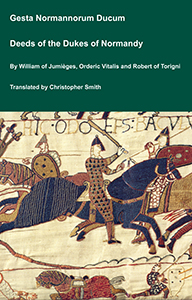
The Deeds of the Dukes of Normandy
The Gesta Normannorum Ducum [The Deeds of the Dukes of Normandy] is a landmark medieval chronicle tracing the rise and fall of the Norman dynasty from its early roots through the pivotal events surrounding the Norman Conquest of England. Originally penned in Latin by the monk William of Jumièges shortly before 1060 and later expanded at the behest of William the Conqueror, the work chronicles the deeds, politics, battles, and leadership of the Norman dukes, especially William’s own claim to the English throne. The narrative combines earlier historical sources with firsthand information and oral testimony to present an authoritative account of Normandy’s transformation from a Viking settlement into one of medieval Europe’s most powerful realms. William’s history emphasizes the legitimacy, military prowess, and governance of the Norman line, framing their expansion, including the conquest of England, as both divinely sanctioned and noble in purpose. Later chroniclers such as Orderic Vitalis and Robert of Torigni continued the history, extending the coverage into the 12th century, providing broader context on ducal rule and its impact. Today this classic work remains a foundational source for understanding Norman identity, medieval statesmanship, and the historical forces that reshaped England and Western Europe between 800AD and 1100AD.
Available at Amazon in eBook and Paperback format.
Paternal Family Tree: Colebrooke
On 14th June 1729 George Colebrooke 2nd Baronet was born to James Colebrooke [aged 49] at Chilham, Kent [Map].
On 18th November 1752 [his father] James Colebrooke [aged 72] died.
In 1754 George Colebrooke 2nd Baronet [aged 24] and Mary Gaynor were married. She bought significant wealth to the marriage being the heiress of her father Peter aka Patrick Gaynor who had considerable slave-holdings.
In 1754 George Colebrooke 2nd Baronet [aged 24] was elected MP Arundel which seat he controlled. He held the seat until 1774.
On 12th October 1759 James Colebrooke 1st Baronet [aged 37] was created 1st Baronet Colebrooke of Gatton in Surrey with a special remainder to his brother George [aged 30] since James only had daughters.
In 1761 [his son] James Edward Colebrooke 3rd Baronet was born to George Colebrooke 2nd Baronet [aged 31] and [his wife] Mary Gaynor.
On 10th May 1761 James Colebrooke 1st Baronet [aged 38] died. His brother George [aged 31] succeeded 2nd Baronet Colebrooke of Gatton in Surrey. George was left in sole charge of the family bank in Threadneedle Street. He invested some of his wealth in buying control of the borough of Arundel where the family lived. Arundel was not a classic pocket borough, where the power to return MPs was literally tied to property rights that could be freely bought and sold, but a thoroughly corrupt one where bribery was routine and where maintaining influence of the elections required constant expenditure.
Around 1764 George Colebrooke 2nd Baronet [aged 34] purchased plantations in Antigua (where his wife already had interests), Grenada and Dominica and was a slave-owner.
On 15th June 1765 [his son] Henry Thomas Colebrooke was born to George Colebrooke 2nd Baronet [aged 36] and [his wife] Mary Gaynor.
In 1767 George Colebrooke 2nd Baronet [aged 37] was appointed Director of the East India Company.
In 1777 George Colebrooke 2nd Baronet [aged 47] moved to Boulogne sur Mer [Map] where he relied on an East India Company pension.
The History of William Marshal was commissioned by his son shortly after William’s death in 1219 to celebrate the Marshal’s remarkable life; it is an authentic, contemporary voice. The manuscript was discovered in 1861 by French historian Paul Meyer. Meyer published the manuscript in its original Anglo-French in 1891 in two books. This book is a line by line translation of the first of Meyer’s books; lines 1-10152. Book 1 of the History begins in 1139 and ends in 1194. It describes the events of the Anarchy, the role of William’s father John, John’s marriages, William’s childhood, his role as a hostage at the siege of Newbury, his injury and imprisonment in Poitou where he met Eleanor of Aquitaine and his life as a knight errant. It continues with the accusation against him of an improper relationship with Margaret, wife of Henry the Young King, his exile, and return, the death of Henry the Young King, the rebellion of Richard, the future King Richard I, war with France, the death of King Henry II, and the capture of King Richard, and the rebellion of John, the future King John. It ends with the release of King Richard and the death of John Marshal.
Available at Amazon in eBook and Paperback format.
On 21st January 1777 the bank owned by George Colebrooke 2nd Baronet [aged 47] was declaredd bankrupt with losses including £190,000 in speculation on hemp.
In 1789 George Colebrooke 2nd Baronet [aged 59], during the French Revolution, returned to England and managed eventually to pay his creditors in full so that some inheritance was left for his descendants.
On 5th August 1809 George Colebrooke 2nd Baronet [aged 80] died. His son James [aged 48] succeeded 3rd Baronet Colebrooke of Gatton in Surrey.