

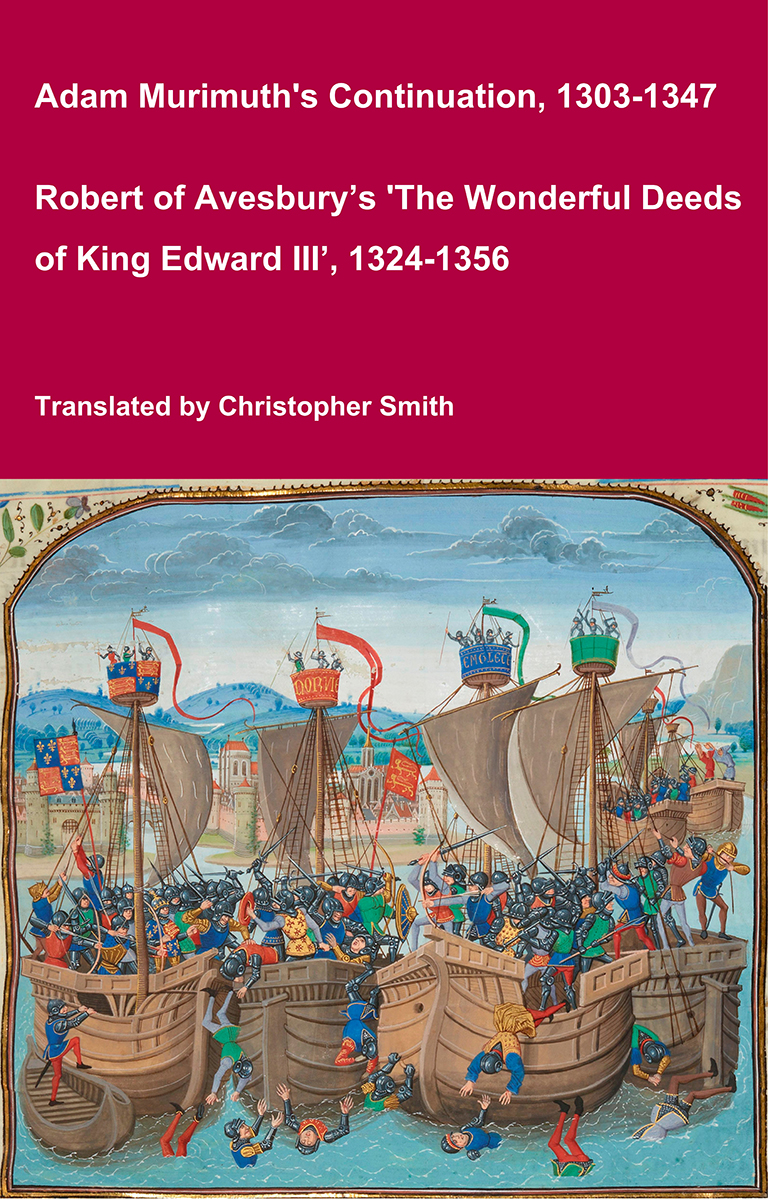
Adam Murimuth's Continuation and Robert of Avesbury’s 'The Wonderful Deeds of King Edward III'
This volume brings together two of the most important contemporary chronicles for the reign of Edward III and the opening phases of the Hundred Years’ War. Written in Latin by English clerical observers, these texts provide a vivid and authoritative window into the political, diplomatic, and military history of fourteenth-century England and its continental ambitions. Adam Murimuth Continuatio's Chronicarum continues an earlier chronicle into the mid-fourteenth century, offering concise but valuable notices on royal policy, foreign relations, and ecclesiastical affairs. Its annalistic structure makes it especially useful for establishing chronology and tracing the development of events year by year. Complementing it, Robert of Avesbury’s De gestis mirabilibus regis Edwardi tertii is a rich documentary chronicle preserving letters, treaties, and official records alongside narrative passages. It is an indispensable source for understanding Edward III’s claim to the French crown, the conduct of war, and the mechanisms of medieval diplomacy. Together, these works offer scholars, students, and enthusiasts a reliable and unembellished account of a transformative period in English and European history. Essential for anyone interested in medieval chronicles, the Hundred Years’ War, or the reign of Edward III.
Available at Amazon in eBook and Paperback format.
John Ternouth is in Sculptors.
On 30th January 1796 John Ternouth was born at Andover, Hampshire [Map].
On 13th August 1814 John Ternouth (age 18) and Sarah Abbot were married. Their first child, William, was born the following May. Three more sons and five daughters were born between 1816 and 1830 and two orphaned nieces joined the sculptor's family in 1839.
Around 1820 John Ternouth (age 23) entered the Royal Academy Schools and studied under Francis Leggatt Chantrey (age 38).
In 1827 John Ternouth (age 30) and his family moved to 9 Lower Belgrave Place, close to Chantrey's workshops at 13 Ecclestone Street and his home at 30 Lower Belgrave Place.
On 11th May 1829 Charlotte Mary Hughes Lady Williams died. Monument in St Marys and St Nicholas Church Beaumaris [Map]. Sculpted by John Ternouth (age 33).
The inscription: In memory of Charlotte Mary, wife of Richard Bulkeley Williams Bulkeley of Baron Hill in this County, esquire and eldest daughter of William Lewis Hughes of Kinmel Park in Denbighshire, esquire, who died on the 11th of May, 1829 aged twenty three.
Er coffadwriaeth am Charlotte Mary, gwraig Richard Bulkeley Williams Bulkeley o'r Baron Hill yn y Sir yma, yswaen a merch hynaf William Lewis Hughes o'r Kinmel Park yn Sir Ddinbech, yswaen, yr hon a fu farw yr 11eg o fis Mai, 1829 yn dair blwydd ar hugain oed.
Charlotte Mary Hughes Lady Williams: she was born to William Lewis Hughes. Before 17th May 1829 Richard Williams-Bulkeley 10th Baronet and she were married. On 1st December 1830 Robert Williams 9th Baronet died. His son Richard succeeded 10th Baronet Williams of Penrhyn in Caernarfonshire. She by marriage Lady Williams.


On 13th December 1848 John Ternouth (age 52) died of typhus. He was buried at Kensal Green Cemetery [Map]. His grave is marked by a Carrara marble stela with a classical relief of a grieving draped woman embracing an urn-topped pedestal. This may be one of his own works.