

Henrici Quinti, Angliæ Regis, Gesta, is a first-hand account of the Agincourt Campaign, and subsequent events to his death in 1422. The author of the first part was a Chaplain in King Henry's retinue who was present from King Henry's departure at Southampton in 1415, at the siege of Harfleur, the battle of Agincourt, and the celebrations on King Henry's return to London. The second part, by another writer, relates the events that took place including the negotiations at Troye, Henry's marriage and his death in 1422.
Available at Amazon in eBook and Paperback format.
In 1617 Katherine Wright Lady Harington was born to Edmund Wright.

In or before 1635 James Harington 3rd Baronet [aged 27] and Katherine Wright Lady Harington [aged 17] were married.
Around 1635 [her son] Edmund Harington 4th Baronet was born to [her husband] James Harington 3rd Baronet [aged 27] and Katherine Wright Lady Harington [aged 18]. He married (1) August 1679 Sarah Alston Lady Harington (2) 6th September 1697 Abigail Vennour Lady Harington.
After 1636 [her son] Henry Harington was born to [her husband] James Harington 3rd Baronet [aged 28] and Katherine Wright Lady Harington [aged 19].
On or before 10th October 1639 [her son] Edward Harington 5th Baronet was born to [her husband] James Harington 3rd Baronet [aged 31] and Katherine Wright Lady Harington [aged 22]. He was baptised on 10th October 1639 at St Peter le Poer Church, Broad Street.
In July 1643 [her father] Edmund Wright died. His daughter inherited Swakeleys House.
In 1652 [her father-in-law] Edward Harington 2nd Baronet died. His son [her husband] James [aged 44] succeeded 3rd Baronet Harington of Ridlington in Rutlandshire. Katherine Wright Lady Harington [aged 35] by marriage Lady Harington of Ridlington in Rutlandshire.

1654. William Faithorne "The Elder" [aged 38]. Portrait of Katherine Wright Lady Harington [aged 37].
Samuel Pepys' Diary. 7th September 1665. Thence to Brainford, reading "The Villaine", a pretty good play, all the way. There a coach of Mr. Povy's [aged 51] stood ready for me, and he at his house ready to come in, and so we together merrily to Swakely, Sir R. Viner's [aged 34]. A very pleasant place, bought by him of [her husband] Sir James Harrington's [aged 57] lady [aged 48]. He took us up and down with great respect, and showed us all his house and grounds; and it is a place not very moderne in the garden nor house, but the most uniforme in all that ever I saw; and some things to excess. Pretty to see over the screene of the hall (put up by Sir Mr. Harrington, a Long Parliamentman) the King's head, and my Lord of Essex [aged 33] on one side, and Fairfax on the other; and upon the other side of the screene, the parson of the parish, and the lord of the manor and his sisters. The window-cases, door-cases, and chimnys of all the house are marble. He showed me a black boy that he had, that died of a consumption, and being dead, he caused him to be dried in an oven, and lies there entire in a box.


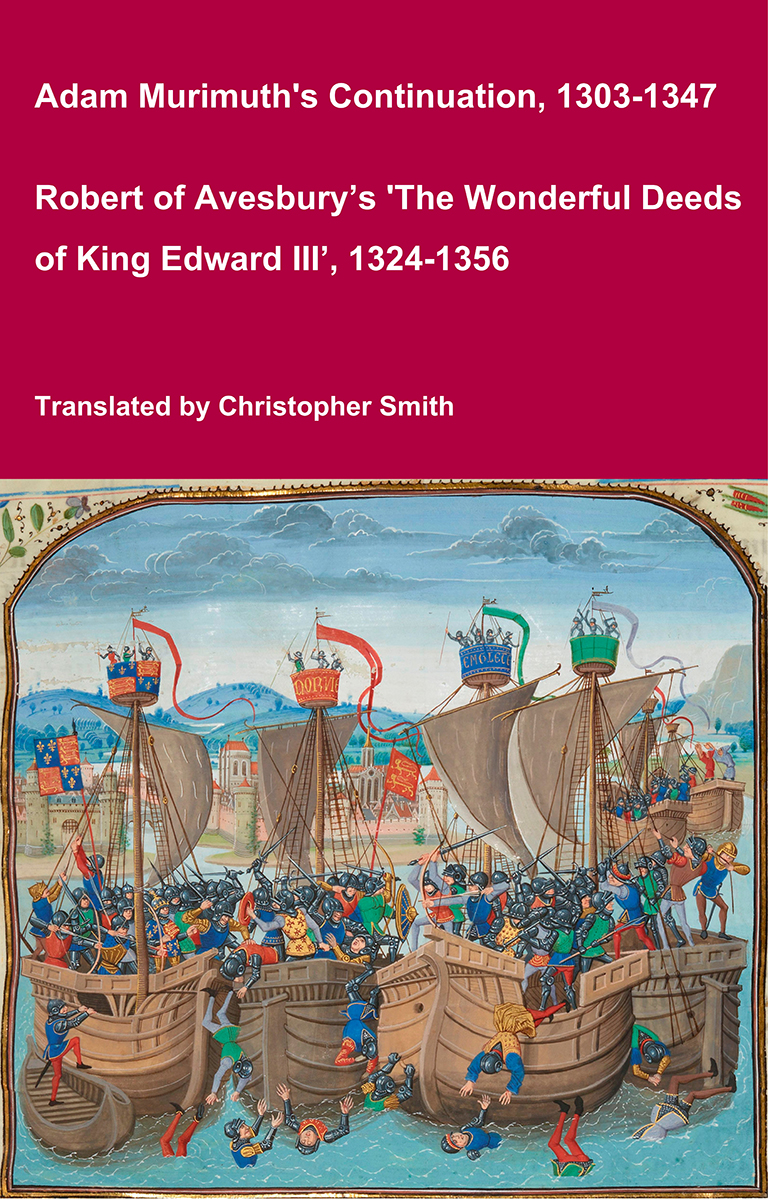
Adam Murimuth's Continuation and Robert of Avesbury’s 'The Wonderful Deeds of King Edward III'
This volume brings together two of the most important contemporary chronicles for the reign of Edward III and the opening phases of the Hundred Years’ War. Written in Latin by English clerical observers, these texts provide a vivid and authoritative window into the political, diplomatic, and military history of fourteenth-century England and its continental ambitions. Adam Murimuth Continuatio's Chronicarum continues an earlier chronicle into the mid-fourteenth century, offering concise but valuable notices on royal policy, foreign relations, and ecclesiastical affairs. Its annalistic structure makes it especially useful for establishing chronology and tracing the development of events year by year. Complementing it, Robert of Avesbury’s De gestis mirabilibus regis Edwardi tertii is a rich documentary chronicle preserving letters, treaties, and official records alongside narrative passages. It is an indispensable source for understanding Edward III’s claim to the French crown, the conduct of war, and the mechanisms of medieval diplomacy. Together, these works offer scholars, students, and enthusiasts a reliable and unembellished account of a transformative period in English and European history. Essential for anyone interested in medieval chronicles, the Hundred Years’ War, or the reign of Edward III.
Available at Amazon in eBook and Paperback format.
In 1675 Katherine Wright Lady Harington [aged 58] died.
In 1680 [her former husband] James Harington 3rd Baronet [aged 72] died in exile in Europe. His son Edmund [aged 45] succeeded 4th Baronet Harington of Ridlington in Rutlandshire. Sarah Alston Lady Harington by marriage Lady Harington of Ridlington in Rutlandshire.