

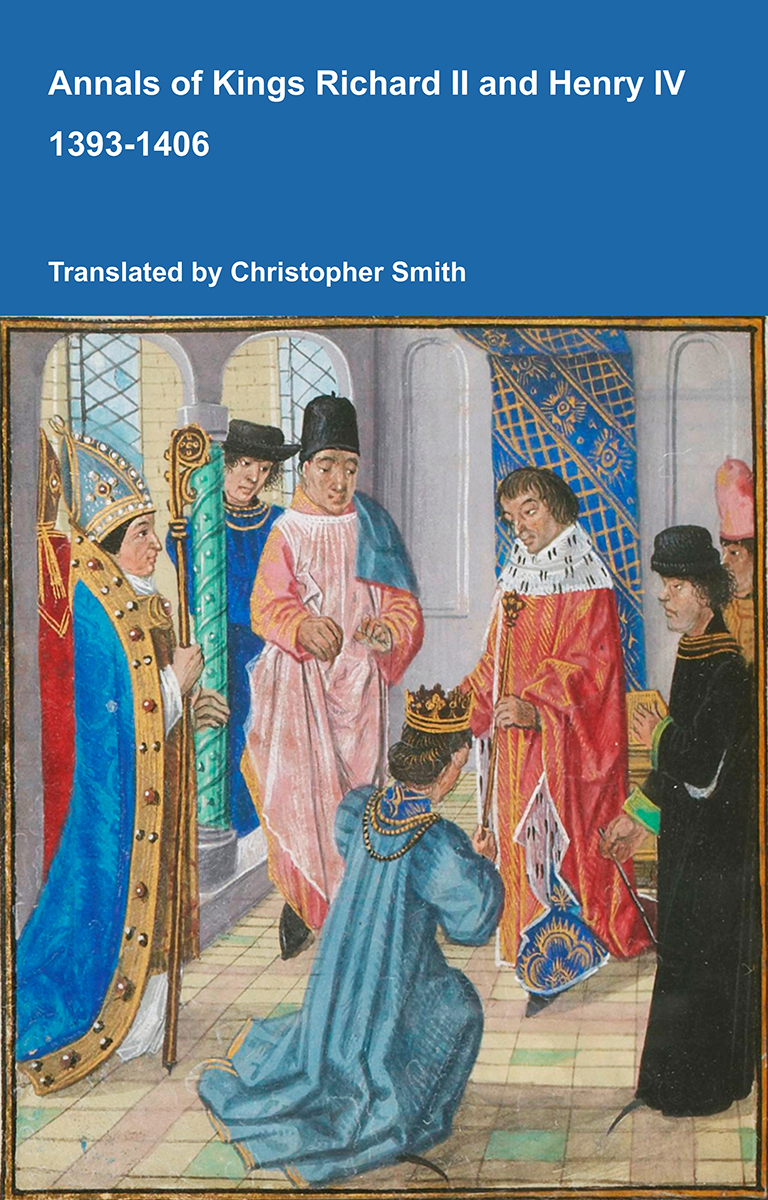
Annals of Kings Richard II and Henry IV 1393-1406
The Annals of Kings Richard II and Henry IV offers a vivid contemporary account of one of the most turbulent periods in late medieval England. Covering the reigns of Richard II and Henry IV, the chronicle records royal ceremonies, political conflict, rebellion, war, taxation, religious controversy, executions, popular unrest and remarkable portents. Its pages include a detailed description of Richard II’s coronation, the fall and deposition of the king, Henry IV’s seizure of the throne, the Percy rebellion, the execution of Archbishop Richard Scrope, the campaigns of Owain Glyndŵr, and England’s relations with Scotland, France, Portugal and Scandinavia. Alongside affairs of state, the annalist preserves reports of miracles, eclipses, prophecies, supernatural events and the experiences of ordinary townspeople, clergy, soldiers and travellers. Written from a monastic perspective, the work combines political observation with moral judgement, presenting victories and disasters as evidence of divine favour or punishment. At once a historical record and a reflection of medieval belief, the Annals provides an invaluable window into the challenges, ceremonies and conflicts of England at the turn of the fifteenth century.
Available at Amazon in eBook and Paperback format.
Life of Lawrence Alma-Tadema by Helen Zimmern. Laurens Alma Tadema was born on January 8th, 1836, at Dronryp, a little town in the very heart of the Frisian province of Holland. Hence by birth Tadema is Dutch, though by residence and naturalization he is now an Englishman. His Dutch birth, as we shall see later, was not without significant effect upon the development and character of his art. The father, Pieter Tadema, was an intelligent lawyer with a pronounced taste for music. Unfortunately, while the young Laurens was still a baby, this parent died, and his education and upbringing were left entirely in the hands of the mother. A woman of unusual capacity, she found herself at an early age with four children upon her hands—two, a girl and our painter, being her own offspring, and two her husband's by a previous marriage. The means at her disposal were small; but undaunted, she put herself to fight single-handed the battle of life, and with such success, that by her unassisted efforts she was able to place all her children well. Laurens, her youngest, was also something of her darling, and even as a child he realized all his mother was doing on her children's behalf. To her early example no doubt are due his great powers of perseverance, his undaunted application, his high-minded sense of duty.
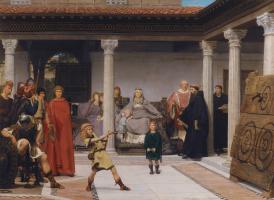
1861. Lawrence Alma-Tadema [aged 24]. "The Education of the Children of Clovis".
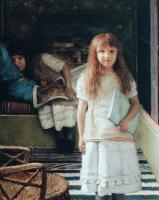
1863. Lawrence Alma-Tadema [aged 26]. A portrait of the artist's daughters Laurense and Anna Alma-Tadema.
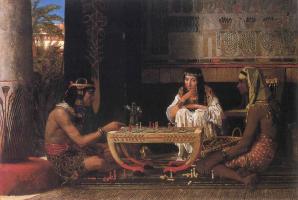
1865. Lawrence Alma-Tadema [aged 28]. "Egyptian Chess Players".
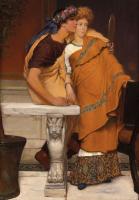
1865. Lawrence Alma-Tadema [aged 28]. "The Mirror".
Life of Lawrence Alma-Tadema by Helen Zimmern. Four years after joining her son [Lawrence Alma-Tadema [aged 28]], Madame Tadema died. It is sad to think that this good parent did not live to witness her son's world-wide fame, but pleasant to know that she still heard the praise aroused by some of his first exhibited pictures, and to see him the recipient of his first gold medal, that accorded to him at Amsterdam in 1862. In 1865 Tadema married a French lady, and removed to Brussels, where he remained until his wife's death. This occurred in 1869, when he was left alone with his sister and two little girls, the eldest, Laurence, who has developed into a gifted writer, and the second, Anna, the delicate, dainty artist who has inherited so much of her father's power for reproducing detail.
It was during the lifetime of his first wife that Alma Tadema paid his first visit to Italy and saw with his own eyes the homes of those Romans who were destined to become his most familiar friends.
Lawrence Alma-Tadema and Marie-Pauline Gressin-Dumoulin were married at the City Hall in Antwerp.
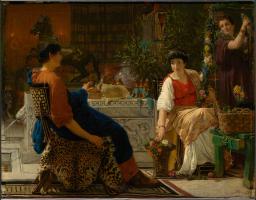
1866. Lawrence Alma-Tadema [aged 29]. "Preparations for the Festivities".
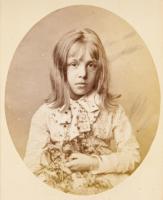
On 16th May 1867 [his daughter] Anna Alma-Tadema was born to Lawrence Alma-Tadema [aged 31] and [his wife] Marie-Pauline Gressin-Dumoulin.
Letters of Christina Rossetti. 56 Euston Square, N.W.
Friday afternoon, 14th. [May 1869]1
My dear Miss Boyd [aged 44]
Thank you warmly for so exceedingly kind an invitation, concerning which I will only put forward one regret, that Mrs Epps [Note. Not clear who Mrs Epps is since [his future wife] Laura Theresa Epps [aged 17] didn't marry Lawrence Alma-Tadema [aged 33] until 1871] should lose what might so have refreshed her both in mind and in body. And indeed, if I may, I will say that should it after all turn out that she could visit lovely Penkill you will without hesitation let me know your altered plans to which I shall most readily conform mine. On the other hand if I go, it will be a special indulgence to travel with the Scotts [Note. William Bell Scott [aged 58] and Letitia Margery Norquoy] and as you give me so generous a latitude I will even feel housed at the Castle until a companion offers with whom to start south again;-the journey being somewhat formidably lengthy. But this, of course, only in case it brings my visit within not altogether unreasonable dimensions. How very kind you are to me, and how much I should like to make my gratitude obvious to you. Knowing what a Dear Mrs Scott is, I think she will kindly let me know her plans in due course: meanwhile I expect to run down to Gloucester next week on a little visit to my Uncle if he will have me, but to be up again in time for Penkill.
My love, please, to Mrs Scott, and a kindred sentiment to Mr Scott. We saw Gabriel [aged 41] last night, but I know nothing at all about his summer plans.2
My Mother [aged 69] desires her most cordial remembrances to you, and adds her thanks to mine on my behalf.
Always and affectionately yours
Christina G. Rossetti [aged 38].
I expect you will find me quite a different order of being this year as regards walking, and I mean to trim up my old hat for possible croquet.
Note 1. Endorsed: "1867." CGR returned to Penkill in 1869, from 9 June to 22 July, not in 1867.
Life of Lawrence Alma-Tadema by Helen Zimmern. An accident brought Tadema to London in 1870, and here he at once took root. A year later he remarried1, his wife this time being Miss Laura Theresa Epps [aged 19], a woman of rare beauty, and herself a painter of distinction.
Note 1. In July 1871 Lawrence Alma-Tadema [aged 35] and Laura Theresa Epps were married.

1876. Lawrence Alma-Tadema [aged 39]. Portrait of [his wife] Laura Theresa Epps [aged 23].
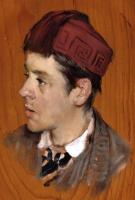
1877. Lawrence Alma-Tadema [aged 40]. Portrait of Henry Thompson 2nd Baronet [aged 17].
Henry Thompson 2nd Baronet: On 2nd April 1859 he was born to Henry Thompson 1st Baronet. On 18th April 1904 Henry Thompson 1st Baronet died. His son Henry succeeded 2nd Baronet Thompson of Wimpole Street in London. On 26th May 1944 he died. Baronet Thompson of Wimpole Street in London extinct.
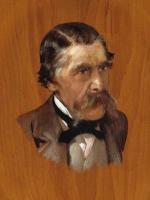
1878. Lawrence Alma-Tadema [aged 41]. Portrait of Henry Thompson 1st Baronet [aged 57].
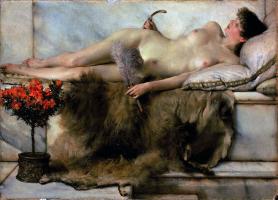
1881. Lawrence Alma-Tadema [aged 44]. "The Tepidarium".
1881. Lawrence Alma-Tadema [aged 44]. "Sappho and Alcaeus". It depicts a concert in the late 7th century BC, with the poet Alcaeus of Mytilene playing the kithara. In the audience is fellow Lesbos poet Sappho, accompanied by several of her female friends. Sappho is paying close attention to the performance, resting her arm on a cushion which bears a laurel wreath, presumably intended for the performer. The painting is based on Athenaeus' "The Deipnosophists" Book 13 Chapter 7:
With the fond love of Lesbian Alcæus,
Who sang the praises of the amorous Sappho,
And grieved his Teian rival, breathing songs
Such as the nightingale would gladly imitate;

1883. Lawrence Alma-Tadema [aged 46]. Portrait of Catherine Lucy Wilhelmina Stanhope Duchess of Cleveland [aged 63].

1885. Lawrence Alma-Tadema [aged 48]. "The Meeting of Antony and Cleopatra".
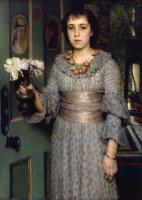
1885. Lawrence Alma-Tadema [aged 48]. Portrait of the artist's daughter Anna Alma-Tadema [aged 17].
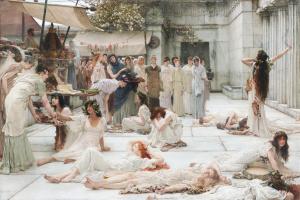
1887. Lawrence Alma-Tadema [aged 50]. "The Women of Amphissa". The artist's wife Laura Theresa Epps [aged 34] centre beneath the shield.
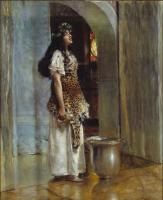
Around 1888. Lawrence Alma-Tadema [aged 51]. "A Priestess of Apollo".

1888. Lawrence Alma-Tadema [aged 51]. "The Roses of Heliogabalus". The painting depicts a, probably invented, episode in the life of the Roman emperor Elagabalus, also known as Heliogabalus, taken from the Augustan History. Alma-Tadema depicts Elagabalus smothering his unsuspecting guests with rose petals released from a false ceiling. The original references are:
He used to strew roses and all manner of flowers ... over his banqueting-rooms, his couches and his porticoes.
In a banqueting-room with a reversible ceiling he once buried his guests in violets and other flowers, so that some were actually smothered to death, being unable to crawl out to the top.
Stravit et triclinia de rosa et lectos et porticus.
Oppressit in tricliniis versatilibus parasitos suos violis et floribus, sic ut animam aliqui efflaverint, cum erepere ad summum non possent.
The painting was commissioned by Sir John Aird [aged 54], 1st Baronet for £4,000 in 1888.
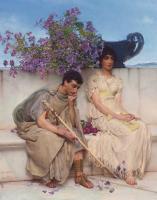
1890. Lawrence Alma-Tadema [aged 53]. "An Eloquent Silence".

Around 1891. Lawrence Alma-Tadema [aged 54]. Portrait of Arthur James Balfour 1st Earl Balfour [aged 42].

Around 1891. Lawrence Alma-Tadema [aged 54]. "Pandora". About to open the box - see Hesiod's Works and Days Lines 83 to 108 lines 90-94.

Around 1891. Lawrence Alma-Tadema [aged 54]. "Interrupted". Portrait of [his wife] Laura Theresa Epps [aged 38].
The Royal Academy Conversazione, 1891, by George Henry Grenville Manton [aged 36].


John Seymour Lucas, Dame Alice Ellen Terry [aged 43], Sir William Quiller Orchardson, Rachel, Countess of Dudley [aged 23], Marcus Stone, Henry Stacy Marks, Sir Henry Irving, Unidentified man, Unidentified man, Sir John Everett Millais [aged 61], William Charles Thomas Dobson.

Unidentified woman, James Sant, William Powell Frith, Sir Hubert von Herkomer [aged 41], Unidentified woman, Briton Riviere, Unidentified man, John Pettie, Sir Lawrence Alma-Tadema [aged 54], Frederic Leighton [aged 60], Baron Leighton.

Philip Hermogenes Calderon, Walter William Ouless, Thomas Faed, Robert Walker Macbeth, Edward Onslow Ford [aged 38], William Frederick Yeames, Unidentified woman, Sir Edward Coley Burne-Jones [aged 57], Unidentified man.

Mary Anderson, John Calcott Horsley, possibly Joanna Margaret Hadley, Unidentified man, Henry Tanworth Wells, possibly Alice Joanna Street, Marion Harry Spielmann, Unidentified woman.
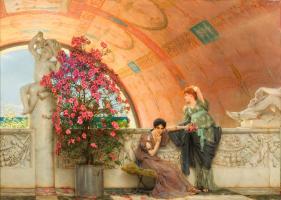
1893. Lawrence Alma-Tadema [aged 56]. "Unconscious Rivals ". The work was displayed at the Royal Academy's Summer Exhibition of 1893 at Burlington House in London. Today the painting is in the collection of the City Museum and Art Gallery in Bristol, having been acquired in 1935.
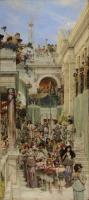
1894. Lawrence Alma-Tadema [aged 57]. "Spring".

1896. Lawrence Alma-Tadema [aged 59]. Self-Portrait.
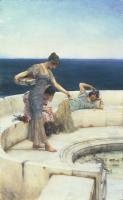
1903. Lawrence Alma-Tadema [aged 66]. "Silver Favourites".
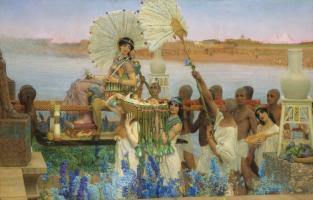
1904. Lawrence Alma-Tadema [aged 67]. "The Finding of Moses".
On 15th August 1909 [his wife] Laura Theresa Epps [aged 57] died.
On 25th June 1912 Lawrence Alma-Tadema [aged 76] died at Kaiserhof Spa, Wiesbaden, Germany where he had travelled with his daughter Anne [aged 45] for treatment of his stomach ulcers. He was buried in the crypt of St Paul's Cathedral [Map].