

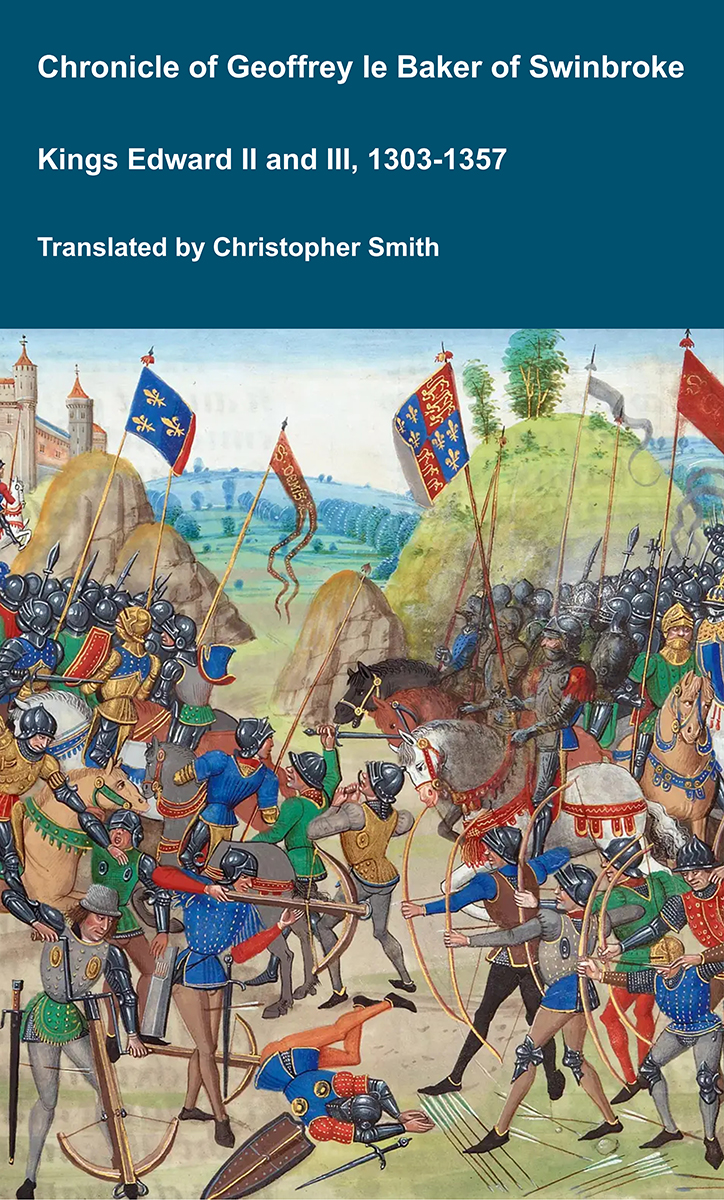
Chronicle of Geoffrey le Baker of Swinbroke
Baker was a secular clerk from Swinbroke, now Swinbrook, an Oxfordshire village two miles east of Burford. His Chronicle describes the events of the period 1303-1356: Gaveston, Bannockburn, Boroughbridge, the murder of King Edward II, the Scottish Wars, Sluys, Crécy, the Black Death, Winchelsea and Poitiers. To quote Herbert Bruce 'it possesses a vigorous and characteristic style, and its value for particular events between 1303 and 1356 has been recognised by its editor and by subsequent writers'. The book provides remarkable detail about the events it describes. Baker's text has been augmented with hundreds of notes, including extracts from other contemporary chronicles, such as the Annales Londonienses, Annales Paulini, Murimuth, Lanercost, Avesbury, Guisborough and Froissart to enrich the reader's understanding. The translation takes as its source the 'Chronicon Galfridi le Baker de Swynebroke' published in 1889, edited by Edward Maunde Thompson.
Available at Amazon in eBook and Paperback format.
Margaret de Cauz was born to John de Cauz and Alina de Bolam.
In or before 1210 [her father] John de Cauz and [her mother] Alina de Bolam were married.
In 1234 [her father] John de Cauz died.
Archaeologia Aeliana Series 4 Volume 32 Pages 126-159. 1234. [her father] John of Cauz died in 1234, and his widow, description as [her mother] Aline of Bolam, probably indicates that she resided there. Their heiress was a daughter, Margery, and her marriage was granted to Walter Gray [aged 54], archbishop of York, who married her to his nephew, [her future husband] William le Bretun.
Before 1246 William de Brito and Margaret de Cauz were married.
In 1246 Richard de Gosebek and Margaret de Cauz were married.
Archaeologia Aeliana Series 4 Volume 32 Pages 126-159. In 1246 both [her mother] Aline of Bolam and [her husband] William le Bretun were dead13, and the wealth of the young widow [Margaret de Cauz] excited the cupidity of a Suffolk knight, Sir Richard of Gosebek, who, with the assistance of a number of his friends, seized her at night, carried her off, and compelled her by force to be his wife14.
Note 13. N.C.H, X, 341, 342.
Note 14. Excerp. e Rot. Fin. in Turn Lon, I, 463 and 465. Cal. P.R. 1232-47, 489.
In 1246 [her mother] Alina de Bolam died.
Around 1246 [her husband] William de Brito died.
Archaeologia Aeliana Series 4 Volume 32 Pages 126-159. In October 1246 the king ordered the sheriff of Norfolk and Suffolk to put [her husband] Gosebek's accomplices in prison and to seize their lands and chattels, as well as those of Richard and Margery, while the sheriff of Berkshire was ordered to take possession of Margery's lands in that county16. Eventually, Richard and Margery regained possession of their estates.
Note 16. See note 14.
Archaeologia Aeliana Series 4 Volume 32 Pages 126-159. In 1256, however, it was stated that "Margery married herself to [her husband] Richard of Gosebek without the license of archbishop"15, the wording suggesting that Margery had connived at her own abduction.
Note 15. S.S., 88, p. 102.
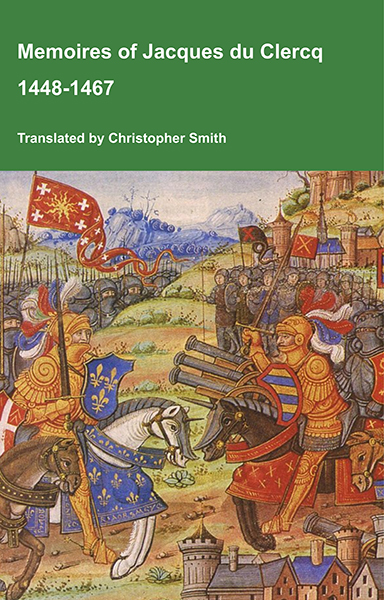
This is a translation of the 'Memoires of Jacques du Clercq', published in 1823 in two volumes, edited by Frederic, Baron de Reissenberg. In his introduction Reissenberg writes: 'Jacques du Clercq tells us that he was born in 1424, and that he was a licentiate in law and a counsellor to Philip the Good, Duke of Burgundy, in the castellany of Douai, Lille, and Orchies. It appears that he established his residence at Arras. In 1446, he married the daughter of Baldwin de la Lacherie, a gentleman who lived in Lille. We read in the fifth book of his Memoirs that his father, also named Jacques du Clercq, had married a lady of the Le Camelin family, from Compiègne. His ancestors, always attached to the counts of Flanders, had constantly served them, whether in their councils or in their armies.' The Memoires cover a period of nineteen years beginning in in 1448, ending in in 1467. It appears that the author had intended to extend the Memoirs beyond that date; no doubt illness or death prevented him from carrying out this plan. As Reissenberg writes the 'merit of this work lies in the simplicity of its narrative, in its tone of good faith, and in a certain air of frankness which naturally wins the reader’s confidence.' Du Clercq ranges from events of national and international importance, including events of the Wars of the Roses in England, to simple, everyday local events such as marriages, robberies, murders, trials and deaths, including that of his own father in Book 5; one of his last entries.
Available at Amazon in eBook and Paperback format.
In or before 1281 [her husband] Richard de Gosebek died.
Archaeologia Aeliana Series 4 Volume 32 Pages 126-159. 1281. [her husband] Richard of Gosebek23 was dead in 1281, holding moieties of Bolam, Aydon and South Middleton, and property at Cowpen24. The property was retained in the king's hands, however, as Margery, his widow, was in Suffolk and unable to take the required oath not to marry again without the king's consent25. A few months later she did homage, took the oath, and was given possession26.
At this time we again find a reference to Shortflatt [Map], in a charter granting land in Greenleighton (Lithdon) to Newminster Abbey [Map], one of the boundaries being defined as "the toft of the lady of Shortflatt" (dominae de Scortfiatte)27. The charter is undated, but it immediately follows one of Richard of Gosebek, and it seems probable that the lady of Shortflatt was Margery of Gosebek.
Note 23. For Richard's trans. with the Jews see Cal. Plea Rolls of Exch. of the Jews, II, 252, 314; and I, 217.
Note 24. I.P.M., 1281—Cal. Inq. Edw. I.
Note 25. I.P.M., 1281
Note 26. Cal. C.R., 1281, October 24th.
Note 27. S.S., LXVI, 90, 92.
Archaeologia Aeliana Series 4 Volume 32 Pages 126-159. 1284. Margery died in 1284, holding land in Bolam, Greenleighton, Deanham, East Brunton, Little Whittington and Aydon in capite by the service of 1½ knights' fees and 20s. castle-guard; and also "Le Scortflat [Map], the manor and 160 acres of land", and land in Middleton, Cambo, Shaftoe and Hawick of the heirs of Hugh of Bolbec, rendering 20s. yearly to those heirs28.
Note 28. Cal. Inq. Edw. I.
Note 29. App. A. In N.C.H., X, 331, William Middleton is identified with the person of that name who became vicar of Bolam before 1281 and was still vicar in Oct. 1294.
In 1285 Margaret de Cauz died.