

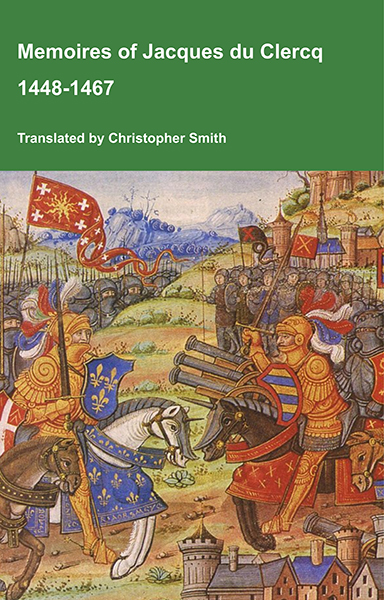
This is a translation of the 'Memoires of Jacques du Clercq', published in 1823 in two volumes, edited by Frederic, Baron de Reissenberg. In his introduction Reissenberg writes: 'Jacques du Clercq tells us that he was born in 1424, and that he was a licentiate in law and a counsellor to Philip the Good, Duke of Burgundy, in the castellany of Douai, Lille, and Orchies. It appears that he established his residence at Arras. In 1446, he married the daughter of Baldwin de la Lacherie, a gentleman who lived in Lille. We read in the fifth book of his Memoirs that his father, also named Jacques du Clercq, had married a lady of the Le Camelin family, from Compiègne. His ancestors, always attached to the counts of Flanders, had constantly served them, whether in their councils or in their armies.' The Memoires cover a period of nineteen years beginning in in 1448, ending in in 1467. It appears that the author had intended to extend the Memoirs beyond that date; no doubt illness or death prevented him from carrying out this plan. As Reissenberg writes the 'merit of this work lies in the simplicity of its narrative, in its tone of good faith, and in a certain air of frankness which naturally wins the reader’s confidence.' Du Clercq ranges from events of national and international importance, including events of the Wars of the Roses in England, to simple, everyday local events such as marriages, robberies, murders, trials and deaths, including that of his own father in Book 5; one of his last entries.
Available at Amazon in eBook and Paperback format.
In May 1821 Mary Ellen Peacock was born to [her father] Thomas Love Peacock.
In January 1844 Edward Nicolls and Mary Ellen Peacock [aged 22] were married.
On 11th March 1844 Edward Nicolls, a naval officer in command of the HMS Dwarf, drowned in the Shannon estuary while rescuing people in distress. His wife of two months Mary Ellen Peacock [aged 22], who was with Edward aboard the vessel, had encouraged him to undertake the rescue attempt in which he lost his life. She was pregnant at the time of her husband's death.
On 9th August 1849 George Meredith [aged 21] and Mary Ellen Peacock [aged 28] were married at St George's Church, Hanover Square. Their honeymoon was to the Rhine Valley where George had been to school.


In 1857 Mary Ellen Peacock [aged 35], wife of [her husband] George Meredith [aged 28], eloped with Henry Wallis [aged 26].

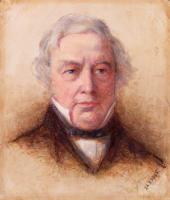
1857. Henry Wallis [aged 26]. Portrait of Mary Ellen Peacock [aged 35].
On 29th September 1857 Mary Ellen Peacock [aged 36] wrote to Henry Wallis [aged 27]:
"If we have to stay in England let us be at Clifton. I have no answer from [her husband] George [aged 29]. I imagine he wants to see Darvall [Henry Darvall] before writing. If he gives no reply in a week I shall take his silence for freedom and go abroad without another word, if you will like it, and where you will… I am always dreading to lose you because I feel I have no right to you, and I love you so really, so far beyond anything I have known of love, that there are ways in which I believe I could bear to lose you. God knows how hard it would be; but I believe I could bear it. Not by Death or weariness or anger. By Death I could not lose you
The love where Death has set his seal
Nor age can chill, nor rival steal
Nor falsehood disavow, (Lord Byron, Elegy on Thyrza)
But I do not fear your Death, because I feel how much you owe to Life, how much Life has for you, and surely I shall in no shape lead you Delilah-like to Death, since it is my one aim to add to your strength, my one prayer 'God grant that I may do this man no harm'. And for weariness or anger, if we begin to thread either of those paths we will part before they possess us."
1858. Henry Wallis [aged 27]. Portrait of Mary Ellen Peacock [aged 36], wife of [her husband] George Meredith [aged 29], with whom Henry Wallis had eloped the previous year.
In October 1861 Mary Ellen Peacock [aged 40] died.
Henrici Quinti, Angliæ Regis, Gesta, is a first-hand account of the Agincourt Campaign, and subsequent events to his death in 1422. The author of the first part was a Chaplain in King Henry's retinue who was present from King Henry's departure at Southampton in 1415, at the siege of Harfleur, the battle of Agincourt, and the celebrations on King Henry's return to London. The second part, by another writer, relates the events that took place including the negotiations at Troye, Henry's marriage and his death in 1422.
Available at Amazon in eBook and Paperback format.
On 18th May 1909 [her former husband] George Meredith [aged 81] died.