

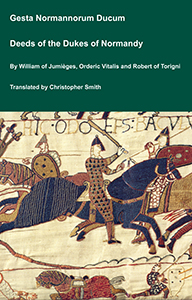
The Deeds of the Dukes of Normandy
The Gesta Normannorum Ducum [The Deeds of the Dukes of Normandy] is a landmark medieval chronicle tracing the rise and fall of the Norman dynasty from its early roots through the pivotal events surrounding the Norman Conquest of England. Originally penned in Latin by the monk William of Jumièges shortly before 1060 and later expanded at the behest of William the Conqueror, the work chronicles the deeds, politics, battles, and leadership of the Norman dukes, especially William’s own claim to the English throne. The narrative combines earlier historical sources with firsthand information and oral testimony to present an authoritative account of Normandy’s transformation from a Viking settlement into one of medieval Europe’s most powerful realms. William’s history emphasizes the legitimacy, military prowess, and governance of the Norman line, framing their expansion, including the conquest of England, as both divinely sanctioned and noble in purpose. Later chroniclers such as Orderic Vitalis and Robert of Torigni continued the history, extending the coverage into the 12th century, providing broader context on ducal rule and its impact. Today this classic work remains a foundational source for understanding Norman identity, medieval statesmanship, and the historical forces that reshaped England and Western Europe between 800AD and 1100AD.
Available at Amazon in eBook and Paperback format.
On 24th September 1869 Maud Cunnington née Pegge was born.
In 1889 Benjamin Howard Cunnington (age 28) and Maud Cunnington née Pegge (age 19) were married.
Wiltshire Archaeological Magazine 1907 V35 Pages 1-20. Notes on the Opening of a Bronze Age Barrow at Manton [Manton Barrow aka Preshute G1a [Map]], near Marlborough By Mrs M E Cunnington (age 37).


Wiltshire Archaeological Magazine 1910 V36 Pages 311-317. Notes On Barrows [King's Play Hill Long Barrow [Map], King's Play Hill Round Barrow 1 [Map], King's Play Hill Round Barrow 2 [Map]] On King's Play Down, Heddington.1 By Maud E. Cunnington (age 40).
Note 1. The three barrows here described were opened by Mr. B. H. Cunnington and myself in August, 1907, by kind permission of Captain Spicer, of Spye Park and of his tenant, Mr. Peak-Garland.
Wiltshire Archaeological Magazine 1910 V36 Pages 300-310. The Discovery Of A Chamber In The Long Barrow At Lanhill [Lanhill Long Barrow aka Hubba's Low [Map]], Near Chippenham. By Maud E. Cunnington (age 40).
Wiltshire Archaeological Magazine 1913 V38 Pages 1-11. June 1913. The Re-Erection of Two Fallen Stones [Longstones Cove aka Devil's Quoits [Map]], and Discovery of an Interment with Drinking Cup, At Avebury.1 By Mrs. M. E. Cunnington (age 43).
Wiltshire Archaeological Magazine 1913 V38 Pages 379-414. June 1914. List Of The Long Barrows Of Wiltshire. By Mrs. M. E. Cunnington (age 44).
[Referred to in the previous List of Prehistoric Antiquities, pp. 153—378, as "Appendix, Long Barrows."]
Wiltshire Archaeological Magazine 1925 V43 Pages 48-58. Figsbury Rings [Map]. An Account Of Excavations In 19241. By Mrs. M. E. Cunnington (age 55).
Wiltshire Archaeological Magazine 1930 V45 Pages 300-335. The "Sanctuary" [Map] On Overton Hill, Near Avebury. By M. E. Cunnington (age 60). Being an account of excavations carried out by Mr. and Mrs. B. H, Cunnington in 1930.
The History of William Marshal was commissioned by his son shortly after William’s death in 1219 to celebrate the Marshal’s remarkable life; it is an authentic, contemporary voice. The manuscript was discovered in 1861 by French historian Paul Meyer. Meyer published the manuscript in its original Anglo-French in 1891 in two books. This book is a line by line translation of the first of Meyer’s books; lines 1-10152. Book 1 of the History begins in 1139 and ends in 1194. It describes the events of the Anarchy, the role of William’s father John, John’s marriages, William’s childhood, his role as a hostage at the siege of Newbury, his injury and imprisonment in Poitou where he met Eleanor of Aquitaine and his life as a knight errant. It continues with the accusation against him of an improper relationship with Margaret, wife of Henry the Young King, his exile, and return, the death of Henry the Young King, the rebellion of Richard, the future King Richard I, war with France, the death of King Henry II, and the capture of King Richard, and the rebellion of John, the future King John. It ends with the release of King Richard and the death of John Marshal.
Available at Amazon in eBook and Paperback format.
In 1950 [her husband] Benjamin Howard Cunnington (age 89) died.
On 28th February 1951 Maud Cunnington née Pegge (age 81) died.

Longstones Cove aka Devil's Quoits [Map], aka Adam and Eve, Longstone Cove, Devil's Coits, describe two large upright sarsen stones in a field to the south-west of the Avebury Henge. One of the stones fell and was re-erected in 1911. During the course of its re-erection husband and wife Benjamin and Maud Cunnington discovered a crouched skeleton with beaker ware at its foot. When re-erected the larger stone, known as Adam, was rotated by around 45 degress clockwise from its original position.
Antiquity 2022 Volume 96.2: References. Cunnington, M. 1929. Woodhenge. Devizes: privately published.