

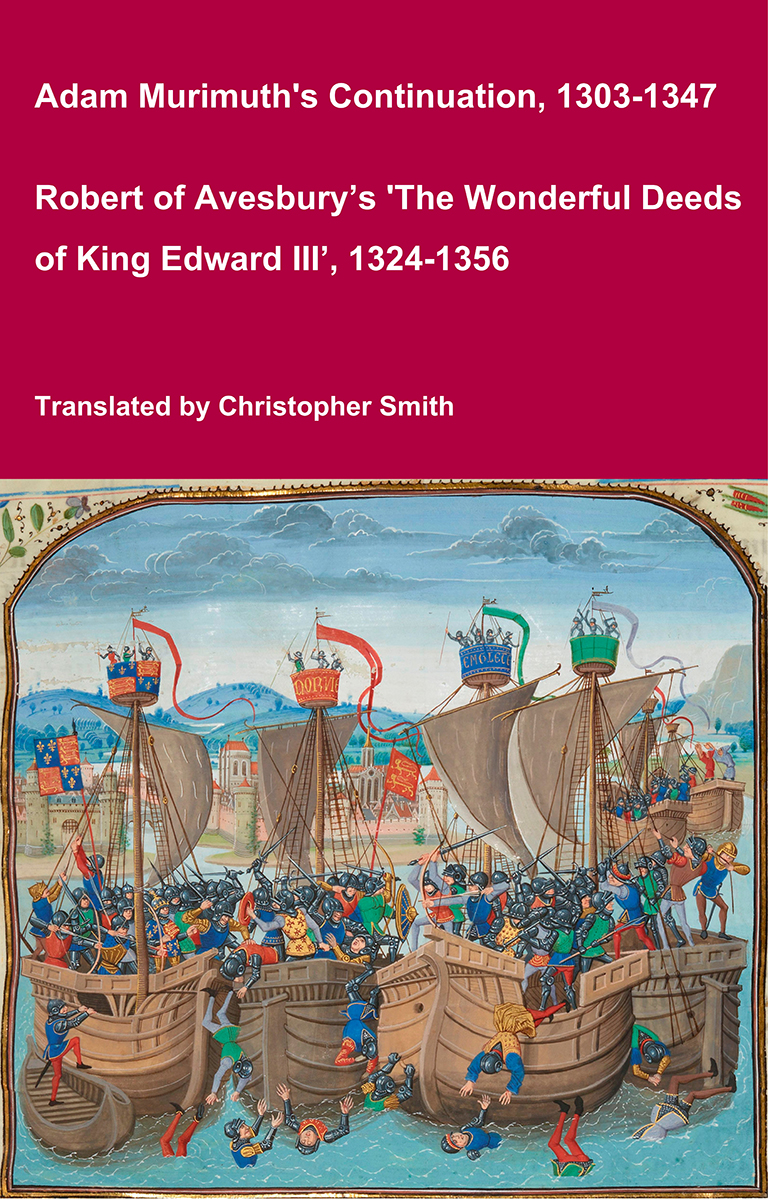
Adam Murimuth's Continuation and Robert of Avesbury’s 'The Wonderful Deeds of King Edward III'
This volume brings together two of the most important contemporary chronicles for the reign of Edward III and the opening phases of the Hundred Years’ War. Written in Latin by English clerical observers, these texts provide a vivid and authoritative window into the political, diplomatic, and military history of fourteenth-century England and its continental ambitions. Adam Murimuth Continuatio's Chronicarum continues an earlier chronicle into the mid-fourteenth century, offering concise but valuable notices on royal policy, foreign relations, and ecclesiastical affairs. Its annalistic structure makes it especially useful for establishing chronology and tracing the development of events year by year. Complementing it, Robert of Avesbury’s De gestis mirabilibus regis Edwardi tertii is a rich documentary chronicle preserving letters, treaties, and official records alongside narrative passages. It is an indispensable source for understanding Edward III’s claim to the French crown, the conduct of war, and the mechanisms of medieval diplomacy. Together, these works offer scholars, students, and enthusiasts a reliable and unembellished account of a transformative period in English and European history. Essential for anyone interested in medieval chronicles, the Hundred Years’ War, or the reign of Edward III.
Available at Amazon in eBook and Paperback format.
In 1488 Miles Coverdale was born.

Henry Machyn's Diary. 24th November 1550. The xxiiij day of November was bered the nobulle ca[ptayn] ser James Wylfford knyght, sum tyme captayn in Franse and .... and ded at the Cruchydffrers, and was cared to beryng from [thence] unto lytyll saynt Bathellmuw besyd sant Antonys, with a standard, a penon, and a harold carehyng the cott armur, and mony m [ourners], and bered in the sam tombe that ys grett unckulle M. James [Wylfford]. Ther was at ys bereyng my lord Gray and the Wylfford ... captaynes, and the company of the Clarkes. Mylles Coverdalle [aged 62] dyd [preach].
Note. Funeral of sir James Wylford. The blank in this passage may be filled up with "Scotland." See the Memoirs of Lord Grey of Wilton, by Sir Philip Egerton, p. 47. Sir James Wilford was knighted by the duke of Somerset after the taking of Leith, Sept. 28, 1547. Holinshed also mentions the circumstance of his being taken prisoner at Dunbar in 1549, by a Gascoigne of the country of Basque called Pellicque, "that won no smal commendation for that his good happe, in taking such a prisoner, whose name for his often approved prowes was so famous among the enimies." This noble captain was of a city family, which had buried for some generations at St. Bartholomew the Little. James Wilford, taylor, one of the sheriffs 1499, founded by will a sermon there on Good Friday for ever. John Wilford, merchant-taylor, alderman, was buried there 1544. (Stowe.)
Henry Machyn's Diary. 7th March 1551. The vij day of Marche was bered my lord Wentworth [deceased], the lord Chamburlayn of the kynges howse, in Westminster abbay, in the sam chapell [Map] that the old abbatt was be [red; there] was iiij of the cheyffe harolds ther, M. Garter, M. Clar [enceux,] M. Yorke, M. Chester, beyryng the cote armur, the elmett, t[arget], then cam the standard, and then mornars alle in blake ... and a C. chylderyn and prestes and clarkes in ther surpl[ices; then] the cors with iiij baners rolles, and the qwyre was hangyd [with black] and the raylles and armes. Mylles Coverdalle [aged 63] dyd pryche, and ther [was a grett] dolle, and a grett compeny of lordes and knyghtes and genty[lmen] morners.
Note. Funeral of lord Wentworth. "March 3. The lord Wentworth lord chambarlaine died about tenne of the cloke at night, leaving behind him 16 children." (King Edward's Diary.)" Thomas lord Wentworth, lord chamberlan of the kinges majesties most honerable houshold, dyed in the kinges majesties paleys at Westmynster on tewsday the 3. of Marche in the 5 yere of E. the 6. and from thence broughte to his house at Westmynster and was buryed in the mynster there on Saterday the 7. of Marche folowing." (MS. Harl. 897, f. 7S^.) A longer account of his funeral is preserved in the College of Arms, I. 11, f. 115. He was buried in the chapel of St. John the Evangelist (Dart ii. 60), but has no monument. There is a portrait of him among Chamberlain's Holbein Heads.


Foxe's Book of Martyrs. 4th February 1555. The fourth of February suffered the constant martyr of God, Master John Rogers [aged 50], concerning whose life, examinations, and suffering, here followeth in order set forth. And first touching his life and bringing up.
John Rogers, brought up in the university of Cambridge, where he profitably travailed in good learning, at length was chosen and called by the merchant adventurers to be their chaplain at Antwerp in Brabant, whom he served to their good contentation many years. It chanced him there to fall in company with that worthy servant and martyr of God William Tyndale, and with Miles Coverdale [aged 67], who both, for the hatred they bare to popish superstition and idolatry, and love to true religion, had forsaken their native country. In conferring with them the Scriptures, he came to great knowledge in the gospel of God, insomuch that he cast off the heavy yoke of popery, perceiving it to be impure and filthy idolatry, and joined himself with them two in that painful and most profitable labour of translating the Bible into the English tongue, which is entitled, The Translation of Thomas Matthewe. He, knowing by the Scriptures, that unlawful vows may lawfully be broken, and that matrimony is both honest and honourable among all men, joined himself in lawful matrimony, and so went to Wittenberg in Saxony, where he, with much soberness of living, did not only greatly increase in all good and godly learning, but also so much profited in the knowledge of the Dutch tongue, that the charge of a congregation was orderly committed to his cure.
In which ministry he diligently and faithfully served many years, until such time as it pleased God, by the faithful travail of his chosen and dear servant, King Edward the Sixth, utterly to banish all popery forth of England, and to receive in true religion, setting God's gospel at liberty. He then, being orderly called, having both a conscience, and a ready good will to help forward the work of the Lord in his native country, left such honest and certain conditions as he had in Saxony, and came into England to preach the gospel, without certainty of any condition. In which office, after he had a space diligently and faithfully travailed, Nicholas Ridley, then bishop of London, gave him a prebend in the cathedral church of Paul; and the dean and the chapter chose him to be the reader of the divinity-lesson there; wherein he diligently travailed, until such time, as Queen Mary, obtaining the crown, banished the gospel and true religion, and brought in the antichrist of Rome, with his idolatry and superstition
After the queen was come to the Tower of London, he, being orderly called thereunto, made a godly and vehement sermon at Paul's Cross, confirming such true doctrine as he and others had there taught in King Edward's days, exhorting the people constantly to remain in the same, and to beware of all pestilent popery, idolatry, and superstition. The council, being then overmatched with popish and bloody bishops, called him to account for his sermon: to whom he made a stout, witty, and godly answer; and yet in such sort handled himself, that at that time he was clearly dismissed. But after that proclamation was set forth by the queen to prohibit true preaching, he was called again before the council; for the bishops thirsted after his blood. The council quarrelled with him concerning his doctrine, and in conclusion commanded him as prisoner to keep his own house; and so he did; although by flying, he might easily have escaped their cruel hands, and many things there were which might have moved him thereunto. He did see the recovery of religion in England, for that present, desperate; he knew he could not want a living in Germany; and he could not forget his wife and ten children, and to seek means to succour them. But all these things set apart, after he was called to answer in Christ's cause, he would not depart, but stoutly stood in defence of the same, and for the trial of that truth, was content to hazard his life.
Thus he remained in his own house as prisoner a long time, till at length, through the uncharitable procurement of Bonner [aged 55], bishop of London, who could not abide such honest neighbours to dwell by him, he was removed from his own house to the prison called Newgate, where he was lodged among thieves and murderers for a great space; during which time, what business he had with the adversaries of Christ, all is not known, neither yet any certainty of his examinations, further than he himself did leave in writing; which God would not to be lost, but to remain for a perpetual testimony in the cause of God's truth, as here followeth recorded and testified by his own writing.
Description of the examination by Lord Chancellor Bishop Stephen Gardiner [aged 72].

Henry Machyn's Diary. 14th June 1555. The xiiij day (of) Juin was a proclamassyon [that all] bokes shuld be broyth [brought] in of Luter, Tendalles, .... and Coverdals [aged 67] and bysshope Cremer [aged 65], and all shyche as .... shuys and all hereses bokes, and he that dyd nott [bring them] in with-in the xv days after shuld go to presun with-owt prysse, of what degre they be of.
Note. P. 90. Proclamation for bringing in heretical books. A printed copy of this, dated 13 June, is in the collection at the Society of Antiquaries: it is inserted in Foxe's Actes and Monuments, vol. iii. p. 271. Of its objects see also Strype, Mem. vol. iii. p. 250.
Henry Machyn's Diary. 12th November 1559. [The xij day of November preached at Paul's cross [Map]] Coverdall [aged 71] the (unfinished)
Henry Machyn's Diary. 28th April 1560. The xxviij day of (April) dyd pryche at the [Paul's] crosse [Map] master Coverdalle [aged 72], and ther was my lord mare [aged 64] and the althermen, and ther was grett audyense.
Henry Machyn's Diary. 27th March 1562. The sam day prychyd at Powlles crosse the parson of sant Mangnus [aged 74].
Henry Machyn's Diary. 30th July 1562. The xxx day of July was bered in sant Talphes in Crepullgatt mastores Parston, late the wyff of master Howelle doctur of phesyke, with a xij clarkes syngyng; and then cam the corse with vj skochyons of bokeram, and a xij mornars, and xvj pore women in blake gownes; and master Coverdalle [aged 74] mad the sermon; and after to the plase to dener.
Henry Machyn's Diary. 29th March 1563. The xxix day of Marche was browthe from sant Savyour's late abbay in Barmsey-strett to be bered my good lade Lane the wyff of ser Robart Lane of Northamtunshyre, and was bered in sant Towllys in Sowthwarke [Map], and ded in chyld-bede; and with xx clarkes, and a-for the corse a xij of her servandes in blake cottes a-for here, and then cam serten gentyll-men mornars, and then cam the penon of armes borne by a gentyll-man, and then cam master Clarenshux [aged 53], and next the corse borne by vj women, and iiij gentyll-men mornars beyryng the iiij corners of the palle of blake velvett, and with armes, and after to the chyrche, and syngyng the clarkes; andt her dyd pryche master Coverdalle [aged 75].
On 20th January 1569 Miles Coverdale [aged 81] died.