

William of Worcester's Chronicle of England
William of Worcester, born around 1415, and died around 1482 was secretary to John Fastolf, the renowned soldier of the Hundred Years War, during which time he collected documents, letters, and wrote a record of events. Following their return to England in 1440 William was witness to major events. Twice in his chronicle he uses the first person: 1. when writing about the murder of Thomas, 7th Baron Scales, in 1460, he writes '… and I saw him lying naked in the cemetery near the porch of the church of St. Mary Overie in Southwark …' and 2. describing King Edward IV's entry into London in 1461 he writes '… proclaimed that all the people themselves were to recognize and acknowledge Edward as king. I was present and heard this, and immediately went down with them into the city'. William’s Chronicle is rich in detail. It is the source of much information about the Wars of the Roses, including the term 'Diabolical Marriage' to describe the marriage of Queen Elizabeth Woodville’s brother John’s marriage to Katherine, Dowager Duchess of Norfolk, he aged twenty, she sixty-five or more, and the story about a paper crown being placed in mockery on the severed head of Richard, 3rd Duke of York.
Available at Amazon in eBook and Paperback format.
Before 16th November 1781 [his father] Reverend James Hodgson (age 32) and [his mother] Jane Coke (age 27) were married.
On 16th November 1781 Reverend Francis Hodgson was born to [his father] Reverend James Hodgson (age 32) and [his mother] Jane Coke (age 27). He was educated at Whitgift School, before proceeding to Eton College [Map] as a King's Scholar, and then as a Scholar to King's College, Cambridge University [Map].
In 1790 [his mother] Jane Coke (age 36) died.
In 1806 Reverend Francis Hodgson (age 24) was appointed Assistant Master at Eton College [Map] which position he resigned after a year to become a resident tutor and Fellow at King's College, Cambridge University [Map]. It was there that he met and formed a lifelong friendship with the poet Lord Byron (age 17), who was at that time an undergraduate at Trinity College [Map]. Their friendship is recorded in the many letters between them that have been published in biographies of Byron.


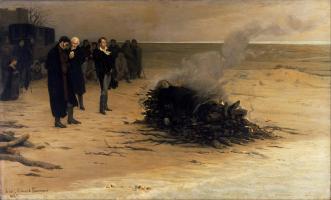
In 1810 [his father] Reverend James Hodgson (age 61) died.
In 1813 Reverend Francis Hodgson (age 31) wished to marry [his future wife] Susanna Matilda Tayler (age 21) (sister-in-law of Henry Drury, master at Harrow School). However Susanna's mother objected to her daughter marrying Hodgson, due to his association with the infamous Byron. Her objection was overcome by Byron himself, who drove with Hodgson in a post-chaise from London to Oxford to plead the cause of his friend with Susanna's uncle Charles Henry Hall, Dean of Christ Church, Oxford.
In 1815 Reverend Francis Hodgson (age 33) and Susanna Matilda Tayler (age 23) were married.
In 1816 Reverend Francis Hodgson (age 34) was appointed Vicar of All Saint's Church, Bakewell, Derbyshire [Map] which office he held until 1840.
On 6th October 1833 [his wife] Susanna Matilda Tayler (age 42) died at Lower Moor, Eardisley.
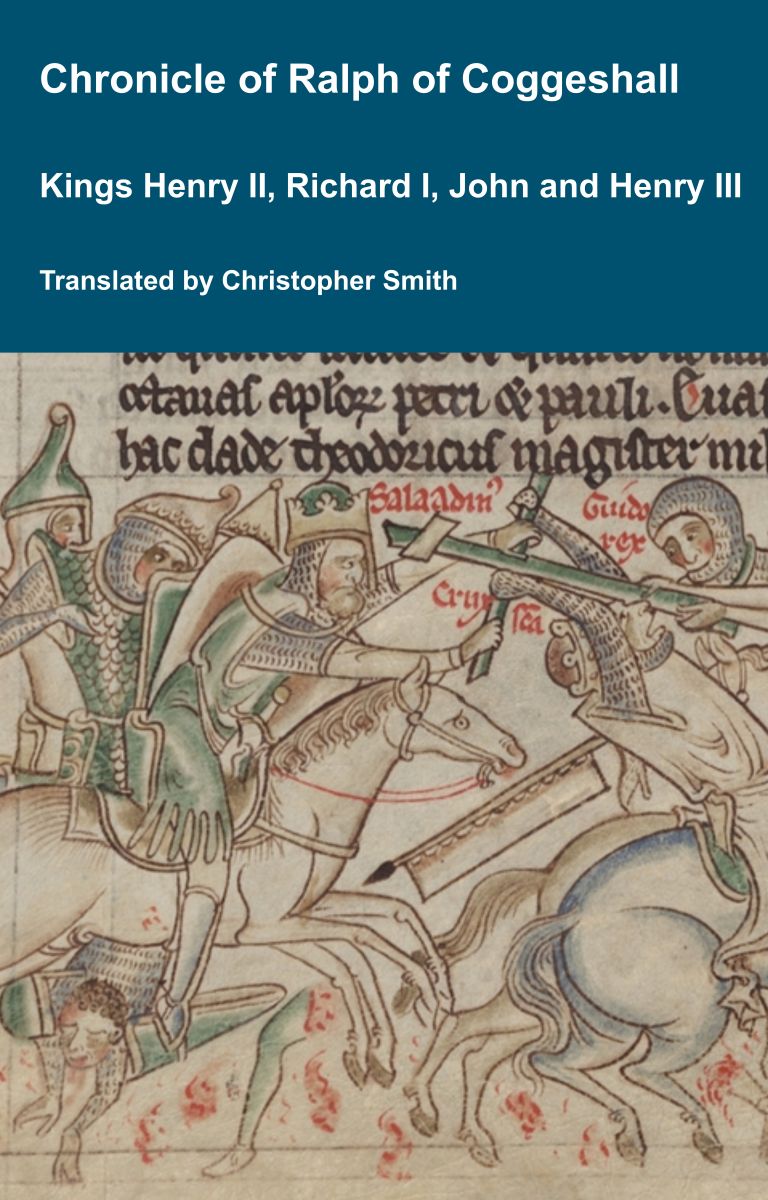
Chronicle of Abbot Ralph of Coggeshall
The Chronicle of Abbot Ralph of Coggeshall (Chronicon Anglicanum) is an indispensable medieval history that brings to life centuries of English and European affairs through the eyes of a learned Cistercian monk. Ralph of Coggeshall, abbot of the Abbey of Coggeshall in Essex in the early 13th century, continued and expanded his community’s chronicle, documenting events from the Norman Conquest of 1066 into the tumultuous reign of King Henry III. Blending eyewitness testimony, careful compilation, and the monastic commitment to record-keeping, this chronicle offers a rare narrative of political intrigue, royal power struggles, and social upheaval in England and beyond. Ralph’s work captures the reigns of pivotal figures such as Richard I and King John, providing invaluable insights into their characters, decisions, and the forces that shaped medieval rule. More than a simple annal, Chronicon Anglicanum conveys the texture of medieval life and governance, making it a rich source for scholars and readers fascinated by English history, monastic authorship, and the shaping of the medieval world.
Available at Amazon in eBook and Paperback format.
In 1838 Reverend Francis Hodgson (age 56) and Eliza Denman were married.
In March 1840 Reverend Francis Hodgson (age 58) returned to Eton, having been nominated to be Provost by the Queen on the advice of Prime Minister Lord Melbourne. The Fellows of Eton, however, rejected his nomination on the basis that Hodgson was not a Doctor of Divinity, a qualification that had always previously been required for the post. They instead elected John Lonsdale, but when Lonsdale became aware of the situation, he stood down in favour of Hodgson.

After 1852. Church of St Mary Magdalene, Eardisley [Map]. Memorial to Reverend Francis Hodgson (age 70).
Before 29th December 1852 Reverend Francis Hodgson (age 71) was appointed Archdeacon of Derby.
On 29th December 1852 Reverend Francis Hodgson (age 71) died at the Provost's Lodge, Eton College. He was buried at Eton College Chapel [Map].
Father: Reverend James Hodgson
Great x 4 Grandfather: Bishop George Coke
Great x 3 Grandfather: William Coke
Great x 2 Grandfather: Francis Coke
Great x 1 Grandfather: George Coke
GrandFather: Richard Coke
Mother: Jane Coke