

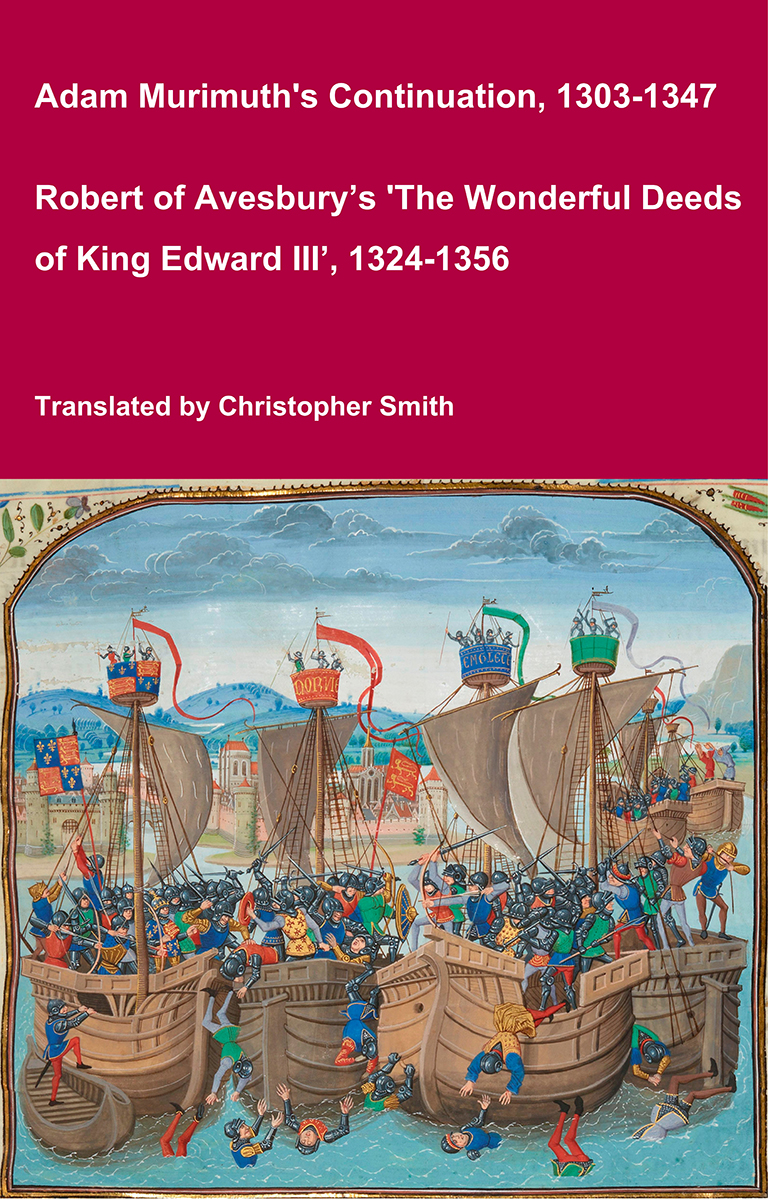
Adam Murimuth's Continuation and Robert of Avesbury’s 'The Wonderful Deeds of King Edward III'
This volume brings together two of the most important contemporary chronicles for the reign of Edward III and the opening phases of the Hundred Years’ War. Written in Latin by English clerical observers, these texts provide a vivid and authoritative window into the political, diplomatic, and military history of fourteenth-century England and its continental ambitions. Adam Murimuth Continuatio's Chronicarum continues an earlier chronicle into the mid-fourteenth century, offering concise but valuable notices on royal policy, foreign relations, and ecclesiastical affairs. Its annalistic structure makes it especially useful for establishing chronology and tracing the development of events year by year. Complementing it, Robert of Avesbury’s De gestis mirabilibus regis Edwardi tertii is a rich documentary chronicle preserving letters, treaties, and official records alongside narrative passages. It is an indispensable source for understanding Edward III’s claim to the French crown, the conduct of war, and the mechanisms of medieval diplomacy. Together, these works offer scholars, students, and enthusiasts a reliable and unembellished account of a transformative period in English and European history. Essential for anyone interested in medieval chronicles, the Hundred Years’ War, or the reign of Edward III.
Available at Amazon in eBook and Paperback format.
On 15th September 1633 William Croone was born.
On 11th December 1642 William Croone [aged 9] was admitted to the Merchant Taylors' School.
On 13th May 1647 William Croone [aged 13] was admitted a pensioner of Emmanuel College, Cambridge University, graduating B.A. in 1651, and M.A. in 1654
On 4th June 1662 William Croone [aged 28] gave a lecture before the Royal Society; the first documented use of a preservative fluid (ethanol in this case) for long-term curation of museum specimens. 4th June is celebrated at the Natural History Museum as 'Croone Day'.
Minutes of the Royal Society. 11th June 1662. 82. Royal Society Meeting Minutes.
Sir Robert Moray [aged 54] President.
Dr Petty's [aged 51] brother [aged 42] showed the Society a draft of the pleasure boat he is to make for the King [aged 32].
Lord Berkeley of Berkely [aged 13] presented the Society with a Bird of Paradise having two feet.
Dr Goddard brought in a moth with feathered wings.
Mr Evelyn [aged 41] presentd the Society with a book called 'The History of Chalcogrphij'.
Mr Ball to be asked to produce his 'Magnetick Instruments',
Mr Boyle1 presented the Society with a book of the 'Weight and Spring of Air'; and also with a glass tube filled with Minium, wherewith the experiment of filtering was made.
The Amanuensis to enquire about the depth of the water under the arches of London Bridge.
Mr Croone [aged 28] to write to Dr Power about the trial of heat and cold in deep caves.
The Amanuensis to bespeak the long glass tube for the Torricellian Experiment.
Note 1. Not clear which Mr Boyle this is since Richard Boyle was elected 20th May 1663 and Robert Boyle [aged 36] on 22nd April 1663.


Minutes of the Royal Society. 18th June 1662. 83. Royal Society Meeting Minutes.
Mr Palmer showed the company three pieces of painted silk material
Mr Croone [aged 28] read Mr Evelyn's [aged 41] account of the Rowling press.
The Amanuensis to provide a box of blacking.
Dr Goddard [aged 45] set several pieces fo gold to anneal and showed their allays.
Mr Palmer to speak to Mr Grigory to come to the Society for the discourse fo the tinged stuffs.
Dr Goddard rea his account of the refining of gold by Antimony and Aqua Regis: It was ordered to be registered. [Note in margin; fol. 167]
Sir Robert Moray [aged 54] read his account of the sounding of the depths of water without a line. Ordered ti be registered. [Note in margin; for. 178]
The Operator to enquire of the length of time fishermen keep their fishes without feeding them.
Sir William Petty [aged 39] proposed a Standard for knowing the velocity of seimming bodies.
Samuel Pepys' Diary. 14th November 1666. So took up my wife, her brother being yet very bad, and doubtful whether he will recover or no, and so to St. Ellen's [St. Helen's], and there sent my wife home, and myself to the Pope's Head, where all the Houblons were, and Dr. Croone [aged 33]1, and by and by to an exceeding pretty supper, excellent discourse of all sorts, and indeed [they] are a set of the finest gentlemen that ever I met withal in my life. Here Dr. Croone told me, that, at the meeting at Gresham College to-night, which, it seems, they now have every Wednesday again, there was a pretty experiment of the blood of one dogg let out, till he died, into the body of another on one side, while all his own run out on the other side2. The first died upon the place, and the other very well, and likely to do well. This did give occasion to many pretty wishes, as of the blood of a Quaker to be let into an Archbishop, and such like; but, as Dr. Croone says, may, if it takes, be of mighty use to man's health, for the amending of bad blood by borrowing from a better body.
Note 1. William Croune, or Croone, of Emanuel College, Cambridge, chosen Rhetoric Professor at Gresham College, 1659, F.R.S. and M.D. Died October 12th, 1684, and was interred at St. Mildred's in the Poultry. He was a prominent Fellow of the Royal Society and first Registrar. In accordance with his wishes his widow (who married Sir Edwin Sadleir, Bart.) left by will one-fifth of the clear rent of the King's Head tavern in or near Old Fish Street, at the corner of Lambeth Hill, to the Royal Society for the support of a lecture and illustrative experiments for the advancement of natural knowledge on local motion. The Croonian lecture is still delivered before the Royal Society.
Note 2. At the meeting on November 14th, "the experiment of transfusing the blood of one dog into another was made before the Society by Mr. King and Mr. Thomas Coxe upon a little mastiff and a spaniel with very good success, the former bleeding to death, and the latter receiving the blood of the other, and emitting so much of his own, as to make him capable of receiving that of the other". On November 21st the spaniel "was produced and found very well" (Birch's "History of the Royal Society", vol. ii., pp. 123, 125). The experiment of transfusion of blood, which occupied much of the attention of the Royal Society in its early days, was revived within the last few years.
On 28th August 1670 William Croone [aged 36] was appointed anatomy lecturer on the muscles by the Company of Surgeons, which office he held until his death.
On 29th July 1675 William Croone [aged 41] was admitted a candidate of the Royal College of Physicians.
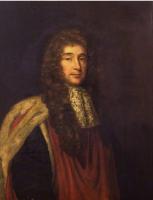
1680. Mary Beale aka Cradock [aged 46]. Portrait of William Croone [aged 46].
Before 12th October 1684 William Croone [aged 51] and Mary Lorymer were married.
On 12th October 1684 William Croone [aged 51] died.
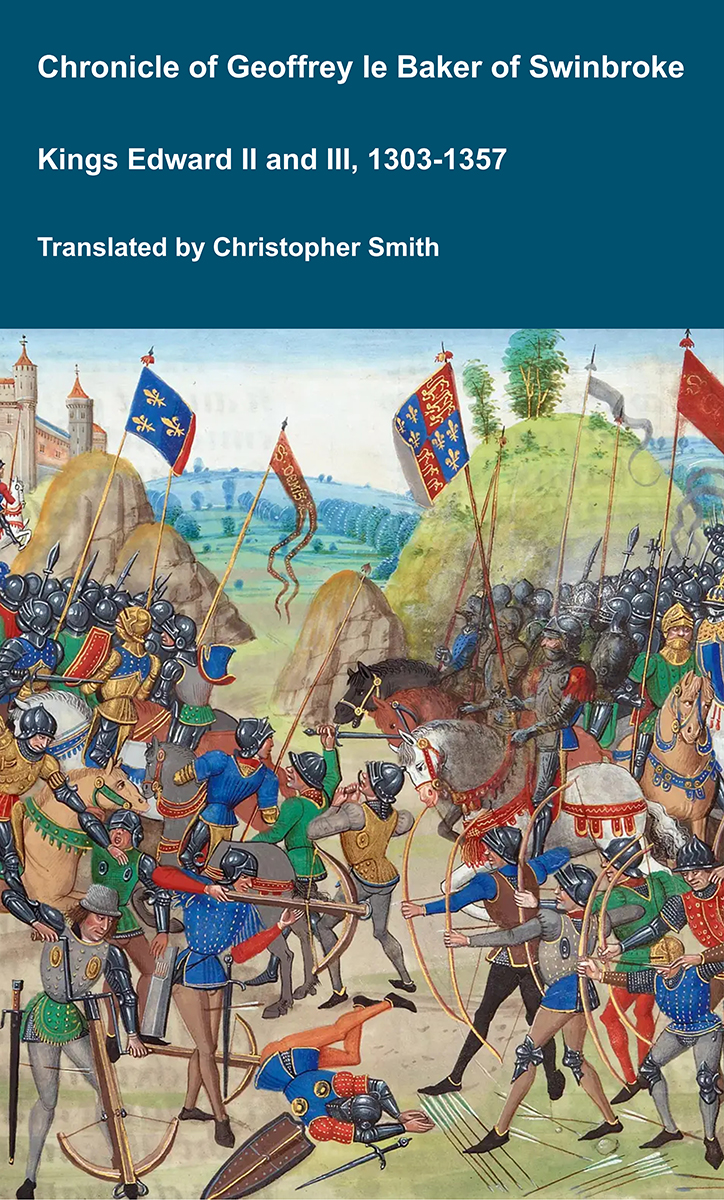
Chronicle of Geoffrey le Baker of Swinbroke
Baker was a secular clerk from Swinbroke, now Swinbrook, an Oxfordshire village two miles east of Burford. His Chronicle describes the events of the period 1303-1356: Gaveston, Bannockburn, Boroughbridge, the murder of King Edward II, the Scottish Wars, Sluys, Crécy, the Black Death, Winchelsea and Poitiers. To quote Herbert Bruce 'it possesses a vigorous and characteristic style, and its value for particular events between 1303 and 1356 has been recognised by its editor and by subsequent writers'. The book provides remarkable detail about the events it describes. Baker's text has been augmented with hundreds of notes, including extracts from other contemporary chronicles, such as the Annales Londonienses, Annales Paulini, Murimuth, Lanercost, Avesbury, Guisborough and Froissart to enrich the reader's understanding. The translation takes as its source the 'Chronicon Galfridi le Baker de Swynebroke' published in 1889, edited by Edward Maunde Thompson.
Available at Amazon in eBook and Paperback format.

After 12th October 1684 Edwyn Sadleir 2nd Baronet [aged 28] and [his wife] Mary Lorymer were married. She by marriage Lady Sadleir of Temple Disney in Hertfordshire.