

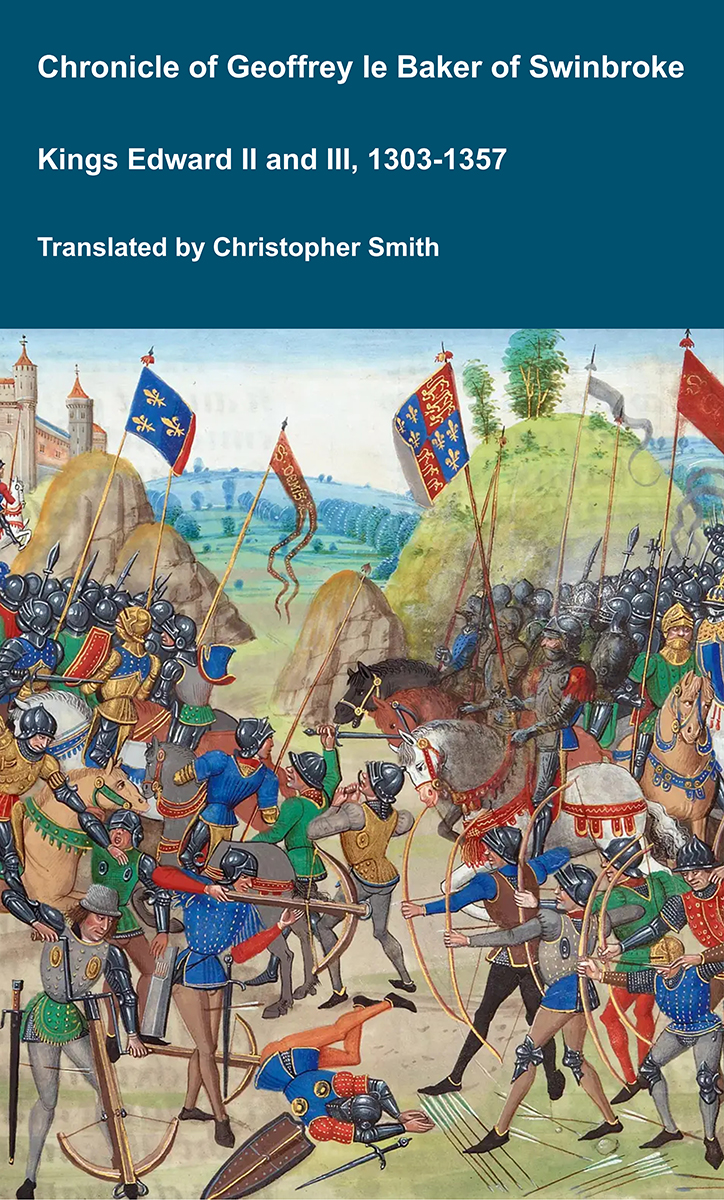
Chronicle of Geoffrey le Baker of Swinbroke
Baker was a secular clerk from Swinbroke, now Swinbrook, an Oxfordshire village two miles east of Burford. His Chronicle describes the events of the period 1303-1356: Gaveston, Bannockburn, Boroughbridge, the murder of King Edward II, the Scottish Wars, Sluys, Crécy, the Black Death, Winchelsea and Poitiers. To quote Herbert Bruce 'it possesses a vigorous and characteristic style, and its value for particular events between 1303 and 1356 has been recognised by its editor and by subsequent writers'. The book provides remarkable detail about the events it describes. Baker's text has been augmented with hundreds of notes, including extracts from other contemporary chronicles, such as the Annales Londonienses, Annales Paulini, Murimuth, Lanercost, Avesbury, Guisborough and Froissart to enrich the reader's understanding. The translation takes as its source the 'Chronicon Galfridi le Baker de Swynebroke' published in 1889, edited by Edward Maunde Thompson.
Available at Amazon in eBook and Paperback format.
In 1617 William Parr was born in Fermoy.
In 1635 William Parr [aged 18] entered Exeter College, Oxford University.
On 13th June 1639 William Parr [aged 22] commenced his Bachelor of Arts.
On 23rd June 1642 William Parr [aged 25] commenced his Master of Arts.

In 1643 James Ussher [aged 61] took refuge in Exeter College, Oxford University at which time he made William Parr [aged 26] his Chaplain.
In 1653 William Parr [aged 36] was appointed Vicar of Camberwell, Surrey [Map].
On 30th October 1660 William Parr [aged 43] was awarded Doctor of Divinity.
John Evelyn's Diary. 20th February 1672. Dr. Parr [aged 55], of Camberwell, preached a most pathetic funeral discourse and panegyric at the interment of our late pastor, Dr. Breton (who died on the 18th), on "Happy is the servant whom, when his Lord cometh", etc. This good man, among other expressions, professed that he had never been so touched and concerned at any loss as at this, unless at that of King Charles our martyr, and Archbishop Usher, whose chaplain he had been. Dr. Breton had preached on the 28th and 30th of January: on the Friday, having fasted all day, making his provisionary sermon for the Sunday following, he went well to bed; but was taken suddenly ill and expired before help could come to him.
John Evelyn's Diary. 18th April 1686. In the afternoone I went to Camberwell [Map] to visit Dr. Parr [aged 69]. After sermon I accompanied him to his house, where he shew'd me the Life and Letters of the late learned Primate of Armagh (Usher), and among them that letter of Bp. Bramhal's to the Primate, giving notice of the Popish practices to pervert this Nation, by sending an hundred priests into England, who were to conforme themselves to all sectaries and conditions for the more easily dispersing their doctrine amongst us. This letter was the cause of yfc whole impression being seiz'd, upon pretence that it was a political or historical account of things not re lating to theology, tho' it had ben licens'd by ye Bishop; which plainely shew'd what an interest the Papists now had, that a Protestant booke, containing the life and le'tters of so eminent a man, was not to be pub lish'd. There were also many letters to and from most of ye learned persons his correspondents in Europe. The book will, I doubt not, struggle through this unjust impediment. Several Judges were put out, and new complying ones put in.
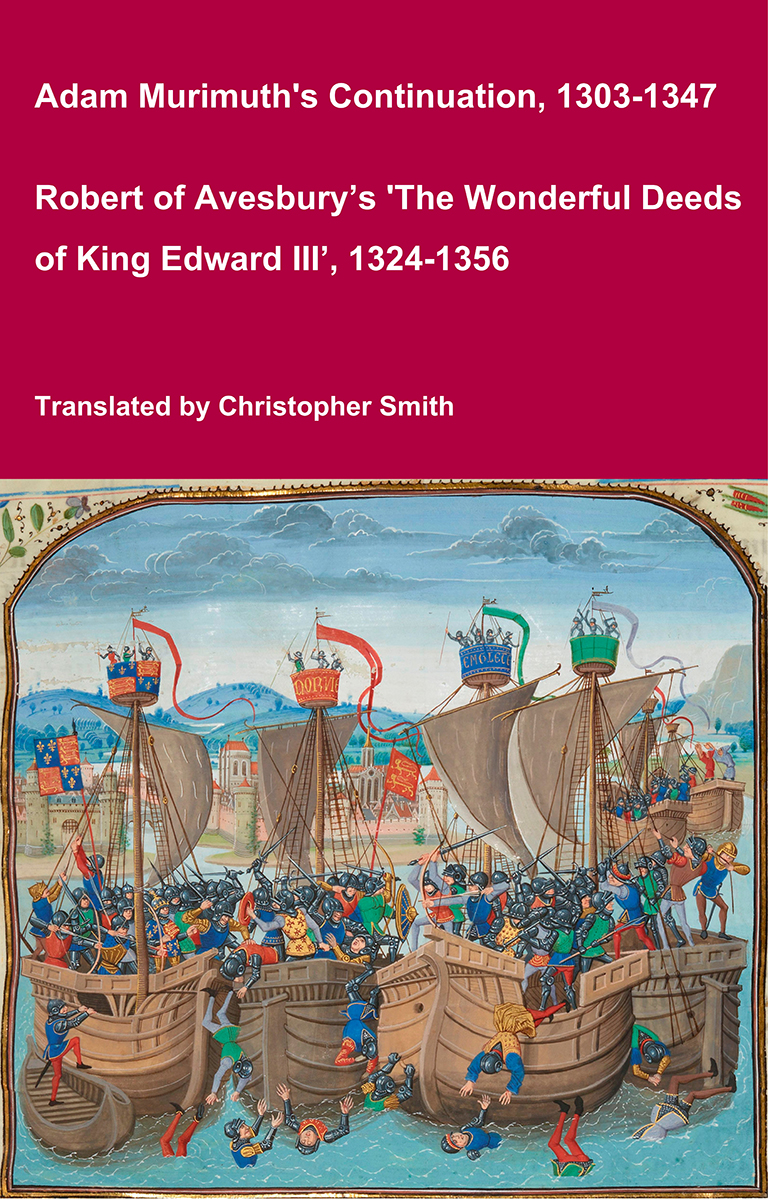
Adam Murimuth's Continuation and Robert of Avesbury’s 'The Wonderful Deeds of King Edward III'
This volume brings together two of the most important contemporary chronicles for the reign of Edward III and the opening phases of the Hundred Years’ War. Written in Latin by English clerical observers, these texts provide a vivid and authoritative window into the political, diplomatic, and military history of fourteenth-century England and its continental ambitions. Adam Murimuth Continuatio's Chronicarum continues an earlier chronicle into the mid-fourteenth century, offering concise but valuable notices on royal policy, foreign relations, and ecclesiastical affairs. Its annalistic structure makes it especially useful for establishing chronology and tracing the development of events year by year. Complementing it, Robert of Avesbury’s De gestis mirabilibus regis Edwardi tertii is a rich documentary chronicle preserving letters, treaties, and official records alongside narrative passages. It is an indispensable source for understanding Edward III’s claim to the French crown, the conduct of war, and the mechanisms of medieval diplomacy. Together, these works offer scholars, students, and enthusiasts a reliable and unembellished account of a transformative period in English and European history. Essential for anyone interested in medieval chronicles, the Hundred Years’ War, or the reign of Edward III.
Available at Amazon in eBook and Paperback format.
On 2nd November 1691 William Parr [aged 74] died.
John Evelyn's Diary. 9th July 1693. Mr. Tippin, successor of Dr. Parr at Camberwell, preached an excellent sermon.