

The History of William Marshal was commissioned by his son shortly after William’s death in 1219 to celebrate the Marshal’s remarkable life; it is an authentic, contemporary voice. The manuscript was discovered in 1861 by French historian Paul Meyer. Meyer published the manuscript in its original Anglo-French in 1891 in two books. This book is a line by line translation of the first of Meyer’s books; lines 1-10152. Book 1 of the History begins in 1139 and ends in 1194. It describes the events of the Anarchy, the role of William’s father John, John’s marriages, William’s childhood, his role as a hostage at the siege of Newbury, his injury and imprisonment in Poitou where he met Eleanor of Aquitaine and his life as a knight errant. It continues with the accusation against him of an improper relationship with Margaret, wife of Henry the Young King, his exile, and return, the death of Henry the Young King, the rebellion of Richard, the future King Richard I, war with France, the death of King Henry II, and the capture of King Richard, and the rebellion of John, the future King John. It ends with the release of King Richard and the death of John Marshal.
Available at Amazon in eBook and Paperback format.
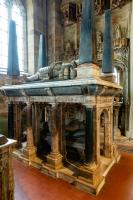
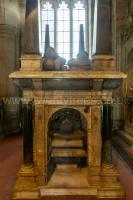
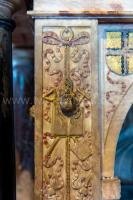
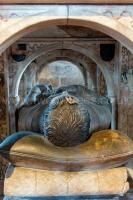
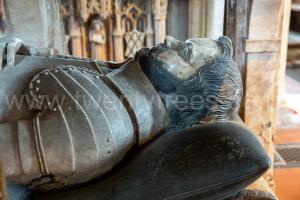
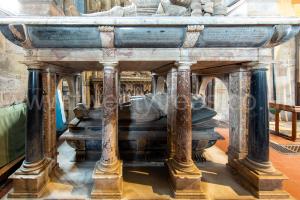
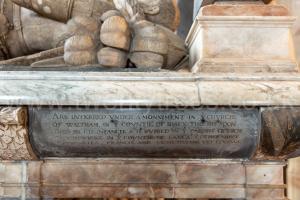
After 1451. St Bartholemew's Church, Tong [Map]. The Stanley Monument to, on top, Thomas Stanley and Margaret Vernon, below, their son Edward Stanley. The monument was originally beside the high altar.
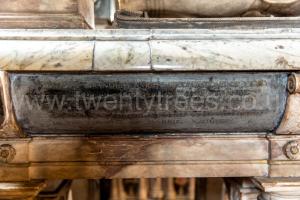
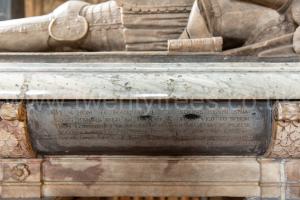
The two epitaphs at each end of the monument are believed to have been written by William Shakespeare:
Ask who lyes heare but do not weep He is not dead he doth but sleep This stoney register is for his bones His fame is more perpetual than these stones And his own goodness with himself being gone Shall lyve when earthlie monument is none
Not monumental stone preserve our Fame Nor sky aspyring pyramids our name The memory of Him for whom this stands Shall outlive marble and defacers hands When all to tyme's consumption shall be geaven Standley for whom this stands shall be in Heaven
Thomas Stanley: he was born to Edward Stanley 3rd Earl of Derby and Dorothy Howard Countess Derby. In or before 1563 Thomas Stanley and Margaret Vernon were married. He the son of Edward Stanley 3rd Earl of Derby and Dorothy Howard Countess Derby. They were third cousin once removed. In 1576 Thomas Stanley died.
Margaret Vernon: In 1540 she was born to George Vernon "King of the Peak" and Margaret Tailboys. In 1610 Margaret Vernon died.
On or before 26th April 1564 William Shakespeare was born. He was baptised on 26th April 1654.
On 23rd April 1616 William Shakespeare [aged 51] died.

Around 1660 Gilbert Soest [aged 55]. Portrait of William Shakespeare.

Around 1670 Pieter Borsseler [aged 36] (possibly). Portrait of William Shakespeare known as the Chesterfield Portrait.
Richard III was written around 1592-1594 by William Shakespeare.