

This is a translation of the 'Memoires of Jacques du Clercq', published in 1823 in two volumes, edited by Frederic, Baron de Reissenberg. In his introduction Reissenberg writes: 'Jacques du Clercq tells us that he was born in 1424, and that he was a licentiate in law and a counsellor to Philip the Good, Duke of Burgundy, in the castellany of Douai, Lille, and Orchies. It appears that he established his residence at Arras. In 1446, he married the daughter of Baldwin de la Lacherie, a gentleman who lived in Lille. We read in the fifth book of his Memoirs that his father, also named Jacques du Clercq, had married a lady of the Le Camelin family, from Compiègne. His ancestors, always attached to the counts of Flanders, had constantly served them, whether in their councils or in their armies.' The Memoires cover a period of nineteen years beginning in in 1448, ending in in 1467. It appears that the author had intended to extend the Memoirs beyond that date; no doubt illness or death prevented him from carrying out this plan. As Reissenberg writes the 'merit of this work lies in the simplicity of its narrative, in its tone of good faith, and in a certain air of frankness which naturally wins the reader’s confidence.' Du Clercq ranges from events of national and international importance, including events of the Wars of the Roses in England, to simple, everyday local events such as marriages, robberies, murders, trials and deaths, including that of his own father in Book 5; one of his last entries.
Available at Amazon in eBook and Paperback format.
All Saints Church, Norton is in Norton, Northamptonshire [Map], Churches in Northamptonshire.
On 3rd June 1602 Elizabeth Seymour [aged 52] died. She was buried at All Saints Church, Norton [Map] on 6th June 1603. Painted alabaster Elizabethan Period monument with recumbent praying effigy in coffered arch flanked by black marble Corinthian Columns and outer obelisks and topped by armorial panels. The monument also to Dudley Knightley [deceased].
Here Lieth ye bodie of ye Right Honorable ye ladie Elizabeth Seymour ye 4 daughter to ye High and Mightie Prince Edward Duke of Somerset Protector of England unckle to King Edward the 6. Who was also ye second wife of Sr Richard Knightley of Norton Kni. By whom he had issue 7 sons & 2 daughters (vis) Seymour, Ferdinand, Dudley, John, Nathaniel, Robert, & Francis; Ann deceased & Ann Knightley ye yonger married to Sr Euseby Andrew of Winick Knight. Wch Ladie Elizabeth died ye 3 June and dni 1602
Elizabeth Seymour: Around 1550 she was born to Edward Seymour 1st Duke of Somerset and Anne Stanhope Duchess Somerset in the year in which her father was executed. Around 1578 Richard Knightley and she were married. They had seven sons and seven daughters. She the daughter of Edward Seymour 1st Duke of Somerset and Anne Stanhope Duchess Somerset. They were fifth cousin once removed. She a great x 5 granddaughter of King Edward III of England.
Dudley Knightley: Around 1583 he was born to Richard Knightley and Elizabeth Seymour. In June 1602 Dudley Knightley died in Norton, Northamptonshire [Map]. He had been shot in the neck whilst in the defence of Ostend. Having returned home he "fell down wherwith a fever took him whereof he died".


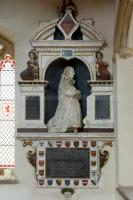
After 1633 . Monument to Elizabeth Verney in All Saints Church, Norton [Map].
After 1658. Monument to Nicholas Breton and his wife Elizabeth in All Saints Church, Norton [Map]. Busts of each and framed by composite columns supporting broken segmental pediment.


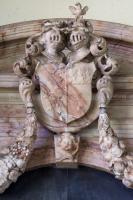
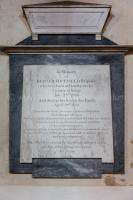
After 1813. Monument to Beriah Botfield erected by his widow Charlotte Withering [aged 35] in All Saints Church, Norton [Map].
Beriah Botfield of Norton Hall, Northamptonshire: he was born to Thomas Botfield and Margaret Baker. Before 5th March 1807 he and Charlotte Withering were married. In 1813 he died.
Charlotte Withering: In 1778 she was born to William Withering.
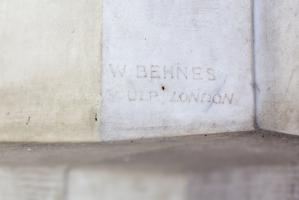
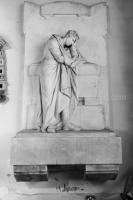
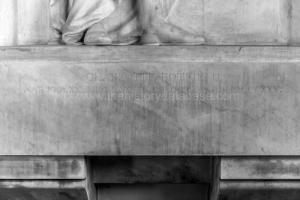
After 1825. Monument to Charlotte Botfield -1825 in All Saints Church, Norton [Map]. Sculpted by William Behnes [aged 30].

After 1918. War Memorial to Alexander George Thynne [aged 44] and the men of Norton erected by Thomas Henry Thynne 5th Marquess of Bath [aged 55] outside All Saints Church, Norton [Map].
Alexander George Thynne: On 17th February 1873 he was born to John Alexander Thynne 4th Marquess of Bath and Frances Isabella Catherine Vesey Marchioness Bath. On 16th September 1918 Alexander George Thynne died.